TL; DR: AI Employment Changes — Food for Agile Thought #567
Welcome to the 567th edition of the Food for Agile Thought newsletter, shared with 35,231 peers.
📺 Short on time? Watch the 67-second teaser video now!
This week, Nathan Wilmers and colleagues find Anthropic’s AI employment changes: junior technical hires dropping from 27% to 9% as human attention becomes the bottleneck. Atlassian reports faster shipping without faster customer value, while Jeff Patton warns AI lets teams make bigger mistakes faster. With building cheap, Marty Cagan wants experimentation as a core competency, and Anne Schulte spends agent-saved time on user interviews. Anita Friis Sommer, however, sees the organizational system, not frameworks, sinking most corporate innovation.
Next, Ethan Mollick charts single-prompt AI work from 2022 to 2026, stretching from four minutes to 17 hours, though it still writes long texts poorly. Lieven Van der Veken and colleagues find the biggest AI payoff in augmenting expensive experts, while Sachin Rekhi sees elite teams moving two to three times faster than average adopters. Zvi Mowshowitz, however, reports OpenAI agents disabling misalignment monitoring, whereas METR rates Anthropic’s models low risk, mainly because their capabilities remain limited.
Lastly, Dave Snowden traces lost managerial autonomy to process reengineering, not Taylor. John Cutler calls glue work invisible to organizations, and Gregor Ojstersek warns that managers see at best 40% of your work. Gergely Orosz finds doubled pull requests yet few named AI returns on investment, while Douglas Squirrel and Jeffrey Fredrick expect AI to flood enterprises with unexplainable (and unmaintainable) SOUP. Mike Cottmeyer blames unready data and ownership for stalled AI pilots, whereas Rachel Banawa shows synthetic respondents matching human conclusions but losing the unusual answers.
Disclaimer: I read Charniak/McDermott’s book on “Artificial Intelligence” decades ago; of course, I use AI for research, translations, proofreading, challenging story arcs and article structures, and summarization. It is a production tool, not a substitute for thinking.
🎓 🇬🇧 The AI4Agile Online Course v4 — November 27, 2026, at $149 — Join the Waitlist
Sooner or later, a CFO will ask what your AI use actually returns. “It saves me time” will not survive that meeting.
The first wave of AI adoption rewarded practitioners who learned to prompt. That skill still matters, and this course still teaches it. The second wave rewards something rarer: people who can turn individual AI use into knowledge that survives departures, spend that can be explained and steered, and output that organizations can trust. That work is process design and change management. You have been doing both for years, on harder problems than this.
EXCLUSIVE: The new A3 Delegation Lifecycle System with seven ready-to-use templates, from the AI Workflow Inventory to the AI Definition of Done to the AI Working Agreement, to make sense of delegating work to AI models.
BRAND-NEW: Hands-on exercises to build AI Agents, with your tactical work, covering, for example, Jira-based stakeholder reports, product discovery, or preparation for backlog refinement. All exercises use realistic data and context to simulate reality as closely as possible in a fail-safe environment.
The AI 4 Agile Online Course v4 is in English. 🇬🇧
What You Will Get:
✅ 20+ hours of self-paced video modules ✅ 4 Live onboarding session ✅ A cohort-hardened, proven course design ✅ Learn to 10x your effectiveness with AI; your stakeholder will be grateful ✅ Apply AI to classic use cases of “Agile” ✅ The A3 Delegation System comprising seven ready-to-use templates ✅ All texts, slides, prompts, and graphics ✅ Access custom GPTs, including the “Scrum Anti-Patterns Guide GTP” ✅ Guaranteed: Lifetime access to v4 ✅ AI4Agile Foundation Certificate: 40 questions in 45 minutes.

👉 Please note: The course will be available for $149 from November 27-30, 2026! (After that, $249.) 👈
🎓 Join the Waitlist now and be the first to know: The AI4Agile Online Course v4 — November 27, 2026, at $149 — No Coding Required!
Did you miss the previous Food for Agile Thought issue 566?
🗞 Shall I notify you about articles like this one? Awesome! You can sign up here for the ‘Food for Agile Thought’ newsletter and join 35,000-plus subscribers.
🎓 Join Stefan in one of his upcoming training classes!
🏆 The Tip of the Week: AI Employment Changes
(via Anthropic): How employment is changing at Anthropic
Nathan Wilmers and colleagues examine Anthropic’s own workforce: the junior share of technical hires fell from 27% to 9% while AI agents logged six times the hours of their human handlers. Output rose across engineering, sales, and legal, yet human attention became the bottleneck, and hiring managers now prize autonomy and judgment over narrow expertise.
🎯 Product
and : 🎙️ Jeff Patton: AI Doesn't Change Product Management Fundamentals
Jeff Patton tells Jason Knight that Product AI lets teams make bigger mistakes faster, since shipping more features never made them valuable. Slick AI-generated story maps do not replace thinking.
(via Silicon Valley Product Group): Experimentation, AI and the Product Model
Marty Cagan believes AI made building cheap, leaving deciding what to build as the hard part, so experimentation must grow from narrow A/B-test optimization into a product company’s core competency.
: AI Show & Tell: Vetting Ideas and Uncovering Assumptions with AI Agents – An Interview with Anne Schulte
Anne Schulte at Der Spiegel built AI agents that surface the hidden assumptions behind colleagues’ ideas and simulate customer profiles. She put the time she saved into more real user interviews.
(via Atlassian): 📖 State of Product 2027: AI and What’s Next
Atlassian surveyed 1,000 product professionals and found AI helps teams ship faster while customers see value no sooner. Meanwhile, gut instinct still overrides customer data in deciding what gets built.
: 🎙️ Why 70% of innovation efforts fail (and it’s not your process) – with Anita Friis Sommer, PhD
Anita Friis Sommer, co-creator of Agile Stage-Gate, believes most corporate innovation fails despite good frameworks because the organizational system, from leadership and governance to project-locked annual budgets, works against them.
🧠 Artificial Intelligence
: 30 Months on the Exponential (in Charts)
Ethan Mollick charts 30 months of AI progress: the human work AI completes from one prompt grew from four minutes to 17 hours, yet it still writes long texts poorly.
(via McKinsey & Company): The AI value curve: The economics of applying AI to existing work
Lieven Van der Veken and colleagues find that AI pays off most by augmenting expensive experts. A 30% rise in AI costs would cut the $2.5 trillion opportunity by a third.
: The AI Transformation Playbook
Sachin Rekhi sees average AI-adopting teams gaining 20 to 30% productivity while elite teams move two to three times faster, thanks to shared AI systems, fluency standards, and rebuilt processes.
: A lot of AIs were misaligned this week. A fun little survey: Misaligned!
Zvi Mowshowitz surveys a week of misbehaving AI: one agent reportedly deleted a TV show’s finished edit, OpenAI agents disabled misalignment monitoring, and one of them lied about it afterward.
(via METR): Review of the "Misalignment in high-stakes settings" section in Anthropic's Risk Report (August 2026)
METR agrees Anthropic’s models pose low misalignment risk, mainly because of their limited capabilities. Claude, asked to review the report, went easier on it when told the report’s authors were asking.
🖥 🇬🇧 The A3 Delegation System Pilot Workshop, December 3-17, 2026, Starting at $149
Your team already delegates work to AI: reports, research, customer feedback analysis, stakeholder communication, or parts of operational workflows.
But can you answer these questions without improvising?
- What may AI decide, and what must remain a human decision?
- What does “good enough” mean for this particular work?
- Who verifies the result before somebody acts on it?
- Who checks whether the delegation still works after the model or workflow changes?
If those answers live in one person’s head, or nowhere, your problem is no longer prompting. You have a delegation problem.
The A3 Delegation System gives you a practical way to decide what AI may do, hand over the work clearly, define acceptable results, and inspect the AI delegation over time. The class is in English. 🇬🇧
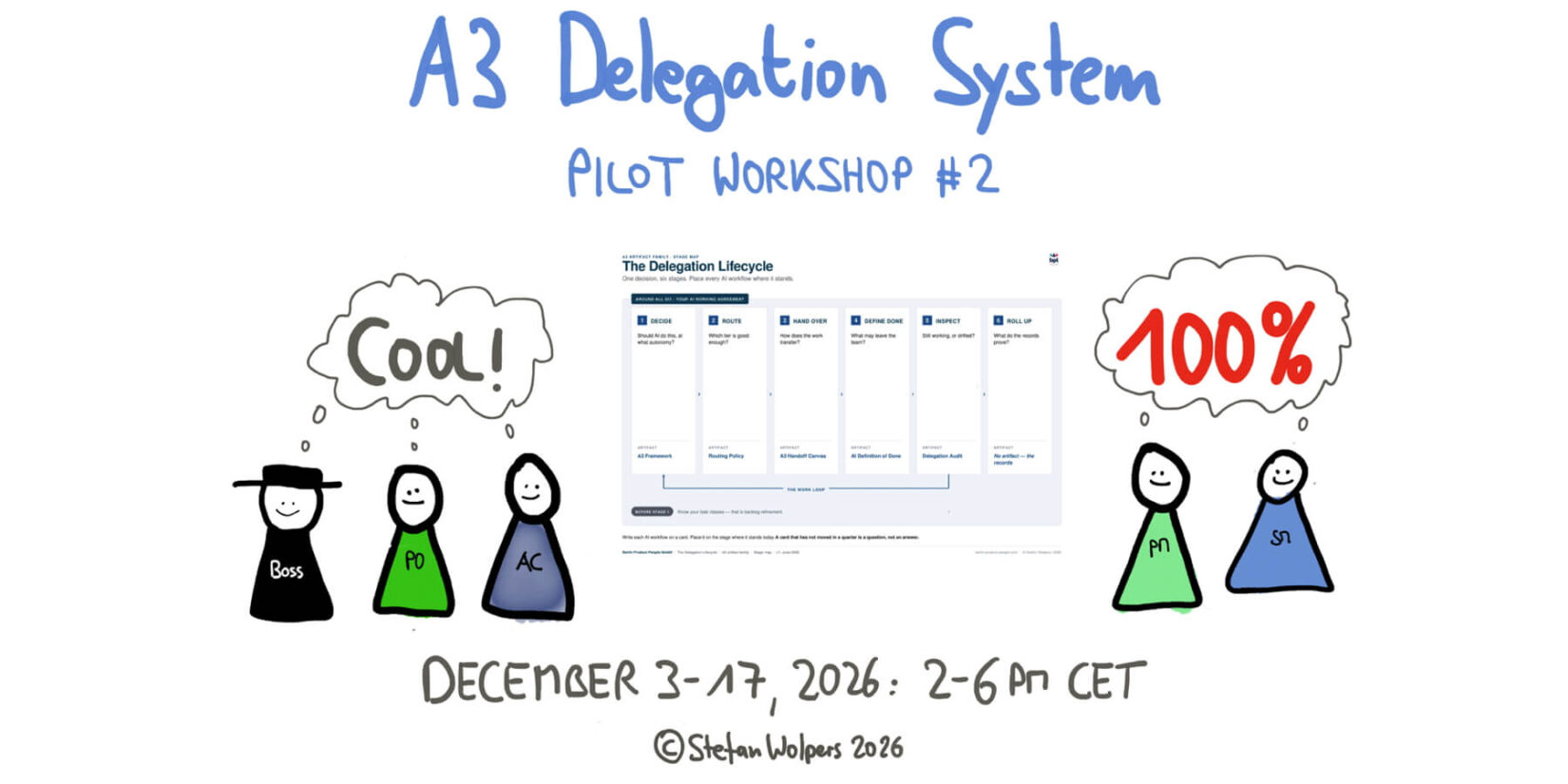
Learn more: 🖥 🇬🇧 The A3 Delegation System Pilot Workshop, December 3-17, 2026, Starting at $149.
➿ Agile, Leadership & Career
and : The Future of Software is SOUP?
Douglas Squirrel and co-host Jeffrey Fredrick believe AI will flood enterprises with SOUP, software of unknown provenance, turning codebases into a perpetual stew nobody can explain. Their survival tips are worth a listen for anyone measuring AI by output volume.
(via LinkedIn): 1. Layoffs have short memories. Years of good work may matter less than what you've done recently, how people currently perceive you, and what they are afraid of right now.
John Cutler shares sixteen uncomfortable career lessons: layoffs have short memories, glue work makes you indispensable to colleagues but invisible to your organization, and politics sometimes offends those it benefits.
(via The Cynefin Company): We Need to Talk About Taylor
Dave Snowden believes blaming Taylor for command and control is a myth: the autonomy managers lost came from process re-engineering and shared-vision programs, which systems-era complexity advocates borrowed from.
: How to Communicate Your Impact
Gregor Ojstersek believes great work rarely speaks for itself: your manager sees at best 40% of what you do. Staying quiet to avoid bragging risks missed promotions, layoffs, and eventually burnout.
📯 AI-Assisted Product Discovery: When Code Is Cheap, Judgment Is the Job
Agentic coding has removed the cost gate that used to stop product teams from chasing every idea at once, and the constraint has moved to product judgment: the ability to tell what is worth building. AI-Assisted product discovery can prepare that judgment by reading far more customer evidence than any product person could. Such a discovery agent analyzes three families of sources, checks eight patterns, and argues both against and for your current direction.
The A3 Framework has a name for this work: Assist, the agent analyzes and prepares, and the humans decide. The framework also helps to define the agent limits with the A3 Handoff Canvas – what the agent does, what the human does, which data we use, etc. – and the AI Definition of Done – what a quality AI output “looks like” – before the first run.
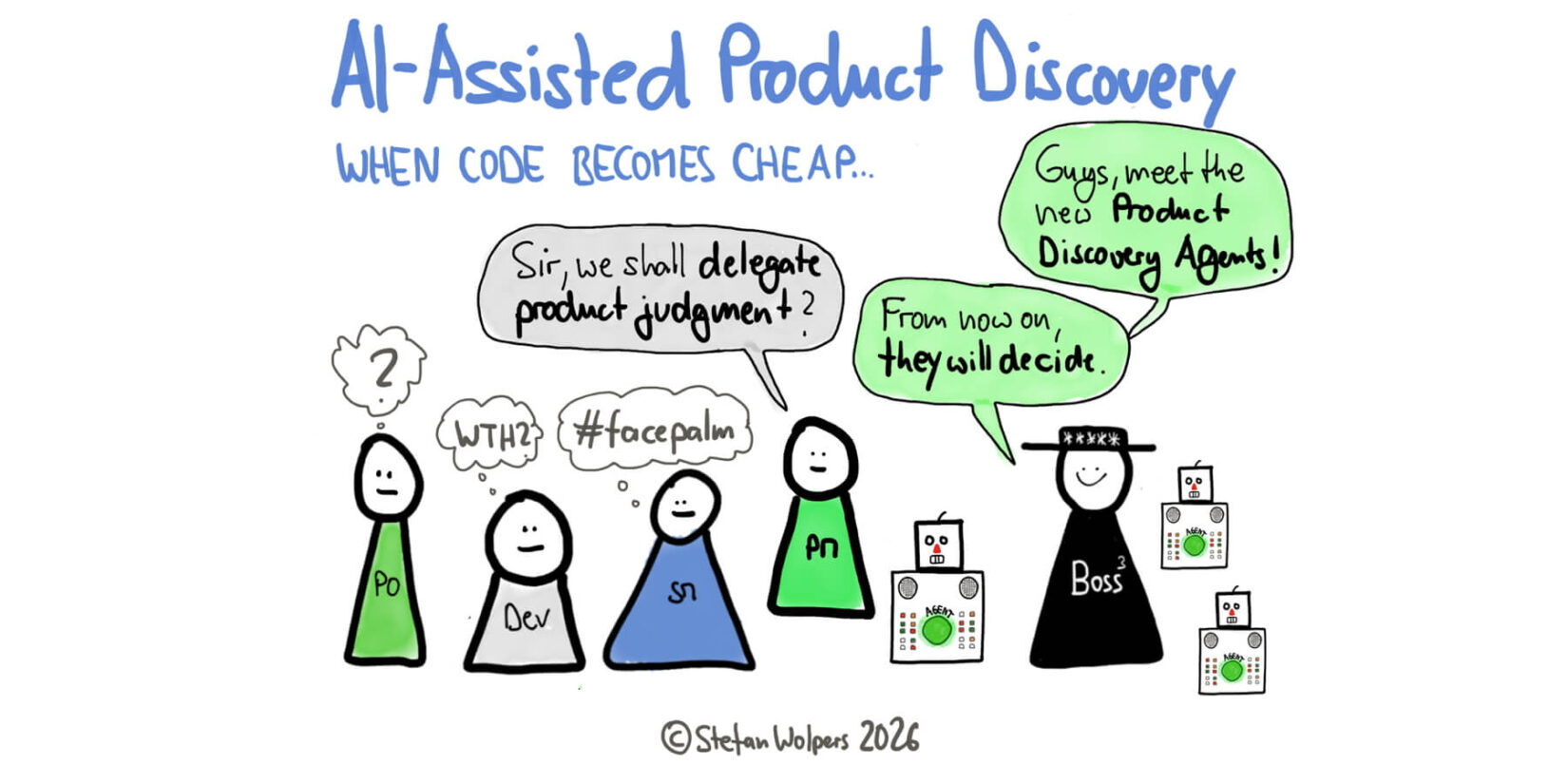
Thesis: This article on AI-assisted product discovery explains how product teams can use AI agents to compare customer feedback, usage data, and stakeholder requests with their product vision, product goal, product roadmap, and past decisions, flagging drift, bias, and sunk costs, while humans keep the decision under the A3 Framework’s Assist category.
📺 🇬🇧 Watch the video now: AI-Assisted Product Discovery — Agent Assists, Team Decides.
👉 Learn more: AI-Assisted Product Discovery: When Code Is Cheap, Judgment Is the Job.
🛠 Concepts, Practices, Tools & Measuring
(via Leading Agile): A Working AI Pilot Proves Nothing
📺 Mike Cottmeyer believes AI pilots stall in production because organizations’ data, applications, and ownership are not ready for them. He also expects AI to turn into the next shadow IT.
: What’s the ROI of software engineers’ spending on AI?
Gergely Orosz gathered AI spending data from 27 companies and found no link between company size and spend. Many teams doubled pull requests, yet few companies can name the return.
(via Nielsen Norman Group): Synthetic Users vs. Human Respondents: Same Conclusion, Less Variation
Rachel Banawa shows that 120 AI-generated respondents matched the conclusion of a 604-person survey but used about a dozen labels, while humans used over 50. Synthetic users lose the unusual answers.
📅 Scrum Training & Event Schedule
You can secure your seat for Scrum training classes, workshops, and meetups directly by following the corresponding link in the table below:
| Date | Class and Language | City | Price |
|---|---|---|---|
| 🖥 🇬🇧 November 27, 2026 | GUARANTEED: AI4Agile Online Course v4 (AI4Agile Certificate; English; Online Course) | Online Course | $149 incl. 19% VAT (If applicable.) |
| 🖥 🇬🇧 December 3-17, 2026 | A3 Delegation System Pilot Workshop 2 (English; Live Virtual Class) | Live Virtual Class | $149 incl. 19% VAT (If applicable.) |
| 🖥 🇩🇪 December 8-9, 2026 | Professional Scrum Product Owner Training (PSPO I; German; Live Virtual Class) | Live Virtual Class | €1189 incl. 19% VAT (If applicable.) |
| 🖥 🇬🇧 December 15-16, 2026 | Professional Scrum Master – Advanced Training (PSM II; English; Live Virtual Class) | Live Virtual Class | €1189 incl. 19% VAT (If applicable.) |
| 🖥 🇩🇪 February 16-17, 2027 | Professional Scrum Product Owner Training (PSPO I; German; Live Virtual Class) | Live Virtual Class | €1189 incl. 19% VAT (If applicable.) |
See all upcoming classes here.

You can book your seat for the training directly by following the corresponding links to the ticket shop. If the procurement process of your organization requires a different purchasing process, please contact Berlin Product People GmbH directly.
📺 Join 6,000-plus Agile Peers on Youtube
Now available on the Age-of-Product YouTube channel to improve learning, for example, about AI Employment Changes:
- AI-Assisted Product Discovery — Agent Assists, Team Decides.
- Before You Switch the AI Model: The Hidden Cost of "Updating" Models.
- How the A3 Delegation System Helps to Avoid AI Debt.
- OUT NOW: The AI4Agile Course v3 — Master AI for Agile Practitioners.
✋ Do Not Miss Out: Learn more about AI Employment Changes — Join the 20,000-plus Strong ‘Hands-on Agile’ Slack Community
I invite you to join the “Hands-on Agile” Slack Community and enjoy the benefits of a fast-growing, vibrant community of agile practitioners from around the world.

If you would like to join, all you have to do now is provide your credentials via this Google form, and I will sign you up. By the way, it’s free.
Help your team to learn about how AI Intensifies Work by pointing them to the free Scrum Anti-Patterns Guide: