TL; DR: Building AI Products — Food for Agile Thought #566
Welcome to the 566th edition of the Food for Agile Thought newsletter, shared with 35,248 peers. This week, Ian Vanagas suspects user conversations will outlast half his lessons in building AI products, whereas John Cutler sees AI amplifying feature-factory habits. With features cheap, Aakash Gupta and Tim Herbig warn that wrong choices get expensive. Gabriel Unger and Arvind Narayanan favor steerable agents over full automation, though Jeremy Korst, Stefano Puntoni, and Sonny Tambe find approving each step pays least. Likewise, Nigel Thurlow shows a completed A3 proves little until you investigate where abnormalities arise.
Next, Ara Kharazian wonders whether AI adoption has peaked, with falling prices stalling token spend. In contrast, Lari Hämäläinen et al. find cheaper tokens fueling usage and favor measuring cost per successful output. Jason Knight and Simonetta Batteiger warn that AI speed may worsen product economics, and Sangeet Paul Choudary sees advantage shifting to companies helping agents decide better, yet ProductSide finds PM judgment lagging. Maarten Dalmijn proposes designing a smaller system rather than descoping to de-risk product investments.
Lastly, Shane Hastie and Matt Gjertsen see AI agents turning contributors into managers, and Addy Osmani names verification their bottleneck. Kate Niederhoffer et al., however, find treating AI as a teammate erodes trust. Art Smalley warns central AI teams recreate Taylor’s thinking-executing split, while Jason Cohen rejects the Precision Fallacy shielding frameworks, favoring single-team pilots. Finally, Yanli Liu’s Claude sessions rebuild a Mac app from notes, so closed code may no longer be a moat.
Disclaimer: I read Charniak/McDermott’s book on “Artificial Intelligence” decades ago; of course, I use AI for research, translations, proofreading, challenging story arcs and article structures, and summarization. It is a production tool, not a substitute for thinking.
🎓 🇬🇧 The AI4Agile Online Course v4 — November 27, 2026, at $149 — Join the Waitlist
Sooner or later, a CFO will ask what your AI use actually returns. “It saves me time” will not survive that meeting.
The first wave of AI adoption rewarded practitioners who learned to prompt. That skill still matters, and this course still teaches it. The second wave rewards something rarer: people who can turn individual AI use into knowledge that survives departures, spend that can be explained and steered, and output that organizations can trust. That work is process design and change management. You have been doing both for years, on harder problems than this.
EXCLUSIVE: The new A3 Delegation Lifecycle System with seven ready-to-use templates, from the AI Workflow Inventory to the AI Definition of Done to the AI Working Agreement, to make sense of delegating work to AI models.
The AI 4 Agile Online Course v4 is in English. 🇬🇧
What You Will Get:
✅ 20+ hours of self-paced video modules ✅ 4 Live onboarding session ✅ A cohort-hardened, proven course design ✅ Learn to 10x your effectiveness with AI; your stakeholder will be grateful ✅ Apply AI to classic use cases of “Agile” ✅ The A3 Delegation System comprising seven ready-to-use templates ✅ All texts, slides, prompts, and graphics ✅ Access custom GPTs, including the “Scrum Anti-Patterns Guide GTP” ✅ Guaranteed: Lifetime access to v4 ✅ AI4Agile Foundation Certificate: 40 questions in 45 minutes.

👉 Please note: The course will be available for $149 from November 27-30, 2026! (After that, $249.) 👈
🎓 Join the Waitlist now and be the first to know: The AI4Agile Online Course v4 — November 27, 2026, at $149 — No Coding Required!
Did you miss the previous Food for Agile Thought issue 565?
🗞 Shall I notify you about articles like this one? Awesome! You can sign up here for the ‘Food for Agile Thought’ newsletter and join 35,000-plus subscribers.
🎓 Join Stefan in one of his upcoming training classes!
🏆 The Tip of the Week
(via PostHog): 38 things we've learned about building AI products
Ian Vanagas shares 38 lessons from four years of building AI products. AI can make your product worse, systems beat assistants, and reliability trumps capability. He suggests half of these lessons will be wrong in a year, while the basics of product work (talk to users, ship fast, experiment) endure.
🎯 Product
: The Feature Factory: A 10-Year Retrospective
John Cutler suggests every team remains a feature factory to some degree. Outcome frameworks and OKRs can become proxies, too, and AI amplifies whatever habits, good or bad, you have.
and : 📺 How you need to think about product strategy in the age of AI
Aakash Gupta and Tim Herbig suggest that when features get cheap, choosing the wrong one gets expensive. AI isn’t your value proposition, and priorities whose opposite sounds stupid aren’t choices.
(via Harvard Business Review): Who Owns the Customer in the Age of AI Agents?
Sangeet Paul Choudary suggests engagement, proprietary data, and even your own AI agent may no longer secure the customer relationship; instead, advantage shifts to companies that help agents decide better.
and : 🎙️ Product Managers Need to Understand the Financials… Not Just the Users
Jason Knight and Simonetta Batteiger discuss why product teams who cannot name their return look like cost centers, and why AI speed may worsen economics when token costs outweigh benefits.
(via Productside): The Product Management Skills Benchmark Report 2026
ProductSide shows how 5,906 product managers rate across 15 core skills. Although 60% use AI daily, their judgment lags, and pairing training with a formal process raises scores by 24%.
🧠 Artificial Intelligence
(via Knowledge @ Wharton): 2026 AI Adoption Report: The Adaptive Advantage: Who’s Winning With AI and How
Jeremy Korst, Stefano Puntoni, and Sonny Tambe show AI adoption is no longer the question; returns are. Efficiency metrics underperform growth metrics, and approving every agent step pays the least.
(via McKinsey & Company): What does AI really cost?
Lari Hämäläinen et al. show that moving AI from pilot to production nearly quadruples costs. Cheaper tokens increase usage, so they suggest measuring cost per successful output, not price per token.
and : Steering AI Beyond Automation
Gabriel Unger and Arvind Narayanan suggest full automation isn’t AI’s destiny and may fail on its own terms. They propose researching collaborative agents that are transparent, fast, and continuously steerable.
(via Ramp Builders): Cracks in the AI Thesis Part 3: Model adoption – have we hit the top of the S-curve?
Ara Kharazian suggests that business AI adoption, at 55.9% of firms he tracks, may sit atop the S-curve, and that falling model prices stalled token spend for two straight months.
: Agentic Verification: The bottleneck has moved from writing code to knowing it’s correct
Addy Osmani suggests your real job is no longer reading every line of agent-written code. Verification is the bottleneck, so define success first and build fast, deterministic checks the agent runs itself.
🖥 🇬🇧 The A3 Delegation System Pilot Workshop, December 3-17, 2026, Starting at $149
Your team already delegates work to AI: reports, research, customer feedback analysis, stakeholder communication, or parts of operational workflows.
But can you answer these questions without improvising?
- What may AI decide, and what must remain a human decision?
- What does “good enough” mean for this particular work?
- Who verifies the result before somebody acts on it?
- Who checks whether the delegation still works after the model or workflow changes?
If those answers live in one person’s head, or nowhere, your problem is no longer prompting. You have a delegation problem.
The A3 Delegation System gives you a practical way to decide what AI may do, hand over the work clearly, define acceptable results, and inspect the AI delegation over time. The class is in English. 🇬🇧
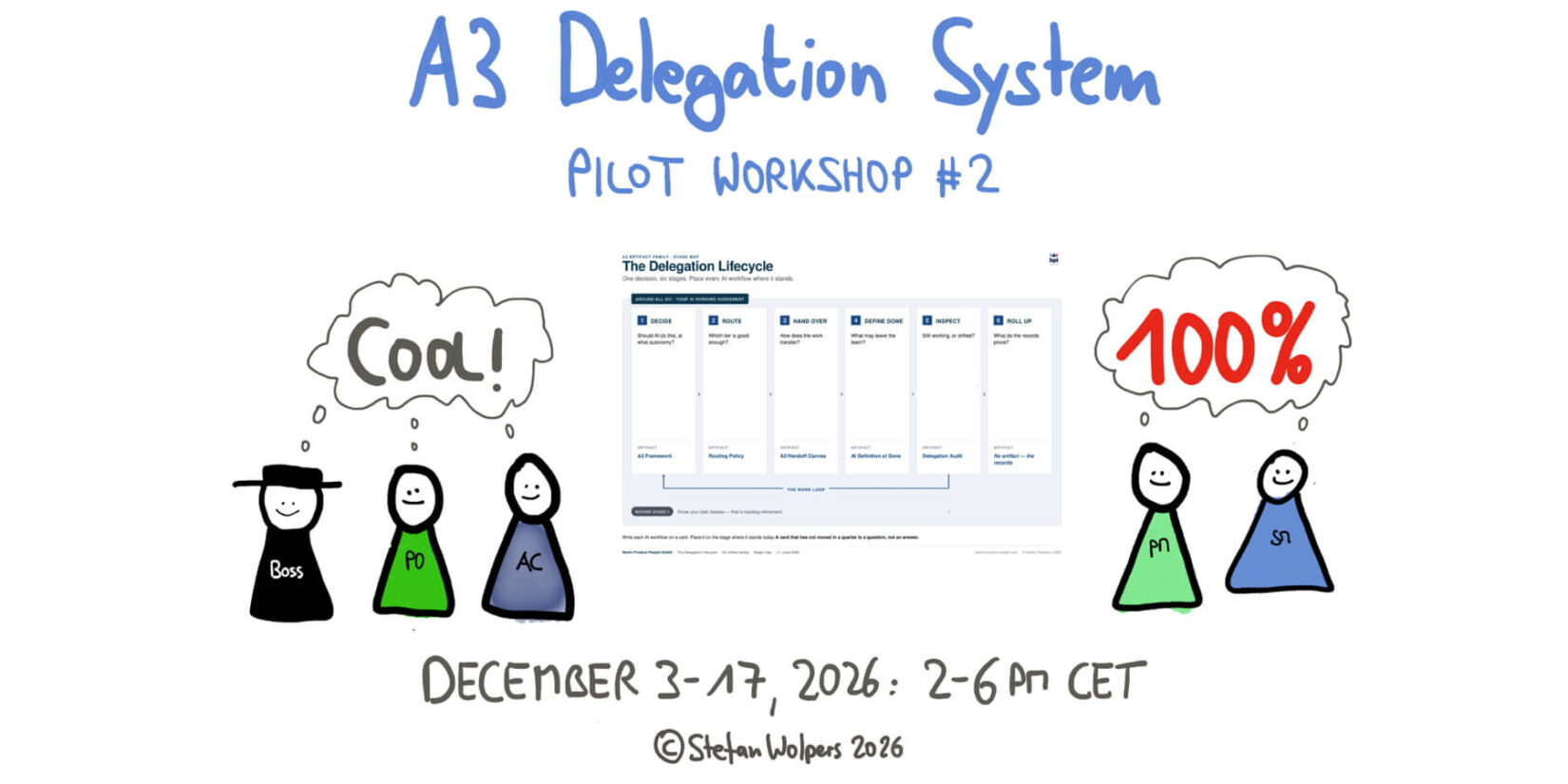
Learn more: 🖥 🇬🇧 The A3 Delegation System Pilot Workshop, December 3-17, 2026, Starting at $149.
➿ Agile & Leadership
(via Harvard Business Review): Team Dynamics Weaken When Employees Turn to AI instead of Colleagues
Kate Niederhoffer et al. show that treating AI as a teammate erodes trust and coordination. They call it 'relationslipping ': skipping colleagues for AI answers blurs everyone’s map of who knows what.
: A3 Problem Solving: Why It Fails and What Toyota Teaches
Nigel Thurlow shows, with an underfilled coffee cup, that a completed A3 proves little and a fishbone lists hypotheses, since causes only surface when you investigate where the abnormality arises.
and (via InfoQ): 🎙️ The Minimum Viable Manager: Building Trust, Feedback, and Alignment
Shane Hastie and Matt Gjertsen discuss why new managers who keep proving their skills neglect the connection that builds trust, and why AI agents turn every contributor into a manager.
(via Lean Enterprise Institute): What the History of Lean Can Teach Us About AI Adoption
Art Smalley suggests that central AI teams designing other people’s work recreate Taylor’s old split between thinking and executing, and that giving people chat access creates no enterprise AI capability.
📯 To Switch, or Not to Switch the AI Model
A new AI model arrives that is cheaper per token, scores better on benchmarks, and seems to require nothing more than a setting change. However, the token bill shows only part of the cost of switching AI models. There is also the effort to check whether your workflows, for example, the one to create status reports for stakeholders, still produce outputs in line with your AI Definition of Done. More often than not, this task remains unaligned with the decision to switch AI models.
In the worst case, switching AI models behind a business workflow can raise operating costs despite cheaper tokens, because business cases can miss the revalidation effort.
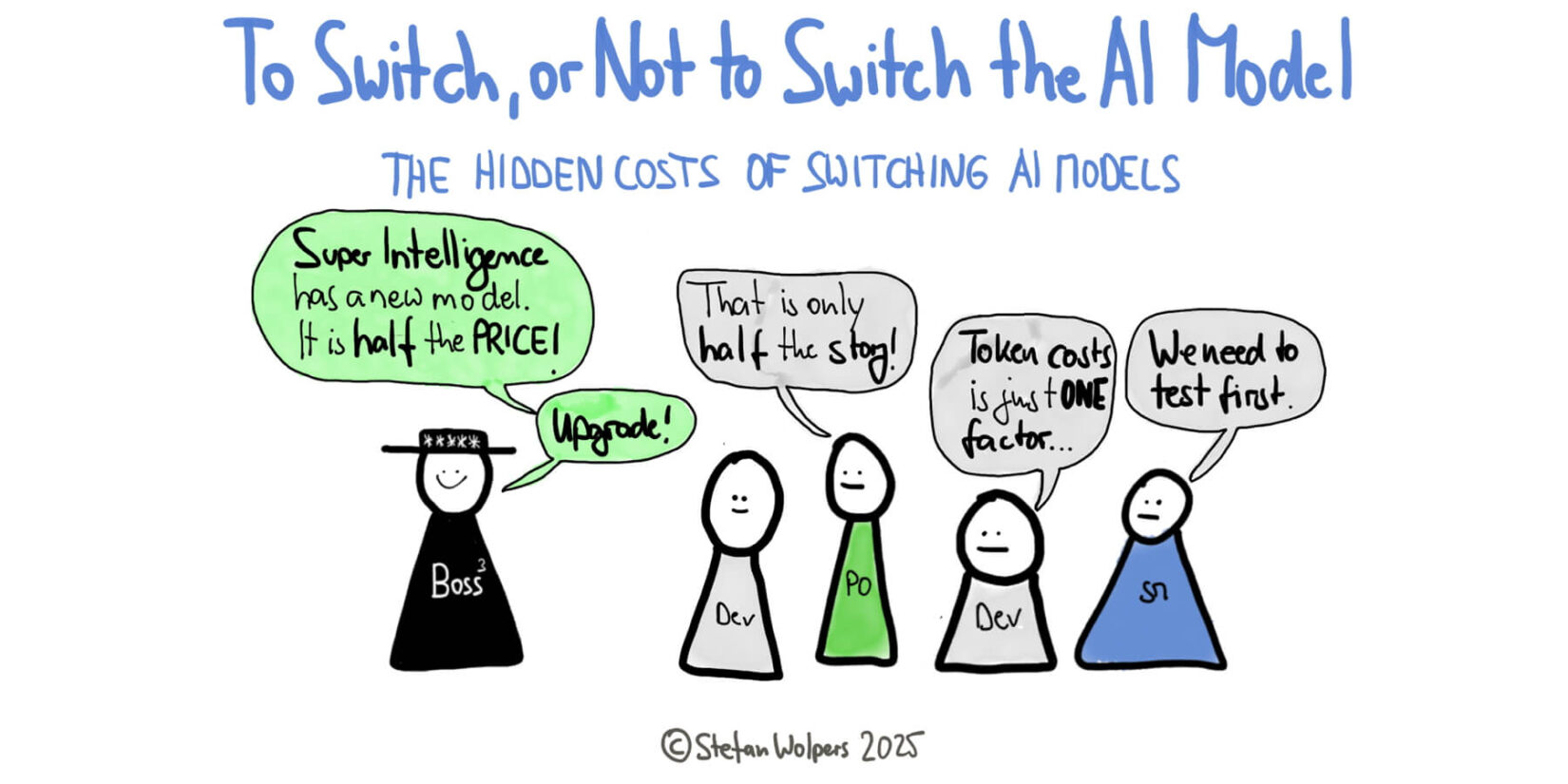
Thesis: This article explains the recurring operational cost of switching AI models behind a business workflow: why the revalidation effort may disappear from upgrade decisions, how to screen a switch, and how Agile teams use an AI Definition of Done, test evidence, and an accountable owner to stay in control.
📺 🇬🇧 Watch the video of the article now: Before You Switch the AI Model: The Hidden Cost of ‘Updating’ Models.
👉 Learn more: To Switch, or Not to Switch the AI Model.
🛠 Concepts, Practices, Tools & Measuring
(via Medium): All Software Is Becoming Readable and Open Source
Yanli Liu tests whether all software is becoming open source: one Claude session studies a Mac app, another rebuilds it from its notes. Closed code may stop being a moat.
: Descoping is the Lazy and Incompetent Approach to Meeting Timelines
Maarten Dalmijn believes descoping to hit deadlines merely shaves the surface of a system you already chose. He suggests rethinking the problem, solution, and technical approach to design a smaller system.
(via Jason Cohen): 'You didn't do it right'
Jason Cohen calls 'you didn’t do it right' the Precision Fallacy, which makes frameworks like OKRs or Scrum unfalsifiable, and suggests piloting one with a single team and adjusting it.
📅 Scrum Training & Event Schedule
You can secure your seat for Scrum training classes, workshops, and meetups directly by following the corresponding link in the table below:
| Date | Class and Language | City | Price |
|---|---|---|---|
| 🖥 🇩🇪 November 3-4, 2026 | Professional Scrum Product Owner Training (PSPO I; German; Live Virtual Class) | Live Virtual Class | €1189 incl. 19% VAT (If applicable.) |
| 🖥 🇬🇧 November 27, 2026 | GUARANTEED: AI4Agile Online Course v4 (AI4Agile Certificate; English; Online Course) | Online Course | $149 incl. 19% VAT (If applicable.) |
| 🖥 🇬🇧 December 3-17, 2026 | A3 Delegation System Pilot Workshop 2 (English; Live Virtual Class) | Live Virtual Class | $149 incl. 19% VAT (If applicable.) |
| 🖥 🇩🇪 December 8-9, 2026 | Professional Scrum Product Owner Training (PSPO I; German; Live Virtual Class) | Live Virtual Class | €1189 incl. 19% VAT (If applicable.) |
| 🖥 🇬🇧 December 15-16, 2026 | Professional Scrum Master – Advanced Training (PSM II; English; Live Virtual Class) | Live Virtual Class | €1189 incl. 19% VAT (If applicable.) |
| 🖥 🇩🇪 February 16-17, 2027 | Professional Scrum Product Owner Training (PSPO I; German; Live Virtual Class) | Live Virtual Class | €1189 incl. 19% VAT (If applicable.) |
See all upcoming classes here.

You can book your seat for the training directly by following the corresponding links to the ticket shop. If the procurement process of your organization requires a different purchasing process, please contact Berlin Product People GmbH directly.
📺 Join 6,000-plus Agile Peers on Youtube
Now available on the Age-of-Product YouTube channel to improve learning, for example, about building AI Products:
- Before You Switch the AI Model: The Hidden Cost of "Updating" Models.
- How the A3 Delegation System Helps to Avoid AI Debt.
- OUT NOW: The AI4Agile Course v3 — Master AI for Agile Practitioners.
✋ Do Not Miss Out: Learn more about Building AI Products — Join the 20,000-plus Strong ‘Hands-on Agile’ Slack Community
I invite you to join the “Hands-on Agile” Slack Community and enjoy the benefits of a fast-growing, vibrant community of agile practitioners from around the world.

If you would like to join, all you have to do now is provide your credentials via this Google form, and I will sign you up. By the way, it’s free.
Help your team to learn about how AI Intensifies Work by pointing them to the free Scrum Anti-Patterns Guide: