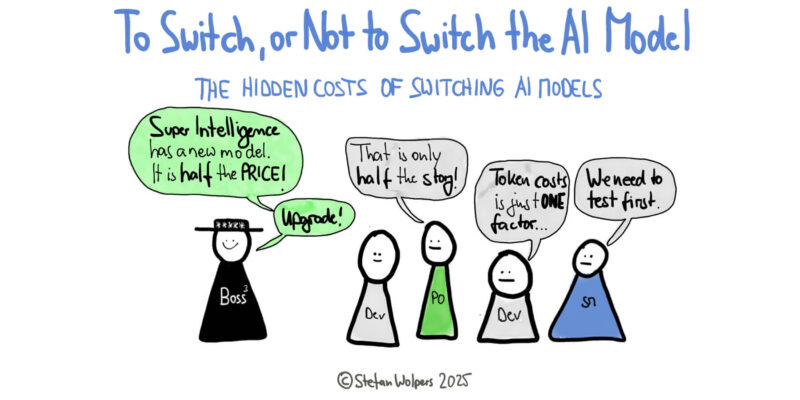
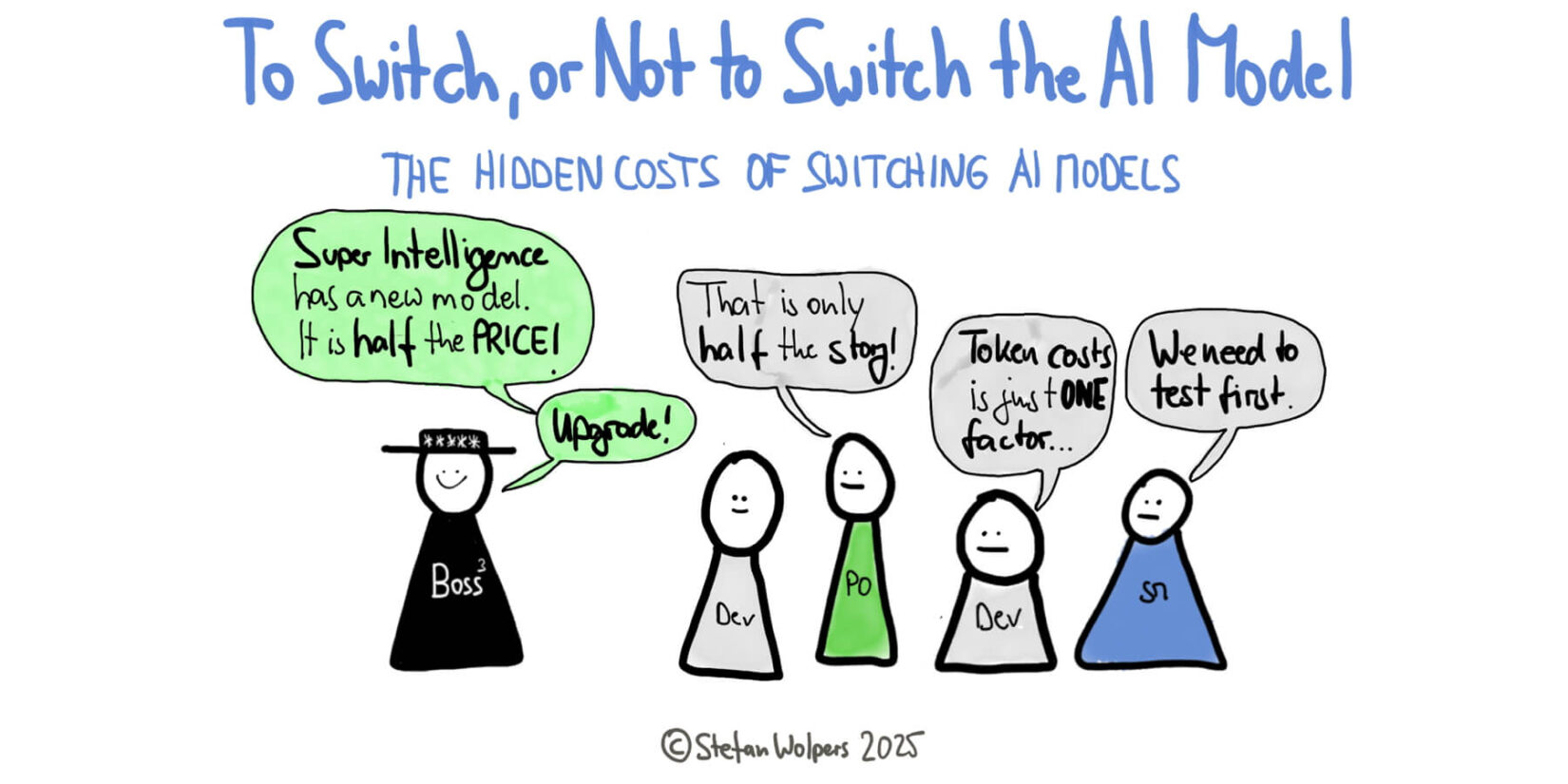
TL;DR: The Hidden Cost of Switching AI Models
A new AI model arrives that is cheaper per token, scores better on benchmarks, and seems to require nothing more than a setting change. However, the token bill shows only part of the cost of switching AI models. There is also the effort to check whether your workflows, for example, the one to create status reports for stakeholders, still produce outputs in line with your AI Definition of Done. More often than not, this task remains unaligned with the decision to switch AI models.
In the worst case, switching AI models behind a business workflow can raise operating costs despite cheaper tokens, because business cases can miss the revalidation effort.
Thesis: This article explains the recurring operational cost of switching AI models behind a business workflow: why the revalidation effort may disappear from upgrade decisions, how to screen a switch, and how Agile teams use an AI Definition of Done, test evidence, and an accountable owner to stay in control.
Disclaimer: I read Charniak/McDermott’s book on “Artificial Intelligence” decades ago; of course, I use AI for research, translations, proofreading, challenging story arcs and article structures, and summarization. It is a production tool, not a substitute for thinking.
🎓 🇬🇧 The AI4Agile Online Course v4 — November 27, 2026, at $149 — Join the Waitlist
Sooner or later, a CFO will ask what your AI use actually returns. “It saves me time” will not survive that meeting.
The first wave of AI adoption rewarded practitioners who learned to prompt. That skill still matters, and this course still teaches it. The second wave rewards something rarer: people who can turn individual AI use into knowledge that survives departures, spend that can be explained and steered, and output that organizations can trust. That work is process design and change management. You have been doing both for years, on harder problems than this.
EXCLUSIVE: The new A3 Delegation Lifecycle System with seven ready-to-use templates, from the AI Workflow Inventory to the AI Definition of Done to the AI Working Agreement, to make sense of delegating work to AI models.
The AI 4 Agile Online Course v4 is in English. 🇬🇧
What You Will Get:
✅ 20+ hours of self-paced video modules ✅ 4 Live onboarding session ✅ A cohort-hardened, proven course design ✅ Learn to 10x your effectiveness with AI; your stakeholder will be grateful ✅ Apply AI to classic use cases of “Agile” ✅ The A3 Delegation System comprising seven ready-to-use templates ✅ All texts, slides, prompts, and graphics ✅ Access custom GPTs, including the “Scrum Anti-Patterns Guide GTP” ✅ Guaranteed: Lifetime access to v4 ✅ AI4Agile Foundation Certificate: 40 questions in 45 minutes.

👉 Please note: The course will be available for $149 from November 27-30, 2026! (After that, $249.) 👈
🎓 Join the Waitlist now and be the first to know: The AI4Agile Online Course v4 — November 27, 2026, at $149 — No Coding Required!
🗞 Shall I notify you about articles like this one? Awesome! You can sign up here for the ‘Food for Agile Thought’ newsletter and join 35,000-plus subscribers.
🎓 Join Stefan in one of his upcoming training classes!
Why a Cheaper Model Can Cost You More
Your vendor has announced a new model. It costs less per million tokens than the one behind your team's workflows, it beats its predecessor on every benchmark the release notes care to mention, and switching seems to require nothing more than a changed setting in a configuration file. The business case writes itself, which is exactly the problem, because it writes itself from the price list.
A lower price per token is a fact about the model, whereas lower operating costs are a claim about your workflow. That claim depends on work no price list contains: somebody has to check whether the workflow still produces acceptable results after the switch, adapt whatever no longer does, and keep checking afterward. That effort recurs with every model change, and it vanishes from the decision whenever existing staff absorb it, because nobody "invoices" for their afternoons to create the desired transparency.
The Upgrade That Looks Like a Configuration Change
Take a hypothetical but ordinary case. A Product Manager runs a workflow that drafts the weekly stakeholder status report: its agent takes the export from the team's project tracker, the product roadmap, and customer input from a variety of sources. It builds on a skill that describes the report structure, including tone instructions, and the model produces a two-page draft that the Product Owner reviews, corrects, and sends out every Friday. (Yes, a written status report in an Agile organization; stakeholders who skip, for example, the Sprint Review still want to know what happened, and a page they read beats a meeting they avoid.)
Over a few months, the review has settled into a quick pass that mostly fixes phrasing. Then the vendor releases a cheaper model, and the switch looks like a one-line change.
Cannot see the form? Please click here.
When the Report Still Reads Well and Is Wrong
After the switch, the reports still arrive on time, in the right structure, and in fluent prose. In the third week, however, the draft describes a blocked item as "on track," because the new model dropped the one sentence in the tracker comment explaining that the item waits for a decision from the legal department. The report reads smoothly; nevertheless, it would have told the stakeholders the opposite of the truth, and the Product Manager caught it only because they happened to know that particular item. If the team had written an AI Definition of Done for its status reports, with a verification level that requires checking every status claim against the project tracker, the report would have failed on the spot; without one, catching the error depended on the Product Owner's memory. (Download the complete A3 Delegation System template including the AI Definition of Done above.)
This is the failure that can make switching AI models expensive: the workflow remains technically operational while it no longer produces acceptable output. A loud failure, say, a rejected parameter or a broken output format, stops the workflow with an error message, and somebody fixes it before lunch. The quiet failure passes every technical check and lands in front of the reviewer, who now reads every report with more suspicion than before, which is where the correction effort starts to climb. The same mechanism explains why a quick trial before the switch proves so little: model output can vary from one run to the next, so one successful run provides limited evidence, and the new model may well have produced a correct report on the day somebody tried it.
Hence, every switch of the model behind a production workflow raises a revalidation question. By revalidation, I mean checking, before you approve the changed workflow for production use, that it still meets its agreed standard, and then inspecting its actual results after deployment. For teams that work with an AI Definition of Done, the trigger is already on paper: the standard names the model tier that suffices for each task class and carries a sign-off with a review date, so a model switch leaves that sign-off without a basis until somebody renews it. The depth of that check should depend on what a failure costs, as a brainstorming assistant and an agent that changes customer records do not deserve the same scrutiny.
Where the Switching Cost Hides
The explicit charges are easy to find: the new model's token price, perhaps a few more tokens per report if the new model writes longer drafts, and, in larger setups, the invoices for tooling or outside help with the migration. Additional costs include operational effort: the hours spent comparing old and new reports before the switch, the extra minutes of correction every Friday since, the test cases somebody has to maintain, the rework when a wrong report has already gone out, and whatever the Product Owner did not do in the meantime. (Have I mentioned the cost of losing stakeholder trust because of a faulty report?)
Salaries are on the books, of course; however, existing staff budgets absorb this effort, and unless somebody attributes it to the migration, it stays out of the business case. Two days a team member spends validating a migration create no new cash expense, yet those two days are gone. That is what I mean by hidden: the cost is on the books, just not on the page where the decision gets made.
Consuming more tokens per task can also outweigh a lower token price, more retries, higher latency, or more human correction. So the unit of comparison is the complete workflow at an acceptable quality level, not the token price list.
A Screening Question Before You Switch
For a switch motivated by cost savings, one division gives you a screening question: divide the one-off migration and revalidation cost by the net monthly savings to get the number of months it takes to recover the investment. "Net" is the word to watch, as it means the savings compared with the existing workflow after changes in review time, corrections, retries, and ongoing maintenance. Meeting the minimum standard, as such, is a precondition rather than a term in the formula: a cheaper workflow that sends wrong reports to stakeholders does not qualify, whatever the arithmetic says.
Then ask whether the expected savings justify the investment, allowing for further migration and revalidation costs. A later change does not erase the savings you have already made. However, it brings its own revalidation cost, and vendors retire models on their own schedule: Anthropic, for example, retired Claude Sonnet 4 and Claude Opus 4 on June 15, 2026, and Claude Opus 4.1 on August 5, 2026. Treat the payback figure as a screen, not a forecast; it works when net savings are positive and reasonably stable, and it tells you whether the switch deserves a closer look.
Beware, though: Upgrades motivated by quality or new capabilities need a different judgment: weigh that benefit against the additional cost directly, without squeezing every improvement into a monetary payback calculation (the attempt invites invented precision as a misleading metric).
When the Vendor Decides for You
Not every switch is voluntary. Anthropic commits to at least 60 days of notice before retiring a publicly released model, and on September 30, 2026, it notified developers that Claude Sonnet 4.5 is scheduled to retire on November 30, 2026. OpenAI gives generally available models at least 6 months of notice, specialized variants at least 3 months, and preview models much less, such as 2 weeks; all of these minimums yield when safety or compliance concerns call for a faster retirement, in which case OpenAI promises "as much notice as reasonably possible."
A forced migration changes the question from whether switching is worthwhile to which viable alternative to choose:
- Moving to the successor model,
- Changing the provider,
- Reducing the workflow's scope,
- Reverting temporarily to manual work, or
- Retiring the workflow altogether.
Teams that run an AI Delegation Audit will recognize the list, as the audit's decisions overlap with it (change the model tier, change the A3 category, update the AI Definition of Done, or retire the delegation). The audit counts retiring an automation that no longer justifies its audit cost as a successful outcome. Continuing the automation is itself a decision, and it deserves the same revalidation as a voluntary switch, with less time to do it. If the Product Manager first has to work out what an acceptable status report looks like, much of the notice period is gone before the first test runs, so the evidence has to exist before the notice arrives.
Evidence That Survives the Switch
The evidence consists of four things, kept together: examples of acceptable and unacceptable work, the criteria you used to judge them, the relevant workflow configuration (prompt, skills, instructions, data, and context), and the results the current workflow produces on those examples. For the status report, that might be a dozen past project tracker exports, the reports you consider correct, and a note on why the blocked-item report was wrong. If the workflow already has an A3 Handoff Canvas, its Records field has settled in advance what to keep (prompts, skills, inputs, outputs, edits, and approvals), which means the evidence accumulates while the workflow runs instead of being reconstructed under a deadline.
Keep that evidence somewhere your organization controls, because testing tools are dependencies, too. OpenAI announced on June 3, 2026, that it is shutting down its Evals platform: existing evals become read-only on October 31, 2026, and the dashboard and API shut down on November 30, 2026. A team that kept its test cases only in that platform must migrate its testing setup, and if its model needs replacing at the same time, the two migrations compound the work.
Passing the same cases supports the decision to deploy; however, a new model can pass every existing case and still fail in ways those cases never covered. So, retain the existing cases, add a case for every newly discovered failure (the blocked item is now case number 13), and inspect the actual results for a while after deployment.
Who Approves Continued Use?
Evidence that nobody acts on is an archive, so somebody has to be accountable for the check happening before a switch, for recording the decision to keep using the workflow, and for noticing when production results drift. Call that person the "workflow owner." They do not have to run every test personally, but they own the answer to "does this still work?"
In the A3 Delegation System, the AI Delegation Audit inspects whether this practice works, much as a Retrospective inspects how the team works. One of its four checks, model fit, asks whether the assigned model still suits the task and its risk level. The audit does not gate individual switches, which a recurring inspection cannot do; the model change remains the trigger.
One limit applies to all of this: you can only revalidate the workflows you know about, and an AI Workflow Inventory, even one that deliberately lists the shortcuts nobody approved, covers only what your discovery turns up. A workflow a team member runs privately through a personal account can change without the team knowing about it, let alone applying its agreed checks. Shadow IT always comes at a price.
Conclusion: One Workflow Before Switching AI Models
Pick one consequential recurring workflow, one where a wrong output would reach a stakeholder, a customer, or a decision before anybody noticed. Then do four things:
- Name the owner: The person who approves continued use after the next model change.
- Write down the standard: What counts as acceptable work for this workflow, ideally as an AI Definition of Done with the model tier it was signed off for and a review date. (If you work with Scrum, the parallel to the Definition of Done is deliberate.) If no such standard exists, writing it is your first task, and the hardest one, because without a standard there is nothing to revalidate against.
- Collect five starter cases: Real past inputs with outputs you consider acceptable and, if you have one, an output you consider wrong, together with the results the current workflow produces today.
- Record what runs it: The model and provider as your tool shows them, and where the evidence lives. (If you keep an AI Workflow Inventory, put this into a separate check record under the workflow's inventory number rather than into the inventory itself.)
Five cases start the exercise; they do not validate anything on their own, and they are not supposed to. Then apply one test: if your vendor announced the retirement of that model tomorrow, could the owner demonstrate within the notice period that the workflow still meets its standard on the new one? If the honest answer is no, you have uncovered operational work that the model's price list leaves out.
Key Questions This Article on Switching AI Models Answers
Does a Cheaper AI Model Lower the Cost of a Business Workflow?
A cheaper AI model does not necessarily lower a workflow's cost, because the token price is only one part of what the workflow costs to run. A cheaper model may need more tokens, more retries, or more human correction, and the effort to revalidate the workflow adds staff time that a business case built from token price lists may not capture. The unit of comparison is the complete workflow at an acceptable quality level.
What Are the Hidden Costs of Switching AI Models?
The hidden costs of switching AI models are the internal efforts that no vendor bill shows: comparing old and new outputs before the switch, extra review and correction afterward, maintaining test cases, and reworking wrong output that already went out. Existing staff budgets absorb this effort, so a business case built from token prices can miss it: two days of validation work creates no new invoice yet still consumes capacity, so it vanishes in the budget noise.
How Do You Check Whether a Workflow Still Works After an AI Model Change?
Revalidate the workflow: before approving it for production use, check it against an agreed standard, such as an AI Definition of Done, and a set of saved cases, then inspect its real results after deployment. Keep acceptable and unacceptable examples, judging criteria, workflow configuration, and previous results in a place your organization controls. Because model output varies between runs, one successful trial is weak evidence, and every newly found failure becomes a new case.
What Should a Team Do When an AI Vendor Retires Its Model?
Treat a vendor's model retirement as a choice between viable alternatives: moving to the successor model, changing the provider, reducing the workflow's scope, reverting temporarily to manual work, or retiring the workflow. Notice periods vary: Anthropic commits to at least 60 days for publicly released models, while OpenAI gives generally available models at least 6 months but may retire faster for safety or compliance reasons. Teams with prepared test evidence can revalidate within that window.
Who Should Approve the AI Model Behind a Recurring Workflow?
A named workflow owner should be accountable for checking the workflow before each model change and for approving its continued use, even if other people run the tests. In the A3 Delegation System, the AI Definition of Done supplies the standard the workflow is checked against, and the AI Delegation Audit inspects whether this practice works over time; the audit does not gate individual model switches.
Switching AI Models — Related Posts
AI Transformations And Agile Transformations Rhyme
You Already Have an AI Working Agreement. Write It Down.
If You Can Facilitate a Retrospective, You Can Audit Your AI
The AI Definition of Done: Human in the Loop Is Not a Quality Standard
The AI Delegation Lifecycle: Your Team Has AI Outputs. Where Are the Decisions?
Assist, Automate, Avoid: How Agile Practitioners Stay Irreplaceable with the A3 Framework
The A3 Handoff Canvas: Six Questions That Turn AI Delegation Into a Repeatable Workflow
The A3 Framework: Assist, Automate, Avoid — A Decision System for AI Delegation
👆 Stefan Wolpers: The Scrum Anti-Patterns Guide (Amazon advertisement.)
📅 Training Classes, Workshops, and Events
Learn more about Switching AI Models with our AI and Scrum training classes, workshops, and events. You can secure your seat directly by following the corresponding link in the table below:
See all upcoming classes here.

You can book your seat for the training directly by following the corresponding links to the ticket shop. If your organization's procurement process requires a different purchasing approach, please contact Berlin Product People GmbH directly.
✋ Do Not Miss Out and Learn More about Switching AI Models — Join the 20,000-plus Strong ‘Hands-on Agile’ Slack Community
I invite you to join the “Hands-on Agile” Slack Community and enjoy the benefits of a fast-growing, vibrant community of agile practitioners from around the world.

If you would like to join, all you have to do now is provide your credentials via this Google form, and I will sign you up. By the way, it’s free.
