
TL; DR: AI Pace Accelerating — Food for Agile Thought #564
Welcome to the 564th edition of the Food for Agile Thought newsletter, shared with 35,278 peers. This week, Simon Willison suggests that the current AI pace exceeds even his predictions, while Jenny Wanger believes it has made the product trio single-player, creating product debt in the process. Dan Shipper proposes a labs team expecting to discard 90% of its work, whereas Teresa Torres and Petra Wille treat innovation as a byproduct, not a goal. Ben Thompson suggests whoever owns your agent becomes the ultimate gatekeeper, yet Madeline Renbarger, M. Sriram, and Tom Dotan report even agentic commerce enthusiasts still want control.
Next, Dror Poleg suggests delegation ties his AI glossary together, and Casey Newton shows its price: OpenAI’s Dots saves him two hours but wants your email and bank account. For delegated code, Addy Osmani fears that the engineer approving it without independent checks becomes the moral crumple zone. Arvind Narayanan and Sayash Kapoor propose AI extinction probabilities are guesses wearing numbers, whereas Paweł Huryn’s analysis of AI subscription benefits rests on API list rates: SuperGrok buys 190x its price.
Lastly, John Cutler suggests your virtues lure you into career traps, while Jonny Miller points out that white-knuckled grinding ends in burnout; let go. Tim Ottinger hopes AI kills ticket culture and revives XP, whereas Viktor Cessan proposes automating internal requests only once volume justifies it. Finally, Fran Noto favors pairing over documentation; the latter captures only a fraction of what experienced people know, and Anuja Karnik and Sumeet Gayathri Moghe suggest trust grows in everyday work, not by orchestrated events.

Disclaimer: I read Charniak/McDermott’s book on “Artificial Intelligence” decades ago; of course, I use AI for research, translations, proofreading, challenging story arcs and article structures, and summarization. It is a production tool, not a substitute for thinking.
🎓 🇬🇧 The AI4Agile Online Course v4 — November 27, 2026, at $149 — Join the Waitlist
Sooner or later, a CFO will ask what your AI use actually returns. “It saves me time” will not survive that meeting.
The first wave of AI adoption rewarded practitioners who learned to prompt. That skill still matters, and this course still teaches it. The second wave rewards something rarer: people who can turn individual AI use into knowledge that survives departures, spend that can be explained and steered, and output that organizations can trust. That work is process design and change management. You have been doing both for years, on harder problems than this.
EXCLUSIVE: The new A3 Delegation Lifecycle System with seven ready-to-use templates, from the AI Workflow Inventory to the AI Definition of Done to the AI Working Agreement, to make sense of delegating work to AI models.
The AI 4 Agile Online Course v4 is in English. 🇬🇧
What You Will Get:
✅ 20+ hours of self-paced video modules ✅ 4 Live onboarding session ✅ A cohort-hardened, proven course design ✅ Learn to 10x your effectiveness with AI; your stakeholder will be grateful ✅ Apply AI to classic use cases of “Agile” ✅ The A3 Delegation System comprising seven ready-to-use templates ✅ All texts, slides, prompts, and graphics ✅ Access custom GPTs, including the “Scrum Anti-Patterns Guide GTP” ✅ Guaranteed: Lifetime access to v4 ✅ AI4Agile Foundation Certificate: 40 questions in 45 minutes.

👉 Please note: The course will be available for $149 from November 27-30, 2026! (After that, $249.) 👈
🎓 Join the Waitlist now and be the first to know: The AI4Agile Online Course v4 — November 27, 2026, at $149 — No Coding Required!
Did you miss the previous Food for Agile Thought issue 563?
🗞 Shall I notify you about articles like this one? Awesome! You can sign up here for the ‘Food for Agile Thought’ newsletter and join 35,000-plus subscribers.
🎓 Join Stefan in one of his upcoming training classes!
🏆 The Tip of the Week: AI Pace Accelerating
: 2026 in LLMs (so far)
Simon Willison, who tests nearly every new AI model, suggests his profession has never changed so quickly. Looking back, even his predictions for 2026 proved too timid, and he is still working out what it all means. If someone this close to the action struggles to keep pace, how well can you possibly anticipate the next three to six months?
🎯 Product
: Building alone, faster: a panel on what AI is doing to the product trio
Jenny Wanger suggests AI has made the product trio single-player: everyone builds alone, faster, and pulls the others in later. Her Denver panel explores who pays that debt downstream and why burnout follows.
and : 🎙️ Unpacking Innovation
Teresa Torres and Petra Wille suggest innovation is a byproduct, not a goal. Chasing novelty breeds complexity and cognitive cost, while the login's history shows yesterday's breakthrough becoming today's friction.
: 📺 How to run your product team like a research lab
Dan Shipper believes product teams struggle to execute roadmaps and explore the AI frontier at the same time. His fix: A tiny labs team expecting to discard 90% of what it builds.
(via Newcomer): Early Optimism Reigns on Agentic Commerce + Personal Agents at the Machine Earning AI Summit
Madeline Renbarger, M. Sriram, and Tom Dotan report that even the crowd of an agent-obsessed summit on Agentic Commerce wants control: the technology arrives long before consumer comfort, and liability for rogue agents remains legally unsettled.
🧠 Artificial Intelligence
(via The Stratechery): Apps, Agents, and Aggregation
Ben Thompson suggests apps were only ever a means to an end. Once AI agents do the work, apps become mere suppliers, and whoever owns your agent becomes the ultimate gatekeeper.
: OpenAI connects the Dots
Casey Newton suggests OpenAI's Dots more or less delivers the agent Bill Gates promised, saving him two hours for 15 minutes of effort. The price is trust: it wants your email and bank account.
: More Words That Explain AI
Dror Poleg extends his AI glossary, from neuralese to slop, and suggests that delegation ties it together: as machines take on work, we decide what to hand over, check, and own.
and : AI existential risk probabilities are (still) too unreliable to inform policy
Arvind Narayanan and Sayash Kapoor suggest AI extinction probabilities are guesses wearing numbers: no reference class, no theory, no measurable forecaster skill. Yet AI doom rhetoric drives public discourse and policy.
: The Code Nobody Reads
Addy Osmani suggests line-by-line code review is going away, and that's fine, unless nothing replaces it. Without independent checks and authority matching accountability, the engineer approving agent-written code becomes the moral crumple zone.
🖥 🇬🇧 AI4Agile BootCamp #9, October 15 – November 5, 2026
The job market’s shifting. Agile roles are under pressure. AI tools are everywhere, and the Agile professionals who learn how to work with AI, not against it, will be the ones leading the next wave of high-impact teams. Therefore, Stefan created the AI4Agile BootCamp.
So, become the professional recruiters‘ first call for „AI‑powered Agile.“ Be among the first to master practical AI applications for Scrum Masters, Agile Coaches, Product Owners, Product Managers, and Project Managers. The AI4Agile BootCamp is in English.
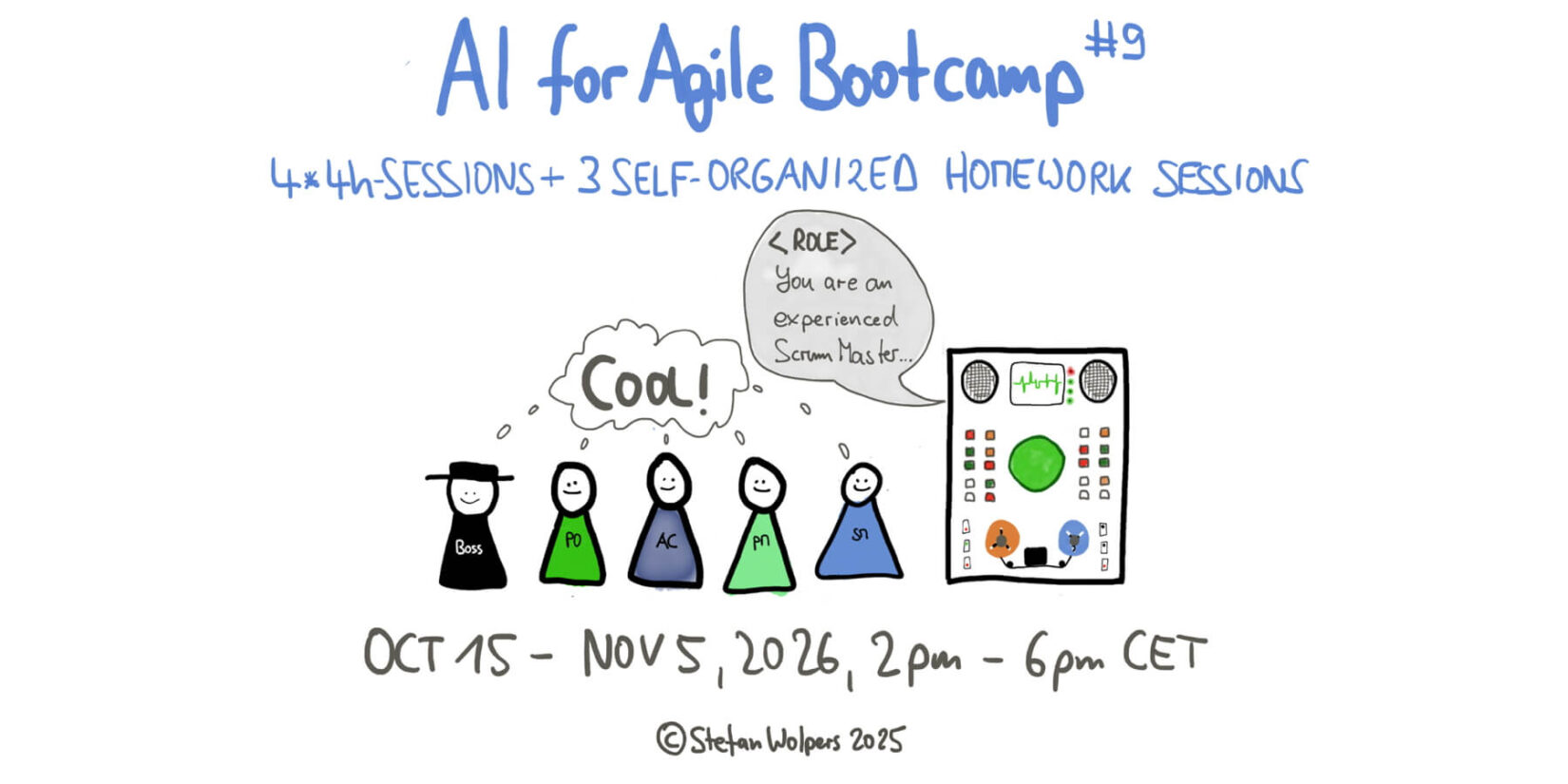
Learn more: 🖥 🇬🇧 AI4Agile BootCamp #9, October 15 – November 5, 2026.
Customer Voice: “Last week, I finished the 𝗔𝗜 𝗳𝗼𝗿 𝗔𝗴𝗶𝗹𝗲 𝗣𝗿𝗮𝗰𝘁𝗶𝘁𝗶𝗼𝗻𝗲𝗿𝘀 course. And I’m mutating… It started on the train. I was scrolling through my messages, half-distracted, when a newsletter from Stefan Wolpers popped up. Stefan, a deep thinker with a hands-on attitude, was launching a new course. A pilot cohort. The mission: explore how AI can actually support us as agile practitioners. I couldn’t resist. I tapped: “𝘚𝘪𝘨𝘯 𝘶𝘱”. What followed were four bi-weekly sessions. Four intense afternoons. Full of exploration, experimentation, and practice. […] At the beginning, Stefan said that 𝘫𝘶𝘴𝘵 𝘴𝘪𝘨𝘯𝘪𝘯𝘨 𝘶𝘱 𝘢𝘭𝘳𝘦𝘢𝘥𝘺 𝘱𝘶𝘵𝘴 𝘶𝘴 𝘢𝘩𝘦𝘢𝘥 𝘰𝘧 𝘮𝘢𝘯𝘺 𝘱𝘳𝘢𝘤𝘵𝘪𝘵𝘪𝘰𝘯𝘦𝘳𝘴. That sounded like a big statement. But somewhere along the way, I noticed a shift… an emerging superpower in how I approach my tasks with AI.⚡And now, as my AI-mutation continues, I catch myself wondering: 💭 𝘏𝘰𝘸 𝘥𝘰 𝘐 𝘶𝘴𝘦 𝘈𝘐 𝘵𝘰 𝘴𝘢𝘷𝘦 𝘵𝘩𝘦 𝘢𝘨𝘪𝘭𝘦 𝘸𝘰𝘳𝘭𝘥?” (Ilya Zaytsev, Leading Agility at HUGO BOSS.)
➿ Agile & Leadership
: 10 Career Traps (Thoughtful People Fall Into)
John Cutler suggests your virtues (curiosity, empathy, spotting weak signals) are exactly what lure you into career traps. He names ten and pinpoints the moment you can still save yourself before each one closes.
: Healthy Feedback: A guide to exchanging criticism or praise in teams
Anuja Karnik and Sumeet Gayathri Moghe suggest that all feedback is positive, feedback sandwiches fail, and peer feedback in performance reviews breeds platitudes. Trust grows in everyday work, not orchestrated events.
(via Lean Enterprise Institute): Toyota’s Answer to Knowledge Walking Out the Door
Fran Noto suggests your documentation captures a fraction of what experienced people know. Toyota's answer was pairing juniors with seniors; he believes high turnover makes this more urgent, not less.
: Services, Products, Systems and Platforms: A Financial Guide to Engineering and Product Leaders
Viktor Cessan suggests that when internal teams fulfill requests by hand, more adoption only adds cost. He proposes standardizing the offer first and automating once volume justifies the investment.
📯 The Jobs Matrix for AI: Four Boxes Instead of Forty Tools
You probably think making sense of AI means keeping up with every new tool, agent, and pricing tier. Steve Jobs faced a similar mess at Apple in 1997, with a dozen versions of the Macintosh, and he fixed it with a two-by-two grid on a whiteboard. Almost 30 years later, the “Jobs Matrix for AI” sorts the AI tool market and, more usefully, the AI use cases of Scrum Masters, Product Owners, Agile Coaches, and anyone else in agile product development.
Replace Consumer and Pro with Team and Organization, and Desktop and Portable with Chatbot and Agent, and you get four boxes that show where a use case belongs, what it takes to move it, and which box should stay empty.
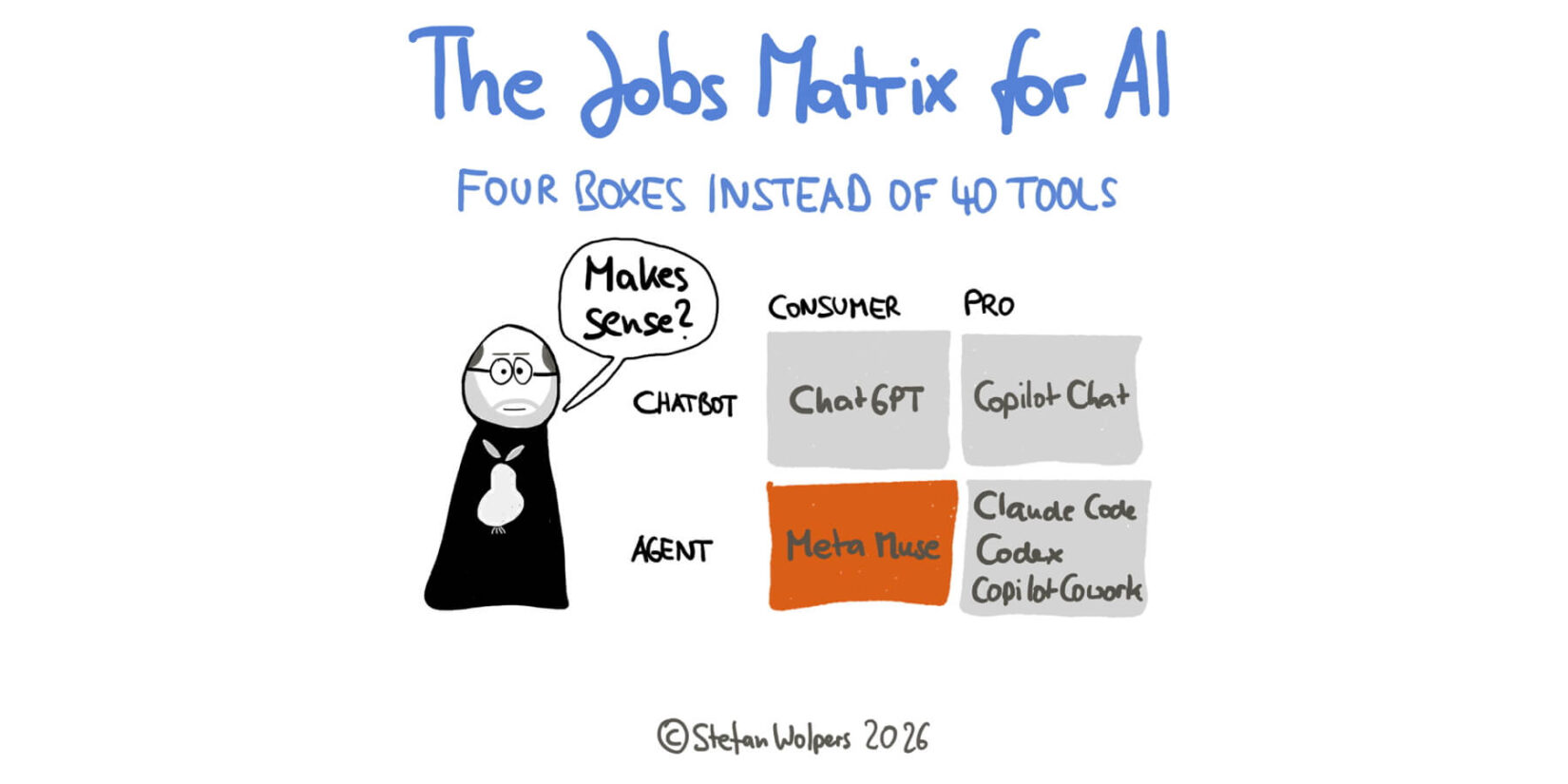
Thesis: This article applies Steve Jobs’ 1997 Consumer/Pro, Desktop/Portable matrix first to the 2026 AI tool market, and then to agile practices, producing a 2×2 matrix that sorts AI use cases by required decision rights and by delegated authority.
👉 Learn more: The Jobs Matrix for AI: Four Boxes Instead of Forty Tools.
🛠 Concepts, Practices, Tools & Measuring
: How to Unclench
Jonny Miller suggests suffering comes not from feelings but from clenching against them. His guide treats unclenching as a trainable skill, and calls white-knuckled grinding a midwit route to burnout.
: The Ticket Is Not The Work
Tim Ottinger suggests tickets have almost nothing to do with agile: ticket culture resurrected waterfall and killed teamwork. He hopes AI kills that culture, since agents make XP affordable again.
: Stop Overpaying for Your AI Subscription: GPT-6.1 Sol, Sonnet 5.5, Opus 5.5
Paweł Huryn priced AI subscriptions at API list rates: SuperGrok buys 190x its price, Claude's top plan 45x, ChatGPT 10x. Yet GPT-6.1 Sol still undercuts Opus 5.5 on actual cost.
📅 Scrum Training & Event Schedule
You can secure your seat for Scrum training classes, workshops, and meetups directly by following the corresponding link in the table below:
| Date | Class and Language | City | Price |
|---|---|---|---|
| 🖥 🇩🇪 November 3-4, 2026 | Professional Scrum Product Owner Training (PSPO I; German; Live Virtual Class) | Live Virtual Class | €1189 incl. 19% VAT (If applicable.) |
| 🖥 🇬🇧 November 27, 2026 | GUARANTEED: AI4Agile Online Course v4 (AI4Agile Certificate; English; Online Course) | Online Course | $149 incl. 19% VAT (If applicable.) |
| 🖥 🇩🇪 December 8-9, 2026 | Professional Scrum Product Owner Training (PSPO I; German; Live Virtual Class) | Live Virtual Class | €1189 incl. 19% VAT (If applicable.) |
| 🖥 🇬🇧 December 15-16, 2026 | Professional Scrum Master – Advanced Training (PSM II; English; Live Virtual Class) | Live Virtual Class | €1189 incl. 19% VAT (If applicable.) |
See all upcoming classes here.

You can book your seat for the training directly by following the corresponding links to the ticket shop. If the procurement process of your organization requires a different purchasing process, please contact Berlin Product People GmbH directly.
📺 Join 6,000-plus Agile Peers on Youtube
Now available on the Age-of-Product YouTube channel to improve learning, for example, about the accelerating AI Pace:
- Stop Writing Prompts. Let AI Do It for You — Hack #01, AI4Agile Online Course v2.
- Socratic Prompting — Hack #10, AI4Agile Online Course v2.
- Check Your AI’s Plan Before — Hack #7, AI4Agile Online Course v2.
- From Product Requirements to Experiments to Learnings — Supported by Generative AI.
- Never Accept an LLM’s First Offer — Improve GenAI’s Usefulness w/ Feedback Loops and Challenges.
✋ Do Not Miss Out: Learn more about the Accelerating AI Pace — Join the 20,000-plus Strong ‘Hands-on Agile’ Slack Community
I invite you to join the “Hands-on Agile” Slack Community and enjoy the benefits of a fast-growing, vibrant community of agile practitioners from around the world.

If you would like to join, all you have to do now is provide your credentials via this Google form, and I will sign you up. By the way, it’s free.
Help your team to learn about how AI Intensifies Work by pointing them to the free Scrum Anti-Patterns Guide: