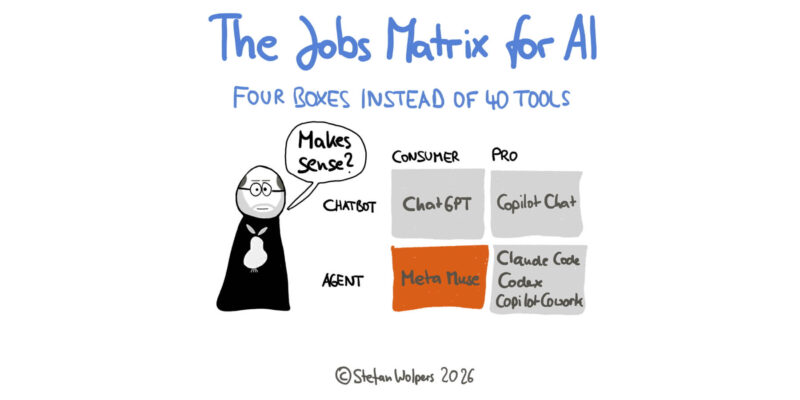
TL;DR: A 2×2 Matrix on AI for Agile Practitioners
You probably think making sense of AI means keeping up with every new tool, agent, and pricing tier. Steve Jobs faced a similar mess at Apple in 1997, with a dozen versions of the Macintosh, and he fixed it with a two-by-two grid on a whiteboard. Almost 30 years later, the “Jobs Matrix for AI” sorts the AI tool market and, more usefully, the AI use cases of Scrum Masters, Product Owners, Agile Coaches, and anyone else in agile product development.
Replace Consumer and Pro with Team and Organization, and Desktop and Portable with Chatbot and Agent, and you get four boxes that show where a use case belongs, what it takes to move it, and which box should stay empty.
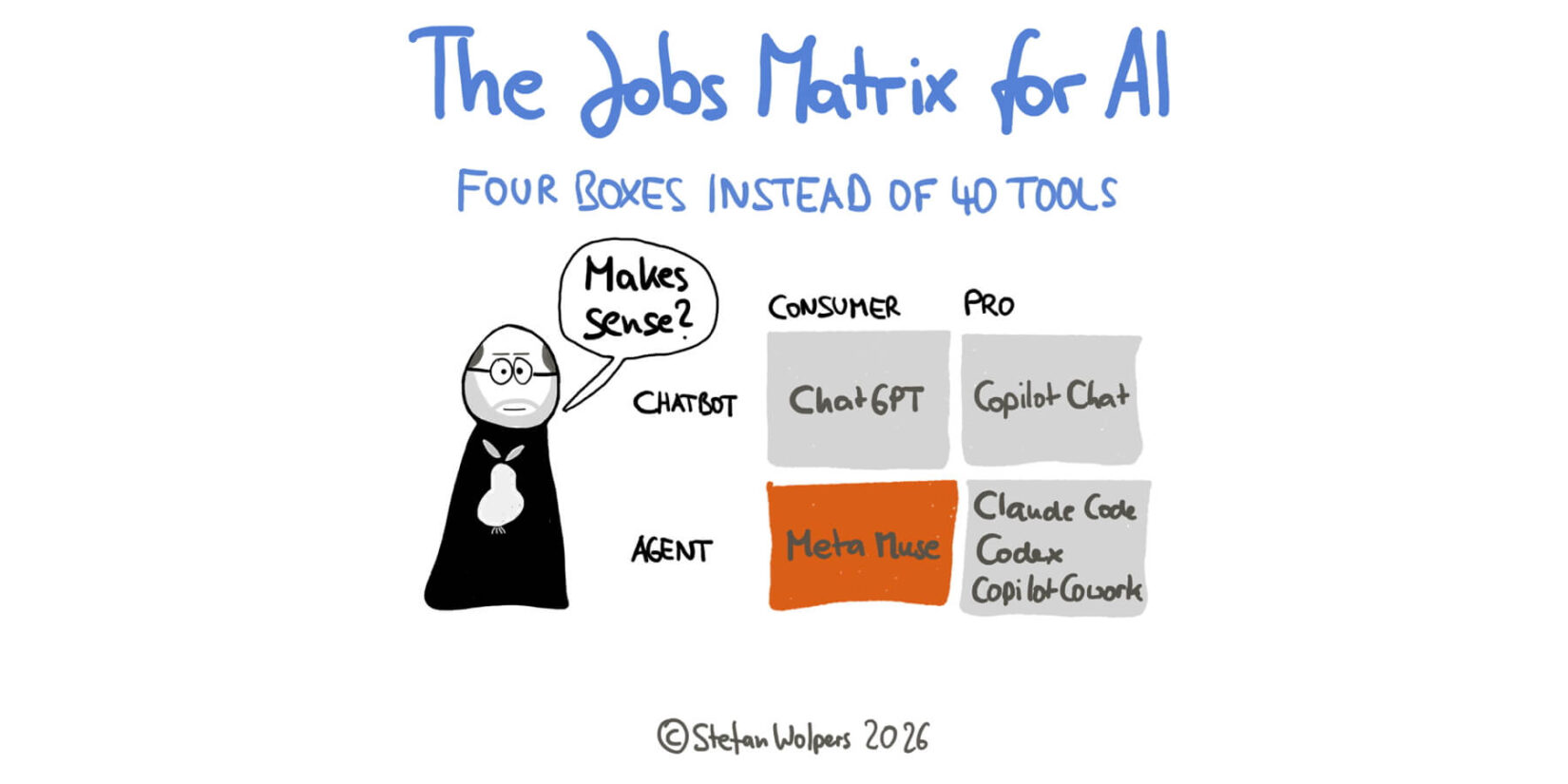
Thesis: This article applies Steve Jobs’ 1997 Consumer/Pro, Desktop/Portable matrix first to the 2026 AI tool market, and then to agile practices, producing a 2×2 matrix that sorts AI use cases by required decision rights and by delegated authority.
Disclaimer: I read Charniak/McDermott’s book on “Artificial Intelligence” decades ago; of course, I use AI for research, translations, proofreading, challenging story arcs and article structures, and summarization. It is a production tool, not a substitute for thinking. Kudos to Claude Design for creating the graphics for this post.
🎓 🇬🇧 The AI4Agile Online Course v4 — November 27, 2026, at $149 — Join the Waitlist
Sooner or later, a CFO will ask what your AI use actually returns. “It saves me time” will not survive that meeting.
The first wave of AI adoption rewarded practitioners who learned to prompt. That skill still matters, and this course still teaches it. The second wave rewards something rarer: people who can turn individual AI use into knowledge that survives departures, spend that can be explained and steered, and output that organizations can trust. That work is process design and change management. You have been doing both for years, on harder problems than this.
EXCLUSIVE: The new A3 Delegation Lifecycle System with seven ready-to-use templates from the AI Workflow Inventory to the AI Definition of Done to the AI Working Agreement to make sense of delegating work to AI models.
The AI 4 Agile Online Course v4 is in English. 🇬🇧
What You Will Get:
✅ 20+ hours of self-paced video modules ✅ A cohort-hardened, proven course design ✅ Learn to 10x your effectiveness with AI; your stakeholder will be grateful ✅ Apply AI to classic use cases of “Agile” ✅ The A3 Delegation System comprising seven ready-to-use templates ✅ The complete MegaBrain.io case package across both acts ✅ All texts, slides, prompts, and graphics ✅ Access custom GPTs, including the “Scrum Anti-Patterns Guide GTP” ✅ Guaranteed: Lifetime access to v4 ✅ AI4Agile Foundation Certificate: 40 questions in 45 minutes.

👉 Please note: The course will be available for $149 from November 27-30, 2026! (After that, $249.) 👈
🎓 Join the Waitlist now and be the first to know: The AI4Agile Online Course v4 — November 27, 2026, at $149 — No Coding Required!
🇩🇪 Zur deutschsprachigen Version des Artikels: Die Jobs-Matrix für KI: Vier Felder statt vierzig Werkzeuge.
🗞 Shall I notify you about articles like this one? Awesome! You can sign up here for the ‘Food for Agile Thought’ newsletter and join 35,000-plus subscribers.
🎓 Join Stefan in one of his upcoming training classes!
Four Boxes Saved Apple From Its Own Product Catalog
In 1997, after weeks of product reviews, Jobs had seen enough. According to Walter Isaacson’s account in the Harvard Business Review, he stopped the meeting, walked barefoot to a whiteboard, and drew a two-by-two grid with “Consumer” and “Pro” above the columns and “Desktop” and “Portable” beside the rows: four great products, one per box, and everything else canceled. “Deciding what not to do is as important as deciding what to do,” he later told Isaacson. (Remember Simplicity–the art of maximizing the amount of work not done–is essential?)
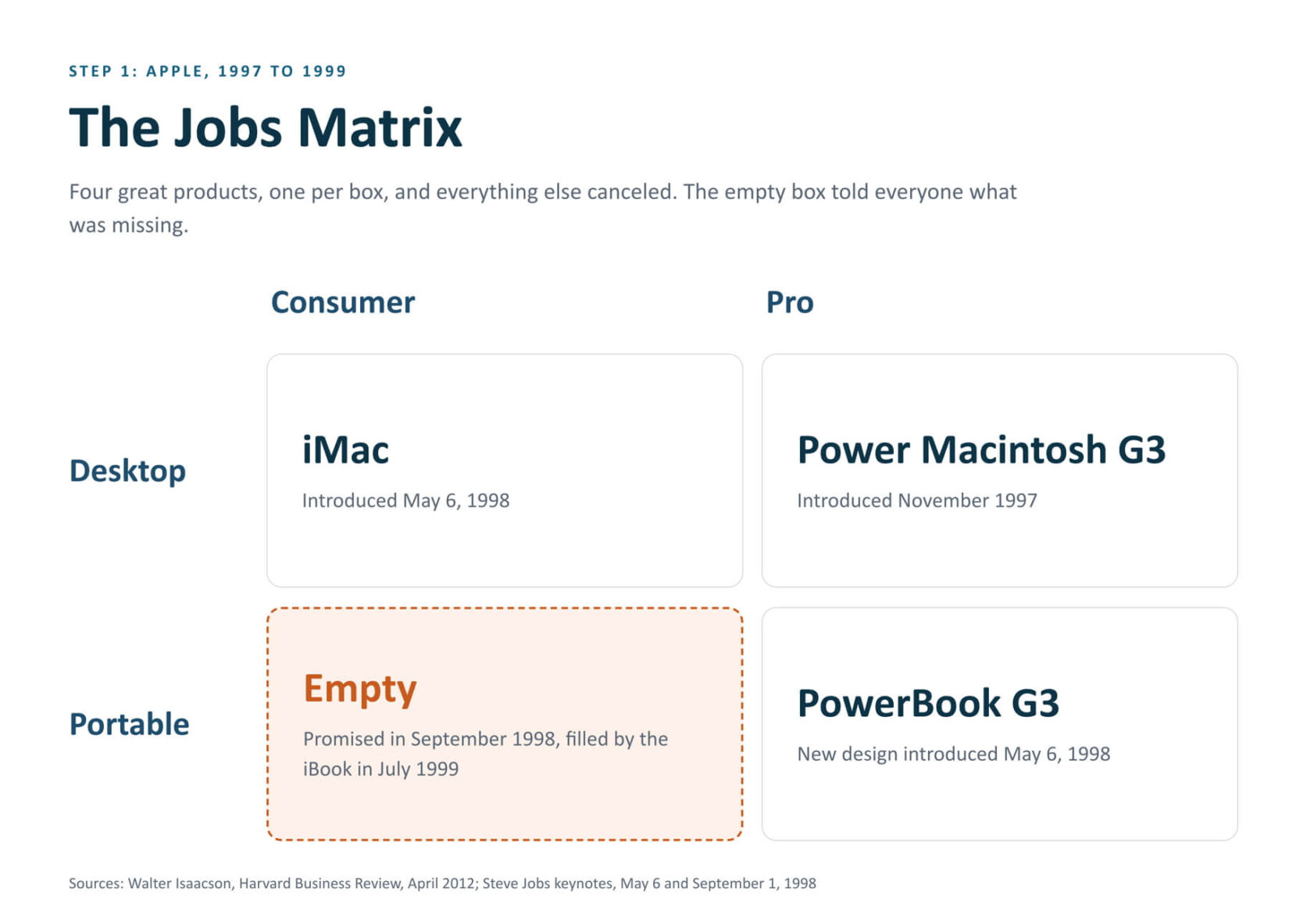
Jobs presented the matrix publicly in his iMac introduction on May 6, 1998, and at Seybold in September 1998, he added the reason that matters to anyone running a portfolio: with only four platforms, Apple could put its A team on every one of them instead of a B or C team on any.
The same keynote showed the matrix’s most useful feature, the empty box: Apple had no consumer portable yet, and Jobs could only promise one for the following year, so everyone, the competition included, could see what was missing until the iBook filled that box in July 1999.
Cannot see the form? Please click here.
The AI Tool Market Fits the Same Matrix, for Now
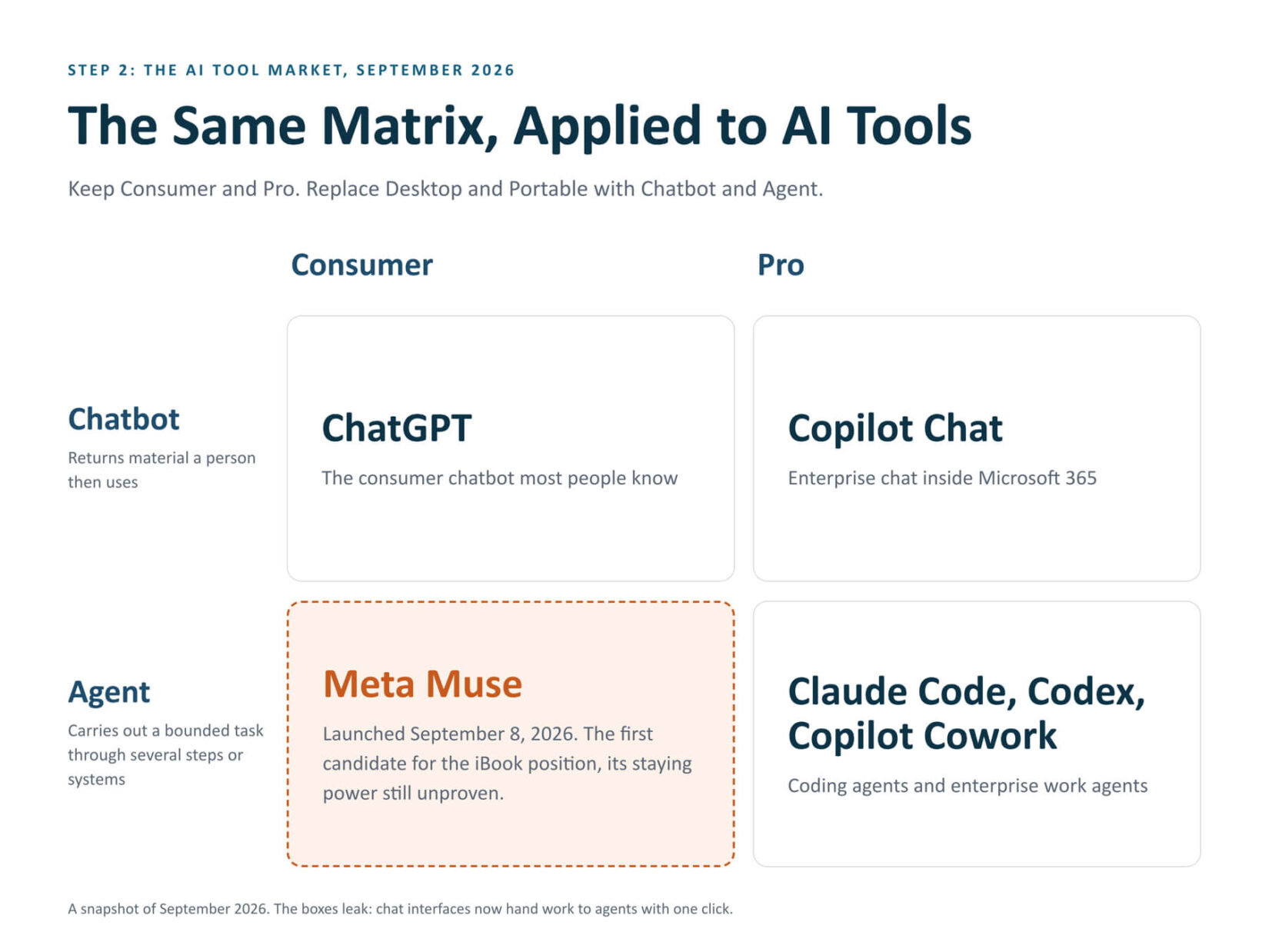
Keep Consumer and Pro, and replace Desktop and Portable with Chatbot and Agent. A chatbot returns material that a person then uses, whereas an agent receives the authority to carry out a bounded task through several steps or systems.
ChatGPT defines the Consumer Chatbot; enterprise chat, such as Copilot Chat in Microsoft 365, holds the Pro Chatbot box; and the Pro Agent box holds coding agents like Claude Code and Codex, plus Microsoft’s Copilot Cowork, which, according to Microsoft, runs defined work end to end, returns a finished result, and stays off until an administrator enables it.
The Consumer Agent box was the thin one until Meta launched Muse on September 8, 2026; by September 24, it had passed 3.4 million downloads, according to Sensor Tower estimates reported by TechCrunch. Downloads measure interest rather than sustained use, which makes Muse the first candidate for the “iBook position,” with its staying power still unproven. The boxes leak, too: Muse lives in a chat interface, and Microsoft 365 Copilot offers a toggle from chat into Cowork, so I would treat the tool matrix as a snapshot (my guess: it will not survive the next 6 months unchanged).
Your Jobs Matrix for AI: Team or Organization, Chatbot or Agent
In a professional environment, nobody is a consumer, and the organization buys the tools anyway, so the columns describe the context and decision rights that the work requires. Two questions place any use case in a box:
- What authority does the AI have after the request? If it returns material for a person to use, it is a chatbot use case; if it carries out a bounded task through several steps or systems, with defined review and approval points, it is an agent use case. What starts it does not matter: a Developer can ask an agent to implement a change, and a schedule can trigger a plain summary.
- Who must contribute, authorize, or respond? If one product team, its Product Person included, can understand and act on the work, it is a Team use case; if several teams or organizational functions must get involved, it is an Organization use case.
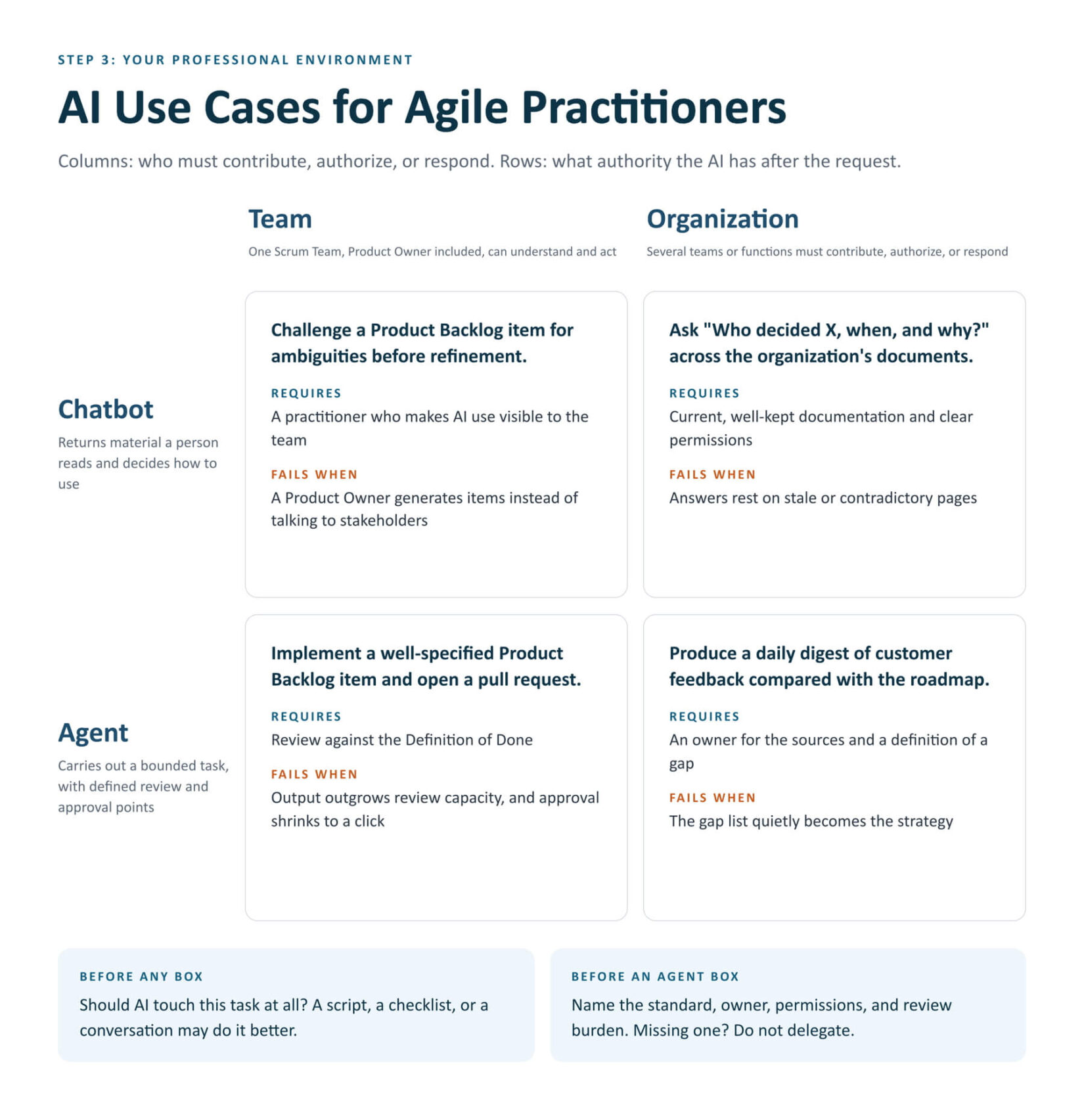
Typical use cases that come to mind are:
Team Chatbot
- Summarizing the notes from Sprint Planning, the Sprint Review, or the Retrospective, including a scheduled summary that a person reads before anyone acts on it.
- Challenging a Product Backlog item for ambiguities and missing acceptance criteria before refinement.
- Drafting test cases from acceptance criteria.
- Designing a Retrospective around a specific team problem.
- Explaining legacy code or domain terms to a new team member.
Requires: A practitioner with judgment who makes AI use visible to the team.
Where it fails: Private, invisible use, for example, a Product Owner who generates Product Backlog items instead of talking to stakeholders.
Team Agent
- After every event, extracting the agreed actions, checking each one with its owner, and posting only the approved items where the team works.
- Implementing a well-specified Product Backlog item and opening a pull request that the Developers review against the Definition of Done and development standards.
- Checking the Product Backlog weekly for stale, duplicate, or unrefined items and proposing changes to the Product Owner.
- Scanning the team’s codebase nightly for vulnerable dependencies and opening draft fixes.
- Publishing release notes from the shipped changes once the Product Owner has approved the draft.
Requires: A named review standard for every output and enough review capacity to apply it. (Capacity refers to humans; an LLM-as-a-judge-only approach is a tricky proposition.)
Where it fails: Output grows faster than the team’s capacity to review it, and approval shrinks to a click.
Organization Chatbot
- Asking “Who decided X, when, and why?” across the organization’s documents.
- Asking which teams work on anything related to a given company objective.
- Checking governance and compliance questions, for example, whether customer data may be used in an experiment.
- Synthesizing past quarterly reviews before a strategy session.
- Querying the organization’s own user and market research.
Requires: Current, well-kept documentation and clear permissions.
Where it fails: It retrieves what the organization wrote down, including every stale and contradictory page.
Organization Agent
- Producing a daily digest of the past 24 hours of customer feedback and support issues, compared with the product roadmap, listing gaps and emerging patterns for a product leadership report.
- Scanning all teams’ plans for dependencies before they turn into blockers.
- Compiling a weekly portfolio report from the actual work instead of from status meetings.
- Routing product usage anomalies to the owning team.
- Tracking competitor releases and comparing them with the roadmap.
Requires: Current data from several sources, clear decision rights, and governance over what the agent may do unattended.
Where it fails: Automated reporting replaces the conversation, and the agents’ lists of gaps quietly become the strategy.
Deciding Which Boxes of the Jobs Matrix for AI Stay Empty
Jobs used his matrix to cancel products, and an agile practitioner’s matrix should do the same. First, ask whether AI should touch the task at all, since a script, a checklist, or a ten-minute conversation often does the job better (the first question of the A3 Delegation System; see below). Second, before a use case moves into an agent box, name four things:
- Standard: What counts as good output.
- Owner: Who answers for the result.
- Permissions: What the agent may read, change, and send.
- Review burden: Who checks the output, how often, and at what cost.
If you cannot name all four, do not delegate the task to an agent; keep a person in charge of the work, or leave AI out of it. That test also exposes a costly shortcut: leadership that starts with the Organization Agent box because it wants visibility first, dashboards are in high demand, and it seems likely to repeat the Agile transformations that began with tooling and reporting.
The standard differs by output, which is why the Definition of Done and development practices cover code but not every piece of agent work:
- Code implementing a Product Backlog item:
- Review standard: The agreed-upon development practices and, likely, the Definition of Done.
- Who approves: The Developers.
- Action items from an event:
- Review standard: Each owner confirms their item.
- Who approves: The item’s owner.
- Release notes:
- Review standard: Accuracy against the shipped changes and a tone that fits the audience.
- Who approves: The Product Owner.
- Feedback digest and gap list:
- Review standard: Named sources and flagged unsupported claims.
- Who approves: The owner of the digest.
- Portfolio report:
- Review standard: Figures traceable to the work.
- Who approves: Whoever sends it upward.
One Use Case, Two Boxes
For example, take the customer feedback digest and keep it in the Organization column. As a chatbot use case, someone in product leadership asks Claude to examine last week’s support tickets and survey comments against the roadmap and decides which findings deserve a conversation with the teams. As an agent use case, an agent gathers feedback from the same sources every morning, compares it with the roadmap, and delivers a recurring list of gaps.
Sources and columns stay the same, yet the move requires new authority, ownership, and review: someone must own the sources, define what counts as a gap, check claims the data does not support, and decide when to pause the digest. The agent may gather and compare, whereas deciding whether a gap deserves attention remains product strategy, a decision whose accountability stays with people. That is the rule across all four boxes: AI may prepare or carry out bounded work, and people keep the decisions and accountability defined for that work. If nobody can take on those jobs, leave the agent box empty.
Jobs Matrix for AI – Conclusion: Find Your Empty Box
Take last week’s AI use in your team, and put every instance into one of the four boxes. If you end up with an empty box, it reflects a decision about capacity and authority, so decide whether it is empty because nobody has got to it yet or because nobody could own it if you filled it.
Key Questions This Article Answers
What Was Steve Jobs’ 2×2 Product Matrix at Apple?
Steve Jobs’ product matrix was a two-by-two grid he drew in 1997 to cut Apple’s lineup to four computers, with Consumer and Pro across the top and Desktop and Portable down the side. According to Walter Isaacson, Apple canceled everything outside the four boxes. By 1998, the iMac, Power Macintosh G3, and PowerBook G3 filled three boxes, and the iBook filled the consumer portable box in July 1999.
What Is the Difference Between an AI Chatbot and an AI Agent?
The difference is the authority the AI has after the request that starts it. A chatbot returns material for a person to read and decide how to use. An agent carries out a bounded task through several steps or systems, with defined review and approval points. A Developer can ask an agent to implement a change, and a schedule can trigger a plain chatbot summary.
How Can Agile Teams Categorize Their AI Use Cases?
Agile teams can sort AI use cases into a 2×2 matrix modeled on Steve Jobs’ 1997 product grid. The columns ask who must contribute, authorize, or respond: one Scrum Team, the Product Owner or Product Manager, or several teams and functions. The rows ask what authority the AI has: returning material (chatbot) or carrying out a bounded task (agent). A Retrospective summary is Team Chatbot; a daily customer-feedback digest compared with the roadmap is Organization Agent.
When Should a Team Delegate a Task to an AI Agent?
A product team should delegate a task to an AI agent only when it can name four things: the standard for good output, the owner who answers for the result, the permissions defining what the agent may read, change, and send, and the review burden. If any of the four is missing, a person stays in charge of the work, or AI stays out of it.
Should Every Box of an AI Use Case Matrix Be Filled?
Not necessarily: an empty box can reflect a sound decision about capacity and authority. Apple’s consumer portable box stayed empty until the iBook arrived in July 1999, and everyone could see what was missing. In an Agile organization, the Organization Agent box should stay empty when nobody can own the sources, define what counts as a gap, check unsupported claims, and decide when to pause the agent.
Jobs Matrix for AI — Related Posts
Webinar: The AI Delegation Audit, Scrum.org, October 6, 2026
AI Transformations And Agile Transformations Rhyme
You Already Have an AI Working Agreement. Write It Down.
If You Can Facilitate a Retrospective, You Can Audit Your AI
The AI Definition of Done: Human in the Loop Is Not a Quality Standard
The AI Delegation Lifecycle: Your Team Has AI Outputs. Where Are the Decisions?
Assist, Automate, Avoid: How Agile Practitioners Stay Irreplaceable with the A3 Framework
The A3 Handoff Canvas: Six Questions That Turn AI Delegation Into a Repeatable Workflow
The A3 Framework: Assist, Automate, Avoid — A Decision System for AI Delegation
👆 Stefan Wolpers: The Scrum Anti-Patterns Guide (Amazon advertisement.)
📅 Training Classes, Workshops, and Events
Learn more about the Jobs Matrix for AI with our AI and Scrum training classes, workshops, and events. You can secure your seat directly by following the corresponding link in the table below:
| Date | Class and Language | City | Price |
|---|---|---|---|
| 🖥 💯 🇩🇪 Sep 30 to Oct 1, 2026 | GUARANTEED: Professional Scrum Product Owner Training (PSPO I; German; Live Virtual Class) | Live Virtual Class | €999 incl. 19% VAT (If applicable.) |
| 🖥 🇬🇧 October 15 to November 5, 2026 | AI4Agile BootCamp #9 (English; Live Virtual Cohort) | Live Virtual Cohort | €499 incl. 19% VAT (If applicable.) |
| 🖥 🇩🇪 Nov 3-4, 2026 | Professional Scrum Product Owner Training (PSPO I; German; Live Virtual Class) | Live Virtual Class | €1189 incl. 19% VAT (If applicable.) |
| 🖥 🇩🇪 Dec 8-9, 2026 | Professional Scrum Product Owner Training (PSPO I; German; Live Virtual Class) | Live Virtual Class | €1189 incl. 19% VAT (If applicable.) |
| 🖥 🇬🇧 Dec 15-16, 2026 | Professional Scrum Master – Advanced Training (PSM II; English; Live Virtual Class) | Live Virtual Class | €1189 incl. 19% VAT (If applicable.) |
See all upcoming classes here.

You can book your seat for the training directly by following the corresponding links to the ticket shop. If your organization’s procurement process requires a different purchasing approach, please contact Berlin Product People GmbH directly.
✋ Do Not Miss Out and Learn More about the Jobs Matrix for AI — Join the 20,000-plus Strong ‘Hands-on Agile’ Slack Community
I invite you to join the “Hands-on Agile” Slack Community and enjoy the benefits of a fast-growing, vibrant community of agile practitioners from around the world.

If you would like to join, all you have to do now is provide your credentials via this Google form, and I will sign you up. By the way, it’s free.