Food for Agile Thought #303: The Failed Agile Rebellion, Prioritizing Hypotheses for Testing, Start Transformations with Finance, Estimating Complexity

TL; DR: Failed Agile Rebellion, Prioritizing Hypotheses — Food for Agile Thought #303

Welcome to the 303rd edition of the Food for Agile Thought newsletter, shared with 32,688 peers. This week, we delve into the failed agile rebellion. Moreover, we aggregate a list of 26 patterns for creating new software successfully, and we point at the root cause of transformation-related cultural problems. Also, we share new ideas on how to ‘bring about cultural shifts and mindset changes’ so you can abandon the idea to simply replicate the approach from a case study in your organization.

We then dive into determining which hypotheses you should test, build, or discard; we detail how to replicate a legacy system’s functionality on a new technology stack, and we point to a playbook that focuses on the essential elements for running a Product Discovery, a good primer for teams starting in this field.

Lastly, we get into estimation, estimates, crazy deadlines, and how not to lose your head when a lot is at stake.

Food for Agile Thought #303: The Failed Agile Rebellion, Prioritizing Hypotheses for Testing, Start Transformations with Finance, Estimating Complexity — Age-of-Product.com
Continue reading Food for Agile Thought #303: The Failed Agile Rebellion, Prioritizing Hypotheses for Testing, Start Transformations with Finance, Estimating Complexity

Food for Agile Thought #302: Agile Lies, 15. State of Agile Survey, Marketing vs. Engineering, Product Operations: From Zero to One

TL; DR: Agile Lies, 15. State of Agile Survey — Food for Agile Thought #302

Welcome to the 302nd edition of the Food for Agile Thought newsletter, shared with 32,531 peers. This week, we lament the state of agile in the industry today, from its perception to agile lies to what people experience in the trenches. Also, we refer to a recent article by Jeff Patton that claims that the Agile Manifesto lacks a value statement, and we reflect on the benefits of creating situations for personal growth where failure will be safe.

We then summarize why the relationship between the marketing and engineering has been tense and filled with frustration for a long time. Moreover, we delve into how to set up ProductOps for the first time, and we provide a detailed guide on how to get going with the mystical minimum viable product.

Lastly, we download the latest version of the ‘State of Agile Survey,’ and we suggest planning and estimating a massive software project, requiring several teams, across several quarters of effort.

Food for Agile Thought #302: Agile Lies, 15. State of Agile Survey, Marketing vs. Engineering, Product Operations: From Zero to One — Age-of-Product.com
Continue reading Food for Agile Thought #302: Agile Lies, 15. State of Agile Survey, Marketing vs. Engineering, Product Operations: From Zero to One

Linking Strategy to Everyday Work — John Cutler at the Agile Camp Berlin 2021

TL; DR: Linking Strategy to Everyday Work w/ John Cutler — ACB21

In this highly engaging speaker session from the Agile Camp Berlin 2021, John Cutler delves into the advantages of linking strategy to everyday work: Motivation, inspiration, seeing the big picture despite working on a small iteration.
Linking Strategy to Everyday Work — John Cutler at the Agile Camp Berlin 2021 — Age-of-Product.com

🗞 Shall I notify you about articles like this one? Awesome! You can sign up here for the ‘Food for Agile Thought’ newsletter and join 33,000-plus subscribers.

🎓 Join Stefan in one of his upcoming Professional Scrum training classes!
Join the Anonymous Poll for the Upcoming Free Scrum Master Salary Report 2022 — Age-of-Product.com

📈 Join the Anonymous Poll for the Upcoming Free Scrum Master Salary Report 2022.

Linking Strategy to Everyday Work (With value creation models, and time-based goals like OKRs)

When teams can link their day-to-day work to a meaningful/concrete representation of “strategy”, they feel more inspired, and confidently work small while thinking big. Too often teams feel like they are iterating to nowhere, or locked into huge, prescriptive batches. Time-based goals like OKRs (alone) don’t help. In this talk we will discuss the difference between point-in-time goals and persistent value-creation models. My goal: inspire teams to adopt some form of persistent value-creation model and link their daily work to that framework.


Cannot see the form?
Please click here

Learn more about John Cutler

John Cutler is keenly focused on user experience and evidence-driven product development. He mixes and matches various methodologies to help teams deliver lasting outcomes for their customers.

“Team tetris and the feature factory will only take you so far. Cross-functional teams desire so much more, and my passion is helping them get there. It’s a win/win for the front-line teams, the business, and the customer and user.”

John currently works as the Head of Product Research & Education at Amplitude. As a former UX researcher at AppFolio, a product manager at Zendesk, Pendo.io, AdKeeper and RichFX, a startup founder, and a product team coach, John has a perspective that spans individual roles, domains, and products.

His viral enthusiasm has been heard through speaking/teaching engagements at QCon NYC, Agile-Lean Ireland, UXThailand, UXLondon, Front, Oredev, Mind The Product, Agile 2015, and various ProductCamps (Vancouver, Los Angeles, Raleigh NC) and MeetUps (Santa Barbara, Los Angeles, New York). John’s talk on Feature Factories was voted one of the Top 10 Product Talks of 2017.

Mixing in some less-than-typical experiences — driving rickshaws in NYC, and touring the US with “five other weird creative people in a van playing music” — John blogs prolifically about collaboration, product development, diversity, UX research, lean startup, and user experience. Some notable posts include The Evolving Product Manager Role, Persona(s) Non Grata, 12 Signs You’re Working in a Feature Factory, and Stop Setting Up Product Roadmaps To Fail.

Meet John Cutler

LinkedIn.

Twitter.

Medium.

Related Content

Sustainable Agility at the Enterprise Level—Agile Camp Berlin 2021.

How to Win with Agile Resistant Teams—Agile Camp Berlin 2021.

Increasing the Velocity of Value—Agile Camp Berlin 2021.

Real Cross-functional Teams for Creating Real and Better Products.

Evidence-based Interventions—Agile Camp Berlin 2021.

✋ Do Not Miss Out and Learn about Linking Strategy to Everyday Work : Join the 10,000-plus Strong ‘Hands-on Agile’ Slack Team

I invite you to join the “Hands-on Agile” Slack team and enjoy the benefits of a fast-growing, vibrant community of agile practitioners from around the world.

Join the Hands-on Agile Slack Group, Learn more about the Developers Code Fallacy

If you like to join now all you have to do now is provide your credentials via this Google form, and I will sign you up. By the way, it’s free.

📅 Scrum Training Classes, Workshops, and Events

You can secure your seat for Scrum training classes, workshops, and meetups directly by following the corresponding link in the table below:

Date Class and Language City Price
🖥 🇩🇪 January 28-31, 2025 Professional Scrum Product Owner Training (PSPO I; German; Live Virtual Class) Live Virtual Class €1.299 incl. 19% VAT
🖥 🇬🇧 February 4-6, 2025 GUARANTEED: Hands-on Agile 2025: From Concept-Based to Context-Based Agility (English) Live Virtual Conference FREE
🖥 🇬🇧 February 12-13, 2025 Professional Scrum Master Advanced Training (PSM II; English; Live Virtual Class) Live Virtual Class €1.299 incl. 19% VAT
🖥 🇬🇧 February 27, 2025 Professional Scrum Facilitation Skills Class (PSFS; English; Live Virtual Class) Live Virtual Class €749 incl. 19% VAT
🖥 💯 🇬🇧 March 6 to April 3, 2025 Guaranteed: Align, Discover, Deliver: The Product Backlog Management Cohort Class (English; Live Virtual Class) Live Virtual Class €499 incl. 19% VAT
🖥 🇩🇪 March 11-12, 2025 Professional Scrum Product Owner Training (PSPO I; German; Live Virtual Class) Live Virtual Class €1.299 incl. 19% VAT
🖥 🇬🇧 March 26-27, 2025 Professional Scrum Master Advanced Training (PSM II; English; Live Virtual Class) Live Virtual Class €1.299 incl. 19% VAT
🖥 🇬🇧 April 10, 2025 Professional Product Discovery and Validation Class (PPDV; German; Live Virtual Class) Live Virtual Class €749 incl. 19% VAT

See all upcoming classes here.

Professional Scrum Trainer Stefan Wolpers

You can book your seat for the training directly by following the corresponding links to the ticket shop. If the procurement process of your organization requires a different purchasing process, please contact Berlin Product People GmbH directly.

If you like to learn more about how to avoid skipping Retrospectives, consider attending Stefan’s Professional Scrum Master classes.
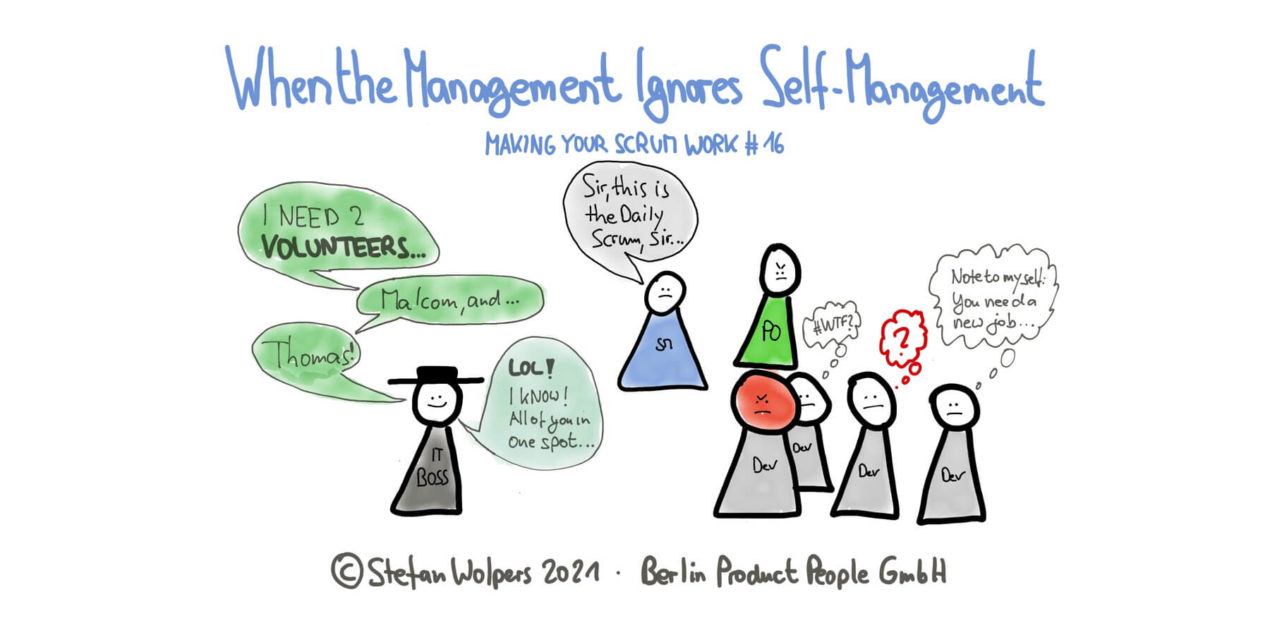
When the Management Ignores Self-Management — Making Your Scrum Work #16

TL; DR: Ignoring Self-Management — Undermining Scrum from the Start

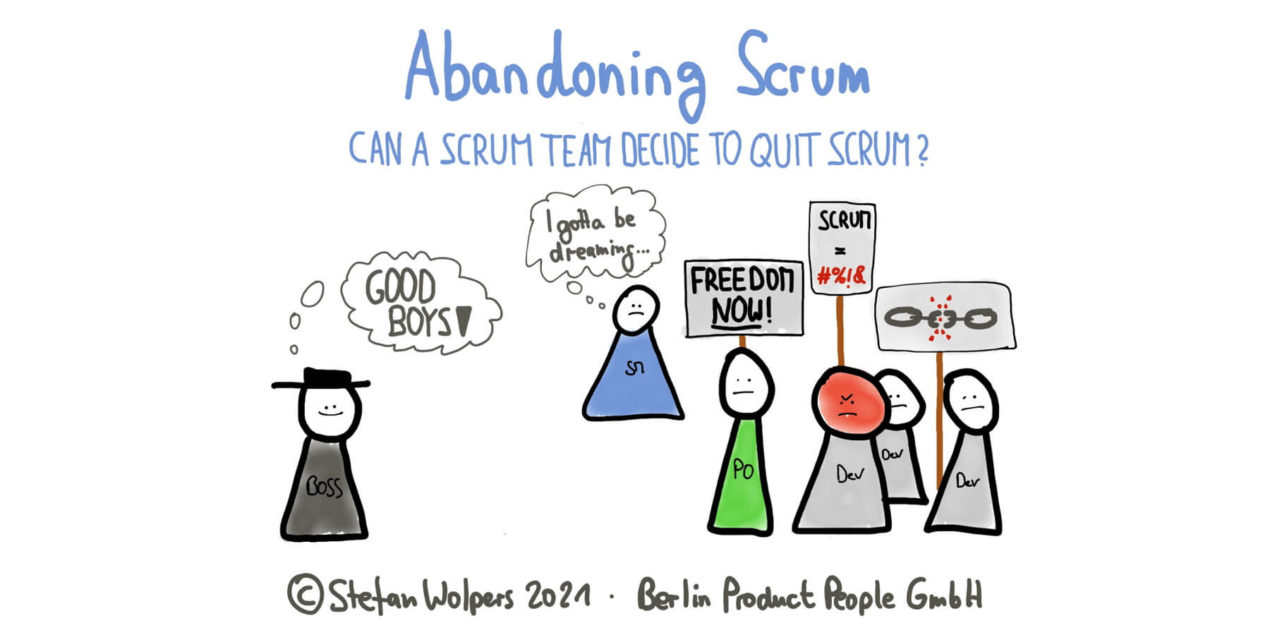
There are plenty of failure possibilities with Scrum. Given that Scrum is a framework with a reasonable yet short “manual,” this effect should not surprise anyone. One of Scrum’s first principles is self-management. It is based on the idea that the people closest to a problem are best suited to find a solution. Therefore, the task of the management is not to tell people what to do when and how. Instead, its job is to provide the guardrails, the constraints within which a Scrum team identifies the best possible solution. Join me and explore the consequences of management ignoring self-management and what you can do about it.

Ignoring Self-Management — Making Your Scrum Work #16 — Age-of-Product.com
Continue reading When the Management Ignores Self-Management — Making Your Scrum Work #16

Food for Agile Thought #301: Knowledge Work & Cottage Industry, Tackling the Product Manager Career, Pre-Mortems to Avoid Disasters, Proof: Design Thinking Works

TL; DR: Knowledge Work & Cottage Industry, Pre-Mortems — Food for Agile Thought #301

Welcome to the 301st edition of the Food for Agile Thought newsletter, shared with 32,359 peers. This week, we reflect on knowledge work, Taylorism, management & trust, and the future of working from home. Also, we tell the story of an empowered Agile product group of three Scrum teams working as contractors for the U.S. federal government, and we learn that digital marketing agencies can succeed in applying Scrum in a non-software environment.

We then talk about becoming the best product manager you can be; we combine Agile, Lean, and Design Thinking in a novel way, and we learn how to apply pre-mortems to avoid ship-wrecking major product launches. (There is a template for running the session, too.)

Lastly, we enjoy John Cutler and Shreyas Doshi delving into the dos and don’ts of a product manager’s career growth, creative intelligence, and product leadership.

Food for Agile Thought #301: Knowledge Work & the Return to the Cottage Industry, Tackling the Product Manager Career, Pre-Mortems to Avoid Disasters, Proof: Design Thinking Works — Age-of-Product.com
Continue reading Food for Agile Thought #301: Knowledge Work & Cottage Industry, Tackling the Product Manager Career, Pre-Mortems to Avoid Disasters, Proof: Design Thinking Works