TL; DR: Agile Coaches vs. Scrum Masters
Do We Need Agile Coaches when Practicing Scrum? Don’t get me wrong; my LinkedIn profile states “Professional Scrum Trainer, Agile Coach, and Scrum Master,” as ‘agile coach’ is an important search term. (Many seem to confuse agile coach with Scrum Master or believe both terms can be used interchangeably. However, that should not be a reason to reduce your chances of meeting a new employer or client.)
I like to point at a scheme, though, that I have encountered several times in the past, particularly in organizations, where the people folks still believe in orchestrated career paths: The Scrum Master is a role at the team level, while the agile coach is dealing with organizational issues.
I do believe that this construct is flawed: When practicing Scrum correctly, Scrum Masters are all you ever need.
🗳 Update: Join the poll and its lively discussion on agile coaches vs. Scrum Masters.
🗞 Shall I notify you about articles like this one? Awesome! You can sign up here for the ‘Food for Agile Thought’ newsletter and join 32,000-plus subscribers.
🎓 Join Stefan in one of his upcoming Professional Scrum training classes!
📈 Join the Anonymous Poll for the Upcoming Free Scrum Master Salary Report 2022.
You can download the Scrum Master Salary Report 2019 here.
The Scrum Master Accountabilities According to the Scrum Guide
Scrum Guide 2020 reserves a lot of attention to the role of the Scrum Master; for example, including ways to support the organization in practicing Scrum:
- Page 7: The Scrum Master serves the organization in several ways, including leading, training, and coaching the organization in its Scrum adoption.
- Page 7: The Scrum Master serves the organization in several ways, including planning and advising Scrum implementations within the organization.
- Page 7: The Scrum Master serves the organization in several ways, including helping employees and stakeholders understand and enact an empirical approach for complex work.
- Page 7: The Scrum Master serves the organization in several ways, including removing barriers between stakeholders and Scrum Teams.
Source: Scrum Guide 2020. (The aggregation is taken from the Scrum Guide 2020 Reordered.)
How Scrum Masters Allocated Their Time when Working with Scrum Teams
It is a fallacy to believe that the Scrum Masters’ accountabilities revolve around the Scrum team. If we were to limit their role to the Scrum team level, all we would accomplish is creating tiny islands of limited agility in an otherwise non-agile environment. (Consequently, these half-hearted approaches of agile transformations result in statements like: ‘We tried Scrum, and it did not work.’)
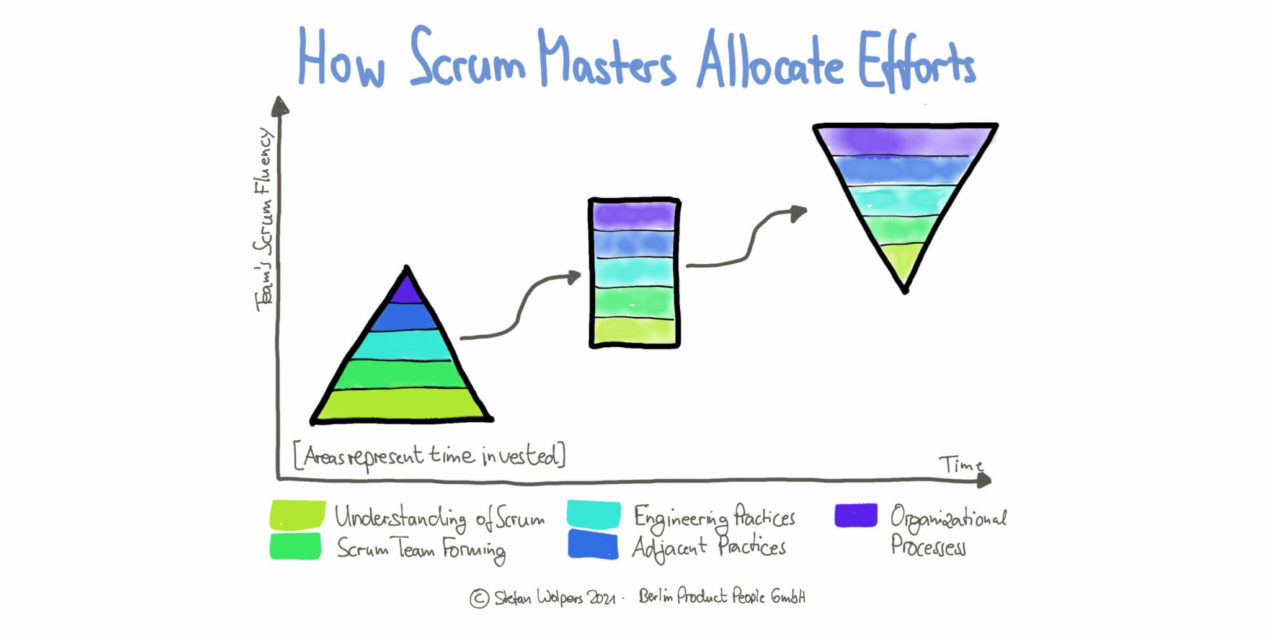
The fact is that Scrum Masters, when a Scrum team becomes more fluent in Scrum, allocate more time to working with the organization. Let’s take Dominik Maximini’s pyramid to visualize the work of a Scrum Master with a newly formed team and add a timeline. We can then imagine working with an experienced Scrum team by turning the original time allocation pyramid upside down. Now, Scrum Masters dedicate more time to support the organization in fine-tuning adjacent and organizational processes to meet the needs of embracing business agility.
Source: Dominik Maximini. (The site lacks SSL encryption; hence I am not linking to it directly.)
If this is a plausible scenario, why would you then seek to limit the work of Scrum Masters to the Scrum team level and engage agile coaches to do the work at the organizational level? Wouldn’t it be advisable to task people with that kind of job who have a thorough understanding of the challenges Scrum teams face in daily operations? Again, what is the benefit of creating a chasm here?
The only argument I have encountered so far is a perceived career path that starts with the Scrum Master role, and if you prove worthy, you are promoted to the next level—working with management and organization—represented by the ‘agile coach.’ (Some may say that Scrum Masters often lack a proper coaching education. However, in my experience, this is also true for many ‘agile coaches.’)
The Agile Community Needs You: Join the Scrum Master Salary Report 2022
The purpose of this anonymous survey is to create a clear, data-backed benchmark that allows everyone in the agile community to understand whether their compensation is adequate. (And yes, the report will cover Scrum Masters as well as Agile Coaches, both employed and freelancing.)
The goal is to have a sufficient number of replies – that would be at least 1,000 – by the end of November 2021 to create the report in time for January 2022. Of course, the report will be available for free.
📈 Join the Anonymous Poll for the Upcoming Free Scrum Master Salary Report 2022.
Conclusion: Do We Need Agile Coaches when Practicing Scrum?
I do believe that the construct of employing agile coaches for work at the organizational level while limiting Scrum Masters to operational tasks at the Scrum team level is flawed: When practicing Scrum correctly, Scrum Masters are all you ever need.
Is your organization employing agile coaches as well as Scrum Masters? If so, please share your learnings with us in the comments.
✋ Do Not Miss Out: Join the 10,000-plus Strong ‘Hands-on Agile’ Slack Team
I invite you to join the “Hands-on Agile” Slack team and enjoy the benefits of a fast-growing, vibrant community of agile practitioners from around the world.

If you like to join now all you have to do now is provide your credentials via this Google form, and I will sign you up. By the way, it’s free.
📖 Agile Coaches vs. Scrum Masters — Related Posts
Scrum Master Salary Report 2019
Scrum First Principles — How to Elon Musk the Scrum Guide
Download the Scrum Anti-Patterns Guide for free.
📅 Scrum Training Classes, Workshops, and Events
You can secure your seat for Scrum training classes, workshops, and meetups directly by following the corresponding link in the table below:
| Date |
Class and Language |
City |
Price |
| 🖥 🇩🇪 January 28-31, 2025 |
Professional Scrum Product Owner Training (PSPO I; German; Live Virtual Class) |
Live Virtual Class |
€1.299 incl. 19% VAT |
| 🖥 🇬🇧 February 4-6, 2025 |
GUARANTEED: Hands-on Agile 2025: From Concept-Based to Context-Based Agility (English) |
Live Virtual Conference |
FREE |
| 🖥 🇬🇧 February 12-13, 2025 |
Professional Scrum Master Advanced Training (PSM II; English; Live Virtual Class) |
Live Virtual Class |
€1.299 incl. 19% VAT |
| 🖥 🇬🇧 February 27, 2025 |
Professional Scrum Facilitation Skills Class (PSFS; English; Live Virtual Class) |
Live Virtual Class |
€749 incl. 19% VAT |
| 🖥 💯 🇬🇧 March 6 to April 3, 2025 |
Guaranteed: Align, Discover, Deliver: The Product Backlog Management Cohort Class (English; Live Virtual Class) |
Live Virtual Class |
€499 incl. 19% VAT |
| 🖥 🇩🇪 March 11-12, 2025 |
Professional Scrum Product Owner Training (PSPO I; German; Live Virtual Class) |
Live Virtual Class |
€1.299 incl. 19% VAT |
| 🖥 🇬🇧 March 26-27, 2025 |
Professional Scrum Master Advanced Training (PSM II; English; Live Virtual Class) |
Live Virtual Class |
€1.299 incl. 19% VAT |
| 🖥 🇬🇧 April 10, 2025 |
Professional Product Discovery and Validation Class (PPDV; German; Live Virtual Class) |
Live Virtual Class |
€749 incl. 19% VAT |
See all upcoming classes here.

You can book your seat for the training directly by following the corresponding links to the ticket shop. If the procurement process of your organization requires a different purchasing process, please contact Berlin Product People GmbH directly.
If you like to learn more about how to avoid skipping Retrospectives, consider attending Stefan’s Professional Scrum Master classes.