TL; DR: 10X Your Agile Leadership Game with 10 Affordable Books
Agile leadership is tricky, covering a lot of ground, from team building, decision-making, servant leadership, and self-management to including everyone and giving everyone a voice—to name a few of the challenges.
In the past, I found the following books beneficial to better understand the problem and solution space agile leadership. Moreover, you can significantly improve your leadership game as Scrum Master, agile coach, or manager for less than $ 200—an excellent investment from a professional perspective.
TL; DR: AI Replacing Developers — Food for Agile Thought #390
Welcome to the 390th edition of the Food for Agile Thought newsletter, shared with 46,277 peers. This week, we ask a simple question: Is AI replacing Developers a likely future? In the meantime, we delve into the importance of (software) architecture in an agile context, suggest alleviating some of the additional cognitive load developers shouldering with DevOps, and deep-dive into lessons learned on overcoming long-standing behaviors and winning hearts and minds.
Then, we suggest that as a product leader, you must ensure that you negotiate the right aspects by going beyond debating solutions and delving deeper to reach a consensus. Moreover, Itamar Gilad cautions against using generative AI to produce product management artifacts, pointing to serious tradeoffs, and Mike Cohn dissects a familiar template, looking at the “elements, advantages, and drawbacks of the three-part story template.”
Finally, we advocate using OKRs with Story Maps to support your release strategy, list positive attributes your goals should reflect, and cherish the ProductOps Manifesto. Lastly, we applaud Matt Schlicht for creating an epic intro to the latest AI trend; we might all become managers, herding bots.
Welcome to the Download Page of the Product Owner & Product Manager Salary Report
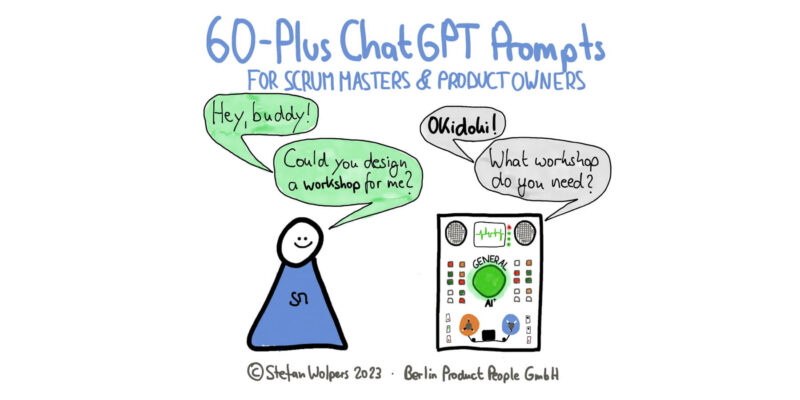
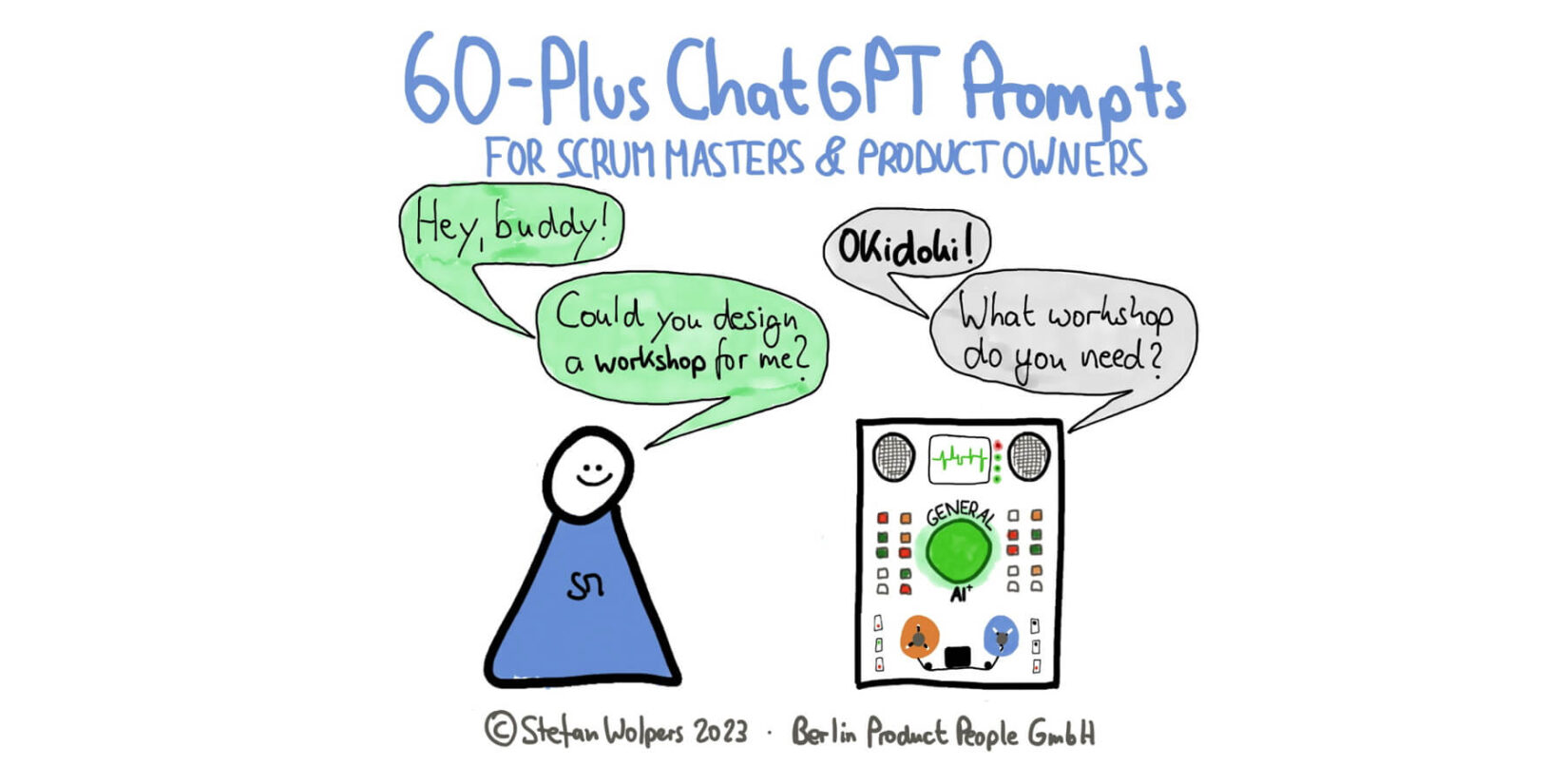
ChatGPT can be an excellent tool for those who know how to create prompts. The simplest form of prompting ChatGPT is to feed it the task and ask for results. However, this approach is unlikely to trigger the best response from the model.
Instead, invest more time in prompt engineering, and provide ChatGPT with a better context of the situation, desired outcomes, data, constraints, etc.
The free ‘60 ChatGPT Prompts for Scrum Masters & Product Owners Guide’ will help you learn to do that:
Is self-management an essential building block on an organization’s path to business agility or a nice-to-have cultural twist to, for example, keep teams happy and attract new talent?
While many people, particularly at the management level, are skeptical about the concept, I am convinced that organizations need to descale and regroup around aligned, autonomous, self-managing teams in a complex environment. Ultimately, only the people closest to the customers’ problems can solve those within the given constraints while contributing to an organization’s sustainability.
Please continue reading and delve into the reasons that support self-management.
TL; DR: Scrum’s Failure — Food for Agile Thought #389
Welcome to the 389th edition of the Food for Agile Thought newsletter, shared with 46,163 peers. This week, we delve into Scrum’s failure: Jason Godesky reminds us that few have ever worked in a true Scrum team, but many have in a Scrum cargo cult environment. Moreover, we delve into “bias and noise” and how they influence forecasting, and we learn how you can use Fluid Scrum Teams to manage multiple data products over various Sprints. Also, in shameless self-promotion, I want to point to the No Nonsense Agile Podcast that Murray Robinson, Shane Gibson, and I recorded recently. (Speaking of anti-patterns: There is also a new article on Jira and its perils if misused, see below.)
Then, we analyze the fundamental misalignment between the ‘business’ — focusing on one customer at a time — and ‘product/engineering,’ focusing on the overall impact for the installed base. Additionally, we point to the importance of embracing a learning mindset as the driver of innovation while process, vetos, institutional memory, and the vilification of failure work against it, and we share a practical and actionable list of recommendations to create a ProductOps handbook.
Finally, we suggest five experiments to help foster a safe working environment, from equal speaking time during meetings to celebrating failure, plus a new tool to ease the often challenging task of communicating project issues: the Definition of Broken. More tools are from John Cutler, who points to the free template library of the complete North Star metrics framework. Lastly, Nicole Abi-Esber and Juliana Schroeder claim that people underestimate how much others want to receive feedback.
If you ask people to come up with popular attributes for “Agile” or “agility,” Scrum and Jira will likely be among the top ten featured. Moreover, in any discussion about the topic, someone will mention that using Scrum running on top of Jira does not make an organization agile. However, more importantly, this notion is often only a tiny step from identifying Jira as a potential impediment to outright vilifying it. So in March 2023, I embarked on a non-representative research exercise to learn how organizations misuse Jira from a team perspective as I wanted to understand Jira anti-patterns.
Read on and learn more about how a project management tool that is reasonably usable when you use it out of the box without any modifications turns into a bureaucratic nightmare, what the reasons for this might be, and what we can do about it.