Scrum Master Duties: supposedly, a great scrum master serves only one scrum team — that’s at least a popular narrative in the scrum community. Nevertheless, there is also a loud voice that doubts that approach: what would you do the whole day – with a single team? Aren’t they supposed to become self-organizing over time? And if so, does the scrum then need a scrum master 24/7?
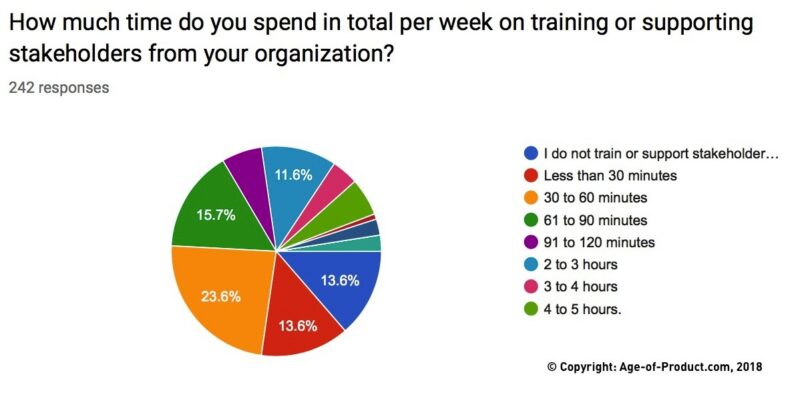
As I worked for years as a product owner on scrum teams without a dedicated scrum master-which was working well-I was curious to learn more about that question, too. Hence I ran a survey in late June and early July 2018, the results of which are presented here.
In total, 261 scrum masters participated in this non-representative survey in the two weeks before July 5th, 2018. 19 participants chose not to provide their consent to Google processing and to store their answers. Hence their contributions were deleted, resulting in a sample size of 242 responses.
Food for Agile Thought’s issue #150—shared with 18,194 peers—focuses on the role of the agile manager — from the perspective of the incumbent middle management. We also address changing the culture: what six steps are required and why putting up new value posters is futile.
We then take a deep dive into product prioritization and how to figure out what is worth building. Moreover, Andrew Chen provides a great collection of essays for those working on marketplaces.
Finally, the question of whether Scrum is iterative or incremental is answered.
Master autonomy purpose — in this article, I present a slightly different way of viewing agile maturity, through Dan Pink’s lens of Mastery, Autonomy, and Purpose; as a simple and useful way of fostering conversations and ensuring all relevant perspectives are considered.
Food for Agile Thought’s issue #149—shared with 18,075 peers—addresses the multitasking fallacy many managers suffer from, how to design an organization that supports agile teams tasked with solving customers’ problems, and what to do when your Scrum team gets too large.
We also enjoy Marty Cagan’s follow-up post—I hope you have read ‘The Revenge of the PMO’—as well as Teressa Torres’ pitch to continuously challenge your beliefs. (Running user interviews seems to be a good starting point.)
However, what if ‘Agile’ is merely a cult, something we made up collectively that is of no importance when it comes to creating outstanding products?
Food for Agile Thought’s issue #148—shared with 17,986 peers—focuses on unagile SAFe ®, how the PMO strikes back, and whether ‘agile’ makes sense at all.
We learn from Marty Cagan that most large organization do not (yet) understand the different concepts of project-orientation vs. product-orientation. Which is a good reason to also dive into the particularities of enterprise product management.
However, there is hope: K2K managed to turn more than 70 organizations into self-organizing flourishing entities. Learn how this happened.
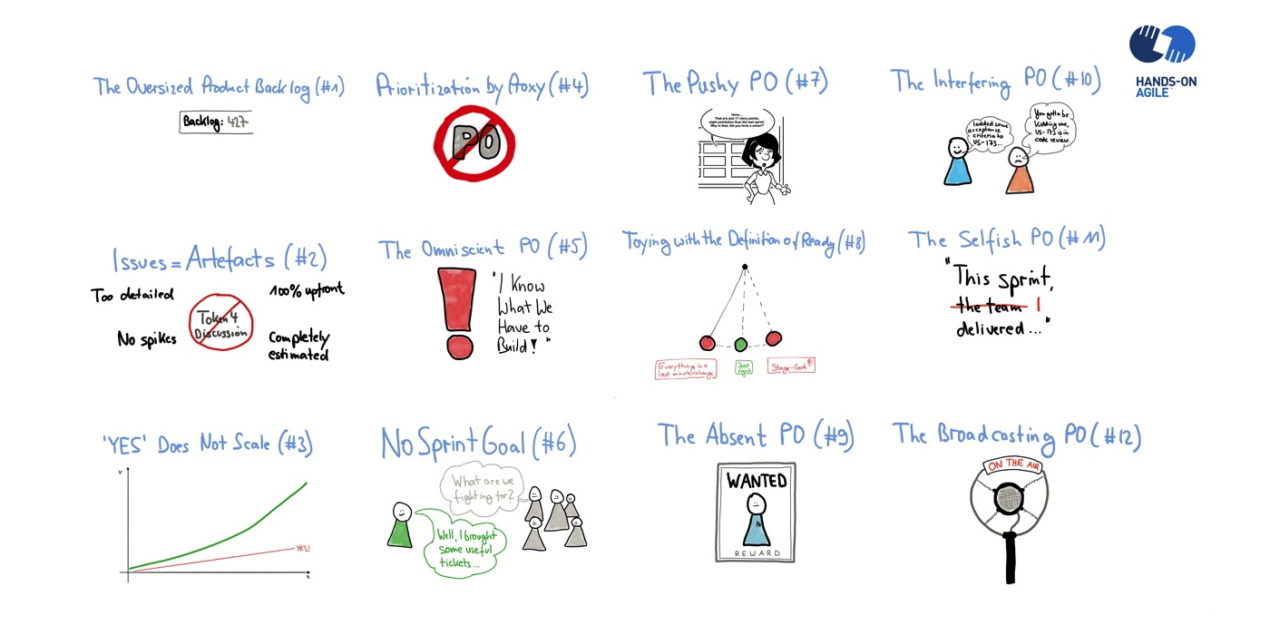
The sixth Hands-on Agile webinar product owner anti-patterns addresses 12 ways to improve a product owner’s skill set. Learn also when you — as the scrum master or scrum team — should reach out to your product owner and offer support.