Food for Agile Thought’s issue #209—shared with 23,558 peers—delves into Design Thinking habits; we consider how to turn dark ‘agile’ into a value-driven approach again, and we go back once again to antipatterns of organizational agility.
We also address validating hypotheses beyond an ordinary A/B-test; we learn how to orchestrate continuous experimentation for fun and profit, and we applaud Jeff Gothelf for sharing the second version of the Lean UX canvas with the community.
Lastly, we put ‘bugs’ into an agile context, starting with a moth in 1946.
Food for Agile Thought’s issue #208—shared with 23,551 peers—sheds light on the fate of Six Sigma; we introduce the free Zombie Scrum Checker for your Scrum Team, and we address once again the cycle-time/velocity prediction issue.
We also delve into Booking.com’s experimentation culture; we learn which traps to avoid when handling payment in a B2C application, and we enjoy a Twitter rant on the uselessness of timeline roadmaps.
Lastly, we thank Ron Jeffries for pointing at the obvious: you get paid for shipping valuable software every single Sprint. Period.
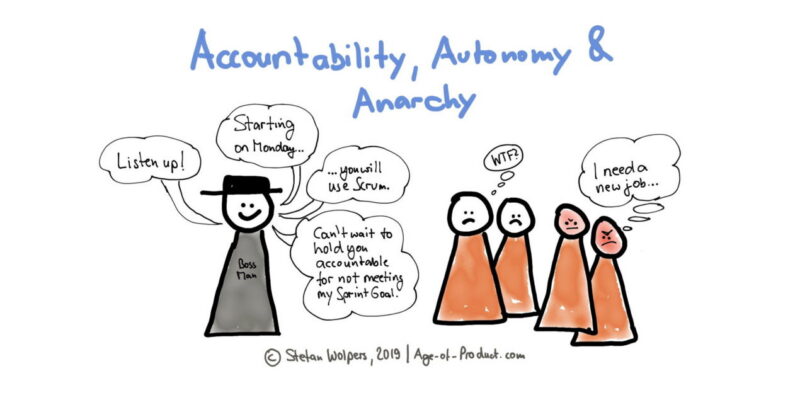
‘Autonomy without accountability equals anarchy’ summarizes an essential design element of any agile organization. Without these checks and balances in place any aspiration to transform an organization is likely to fail. (Or at best level out at a mechanistic level.) Learn more about how Scrum deals with accountability.
Food for Agile Thought’s issue #207—shared with 23,508 peers—continues its support of Liberating Structures; this time, Barry addresses the Sprint Review. We enjoy the State of DevOps 2019 report, and then we follow up on the Sprint Review with an unconventional suggestion.
We also learn to distinguish between delivery and product teams; we acquire new skills to influence the business side, and we delve into OKR and hypotheses as a means of team alignment.
Lastly, we learn about three obsolete, yet popular mental models of the industrial paradigm impeding transformations.
Food for Agile Thought’s issue #206—shared with 23,491 peers—covers Spotify’s approach to breaking hierarchy; we revisit the estimation discussion, and we consider reasons why teams may not be interested in becoming agile.
We also learn how to 10x our experimentation capacity; we discover five machine learning lessons for product managers, and we track value in an agile transformation.
Lastly, we delve into types of agile coaches—from cargo cult to transformative.
TL; DR: The Liberating Structures Daily Scrum Meetup
This Liberating Structures for Scrum meetup addressed the Daily Scrum, particularly the notion that it is barely possible to create a Liberating Structure Daily Scrum string that fits into the 15-minutes time-box of the Daily Scrum. Learn more on how to bust that myth.