TL; DR: Innovation Failure, Distributed Teams, PMs to CEOs, Keeping Track of Hypotheses—Food for Agile Thought #223
Food for Agile Thought’s issue #223—shared with 24,653 peers—addresses innovation failure; we revisit standups and what makes them successful, and we learn more about the magic stance of actively doing nothing.
We also delve into the ‘2019 Annual Product Management and Product Marketing Survey’ results; we pick up a few useful visualizations to explain product management to outsiders, and we consider bringing order to our user-related questions, hypotheses, and assumptions to prevent user research from turning ugly.
Lastly, we thank both VPs of Engineering from Buffer and Splice for sharing a guide on how to make distributed teams successful with us.
On our own account: Issue 224 will be delivered on January 12th, 2020. Enjoy a chillaxing Holiday season… 🎉
TL; DR: The Agile Movers & Shakers Interview with Diana Larsen
While Diana Larsen continues her coaching, mentoring, and consulting practice in a limited way, she has shifted more toward involvement as a co-founder of the Agile Fluency Project, a startup that is intended to help agile coaches grow and strengthen their practices with the Agile Fluency Suite of materials and the Agile Fluency Game.
TL; DR: Agile Coaching Spotify Style, Empathy w/ Engineers—Food for Agile Thought #222
Food for Agile Thought’s issue #222—shared with 24,597 peers—addresses agile coaching Spotify style; we come back to technical debt—a never-ending story—, and we listen to a take on what high-performing engineering teams need.
We also learn how to empathize with engineers as a product manager; we pick up a formula on how to measure product/market fit, and we dive into seven likely cases of internal (product) politics.
Lastly, we dare to ask: what is sociocracy, and what is it good for?
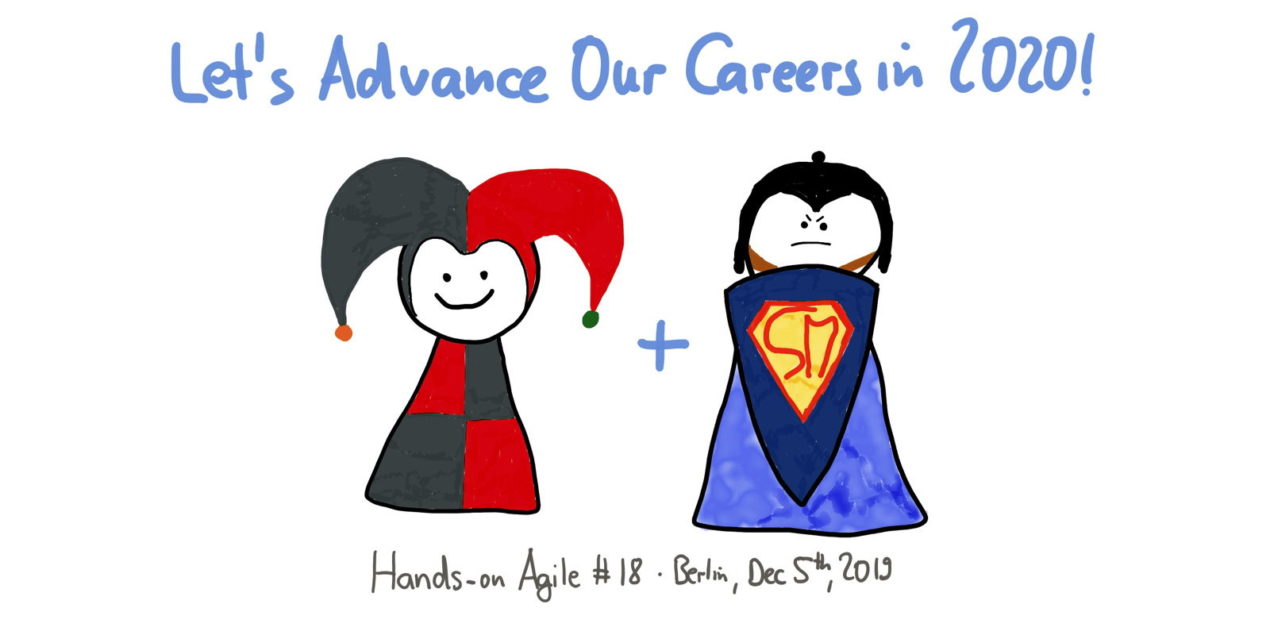
Last week, about 30 members of the Hands-on Agile community in Berlin came together to identify opportunities for personal and professional growth for the coming year, using Liberating Structures’ Ecocycle Planning in the process, to further your Scrum Master career 2020.
Read on and learn in this post what opportunities you have to advance your career as a Scrum Master or agile coach in the next year.
TL; DR: Flow Thinking, Trust Building, North Star Playbook, Prediction & Planning — Food for Agile Thought #221
Food for Agile Thought’s issue #221—shared with 24,513 peers—addresses the evolution of flow thinking; we delve into visualizing of forecasts, OKR, and non-static roadmaps, and we learn how to build professional trust in the workspace.
We also appreciate a new guide on north star metrics; we face our industry’s dismal track record regarding dealing with uncertainty, and we agree on that product strategies shouldn’t be executed blindly, but inspected and adapted like all the rest.
Lastly, we thank Allan Holub for voicing the obvious: when teamwork becomes the new standard, HR techniques from the Roaring Twenties need to be ditched.
TL; DR: Taylorism & Agile, Kick-Start Self-Organization — Food for Agile Thought #220
Food for Agile Thought’s issue #220—shared with 24,421 peers—asks whether Taylorism is probably less of a villain than often believed; we get back to the agile-industrial complex, and we appreciate a simple introduction on how to kick-start self-organization.
We then learn more about value propositions in niche markets; we can compare our activities as product managers with the results of a recent study, and we listen to a discussion on six critical ingredients for a great product strategy.
Lastly, we consider a heretic thought: might the benefit of team longevity be overrated?