Food for Agile Thought #532: Cognitive Debt, Product Team Accountability, AI Opportunity Solution Tree, Toyota’s Andon Cord

TL; DR: Cognitive Debt — Food for Agile Thought #532

Welcome to the 532nd edition of the Food for Agile Thought newsletter, shared with 35,728 peers. This week, Margaret-Anne Storey warns that AI-augmented development creates “cognitive debt” as teams lose shared understanding of their own software. Janna Bastow proposes that product teams need clearer accountability for business outcomes, not more empowerment, and Teresa Torres introduces an AI-powered tool turning interview recordings into draft Opportunity Solution Trees. Ethan Mollick breaks down three layers you need to grasp when using AI. Also, Lenny Rachitsky talks to Boris Cherny about building Claude Code at Anthropic, while Sebastian Siemiatkowski explains how Klarna flipped its AI strategy to turn human customer service into a premium experience.

Next, Ondrej Machart shares 13 Claude Code projects that transformed his product manager role and the mindset shifts that made them possible. John Cutler uses three juggling metaphors to help teams diagnose whether their strategy reflects deliberate choice or undisciplined prioritization. At the same time, Zvi Mowshowitz breaks down Dario Amodei’s latest podcast on AI timelines and adoption barriers. Aakash Gupta reviews Claude Cowork’s expanding capabilities, and Lorin Hochstein explores why Drucker’s OKR approach outlasted Deming’s systems thinking in U.S. management.

Then, Naval Ravikant explains how AI turns English into a programming language, flooding markets with apps and raising the bar beyond average. Sasha Rogelberg reports that a study of 6,000 executives found nearly 90% see no AI impact on productivity, reviving Solow’s 1987 paradox for a new era, and Elena Verna shows how Lovable boosted engagement and retention by adding credit top-ups alongside subscriptions. Tom Geraghty connects Toyota’s Andon Cord to psychological safety, while Martin Alderson shares a three-step method for generating branded reports and slides with AI coding agents.
Food for Agile Thought #532: Cognitive Debt, Product Team Accountability, AI Opportunity Solution Tree, Andon Cord - Age-of-Product.com
Continue reading Food for Agile Thought #532: Cognitive Debt, Product Team Accountability, AI Opportunity Solution Tree, Toyota’s Andon Cord

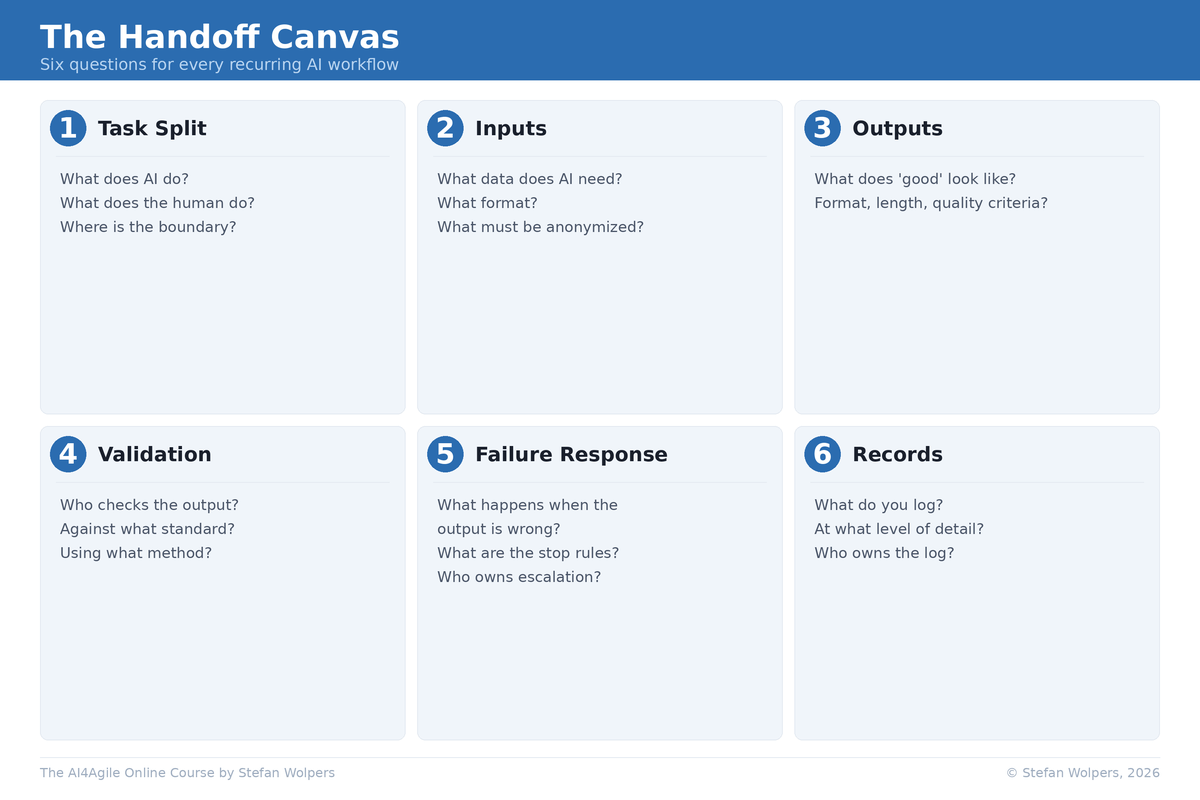
The A3 Handoff Canvas: Six Questions That Turn AI Delegation Into a Repeatable Workflow

TL;DR: The A3 Handoff Canvas

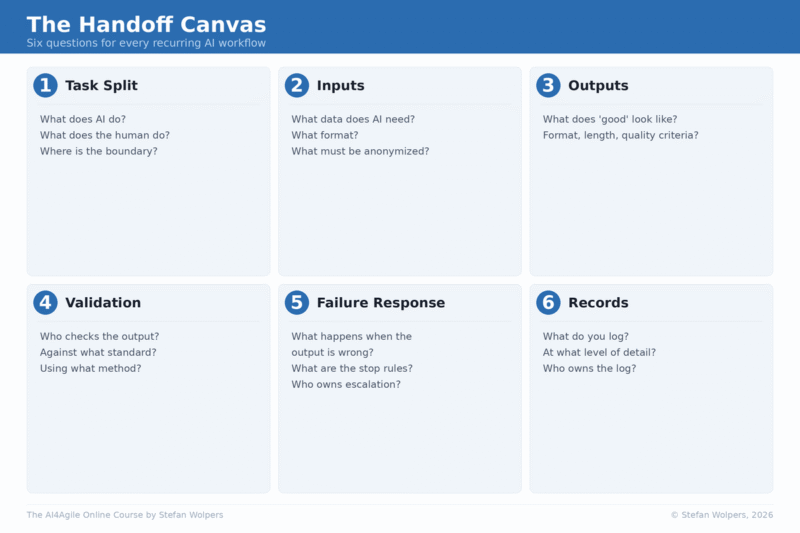
The A3 Framework helps you decide whether AI should touch a task (Assist, Automate, Avoid). The A3 Handoff Canvas covers what teams often skip: how to run the handoff without losing quality or accountability. It is a six-part workflow contract for recurring AI use: task splitting, inputs, outputs, validation, failure response, and record-keeping. If you cannot write one part down, that is where errors and excuses will enter.

The Handoff Canvas closes a gap in a useful pattern: from an unstructured prompt to applying the A3 framework to document decisions with the A3 Handoff Canvas, to creating transferable Skills, potentially leading to building agents.

The A3 Handoff Canvas: Six Questions That Turn AI Delegation with the A3 Framework Into a Repeatable Workflow — Age-of-Product.com
Continue reading The A3 Handoff Canvas: Six Questions That Turn AI Delegation Into a Repeatable Workflow

Food for Agile Thought #531: AI Intensifies Work, Perils of Shipping Fast, Tragedy of Planning, Agile Manifesto at 25

TL; DR: AI Intensifies Work — Food for Agile Thought #531

Welcome to the 531st edition of the Food for Agile Thought newsletter, shared with 35,736 peers. This week, Aruna Ranganathan and Xingqi Maggie Ye found that AI intensifies work rather than reduces it, and Siddhant Khare describes how they paradoxically increase engineer exhaustion. Cleo Lant explores how product velocity overwhelms user adoption capacity, while Maarten Dalmijn argues that PUSH planning systems fail for complex work. Teresa Torres explains context rot in AI models, while Paweł Huryn shares architectural lessons from building Agent One as a secure alternative to OpenClaw.

Next, Jim Highsmith reflects on Agile’s 25 years, noting it won by reshaping delivery but lost by hardening into a set of ceremonies. David Pereira interviews John Cutler on product operating models and messy transformations, and Aakash Gupta and Caitlin Sullivan demonstrate AI discovery workflows that compress 10+ hours into 30 minutes. Also, Grant Harvey argues that AI collapsed execution, making taste and judgment critical. Azeem Azhar and Nathan Warren conclude that AI faces a capacity stampede as compute demand outpaces infrastructure.

Then, Reddit user morsofer describes how a new board dismantled 10 years of Agile transformation in 6 months. Michael Lopp examines three bad but successful managers and why adapting your approach matters. Additionally, Jenny Wanger explores how AI’s variable response latency fragments attention and breaks flow, and Andi Roberts shares mechanics for creating living team charters through observable behaviors. Finally, the DORA AI Capabilities Model identifies seven capabilities that amplify AI benefits.

Food for Agile Thought #531: AI Intensifies Work, Perils of Shipping Fast, Tragedy of Planning, Agile Manifesto at 25 - Age-of-Product.com
Continue reading Food for Agile Thought #531: AI Intensifies Work, Perils of Shipping Fast, Tragedy of Planning, Agile Manifesto at 25

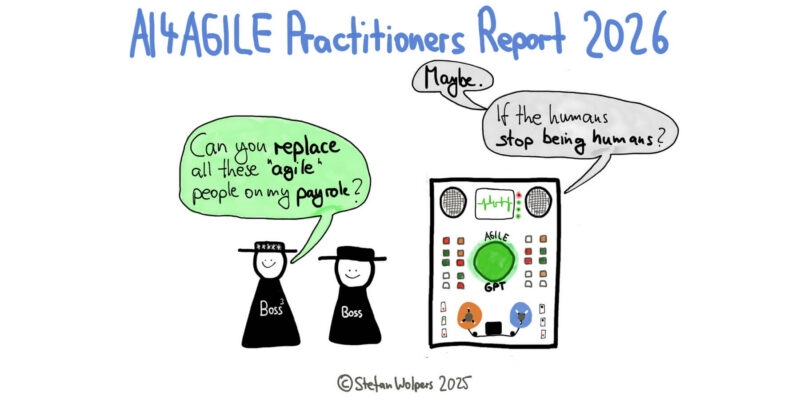
The AI4Agile Practitioners Report 2026 — Out Now!

TL;DR: The AI4Agile Practitioners Report 2026

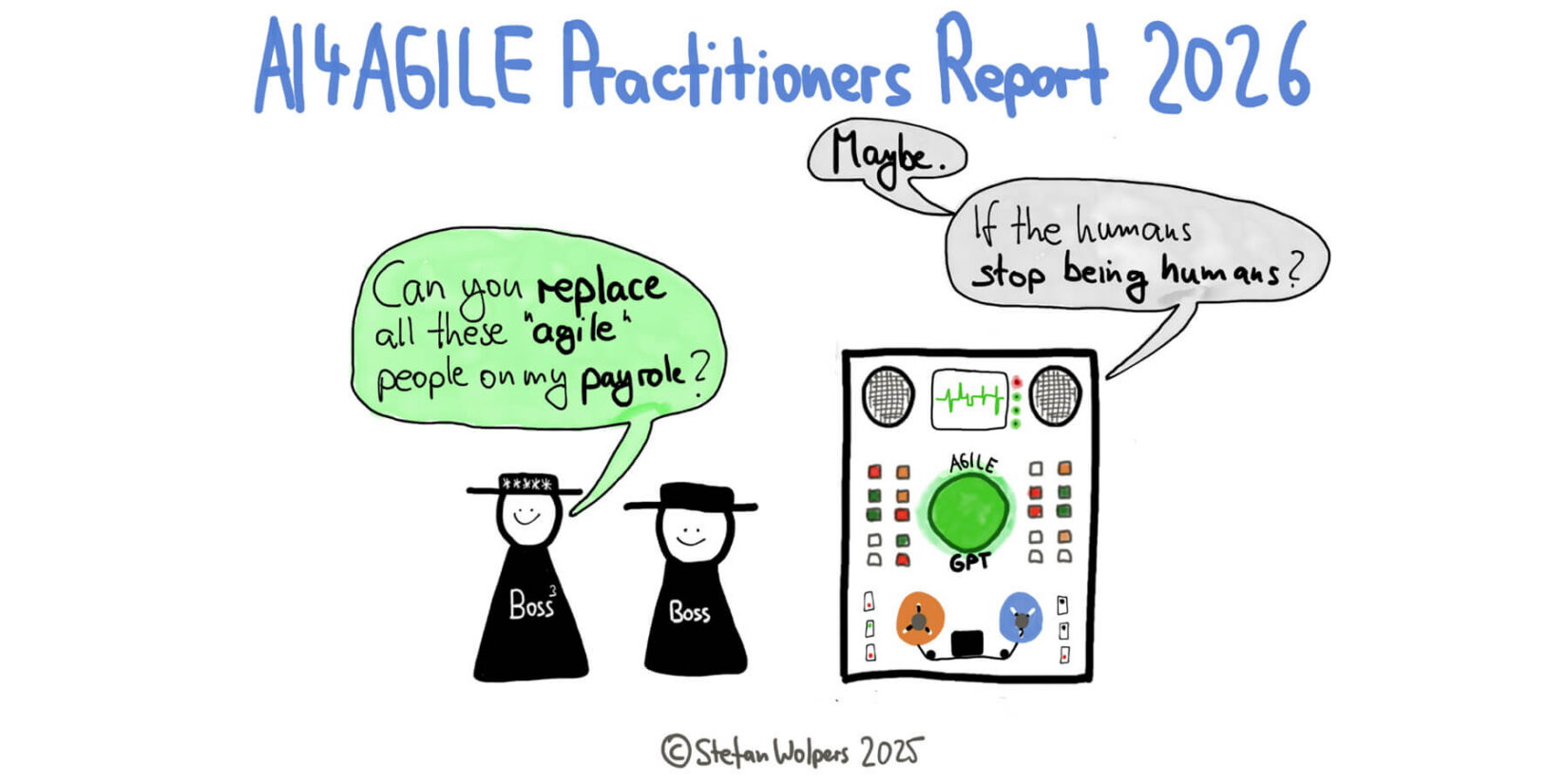
83% of Agile practitioners use AI, but most spend 10% or less of their time with it because they do not know where it fits. Our survey of 289 Agile practitioners identifies the real adoption barriers and shows where AI creates value you can act on. Learn more by downloading the free AI4Agile Practitioners Report 2026.

AI4Agile Practitioners Report 2026 — Learn how You Compare to Your Peers’ Application of AI — Age-of-Product.com
Continue reading The AI4Agile Practitioners Report 2026 — Out Now!

Food for Agile Thought #530: Orbital Data Centers? POM Success Factors, Status Rules Everything, Hiring Groupthink

TL; DR: Orbital Data Centers? — Food for Agile Thought #530

Welcome to the 530th edition of the Food for Agile Thought newsletter, shared with 35,729 peers. This week, Dwarkesh Patel and John Collison press Elon Musk on orbital data centers, power limits, space solar for cheaper AI within three years, while Itamar Gilad urges experiments without hype, since discovery, constraints, maintenance, and outcomes still rule. Roman Pichler outlines a product operating model with long-lived products and empowered teams. Also, Deb Liu shares charts on adoption, costs, and uneven gains, and Tom Geraghty ties status to busyness rather than impact.

Next, Stephanie Leue shows how a “clear” strategy still burns teams out when priorities multiply, and she urges explicit trade-offs, surfaced hidden work, and ranked outcomes with visible de-scoping. Aakash Gupta describes Mike Bal’s AI native PM system using Cursor or Claude Desktop, MCP tools, and vetted research, and Arvind Narayanan challenges Moravec’s Paradox and calls for a diffusion-minded policy. Additionally, Benedict Brady automates AI-generated feedback into PRs, and Teresa Torres and Petra Wille reframe hiring as discovery.

Then, Scott Alexander reports on Moltbook’s first weekend, asking whether AI posts cause real effects, then maps influencers, spam, crypto manipulation, micro religions, builders, and fragile self-moderation. Greg Satell debunks change myths and urges committed minorities plus resistance planning, while Maarten Dalmijn warns that post-failure rules kill competence and trust. Also, Jayshree Seth and Amy C. Edmondson frame AI adoption as team learning with reviews and overrides. Lastly, Victor Yocco refocuses UX on trust, consent, and accountability.

Food for Agile Thought #530: Orbital Data Centers? POM Success Factors, Status Rules Everything, Hiring Groupthink - Age-of-Product.com
Continue reading Food for Agile Thought #530: Orbital Data Centers? POM Success Factors, Status Rules Everything, Hiring Groupthink

AI Transformation Anti-Patterns (And How to Diagnose Them)

TL;DR: AI Transformation Anti-Patterns

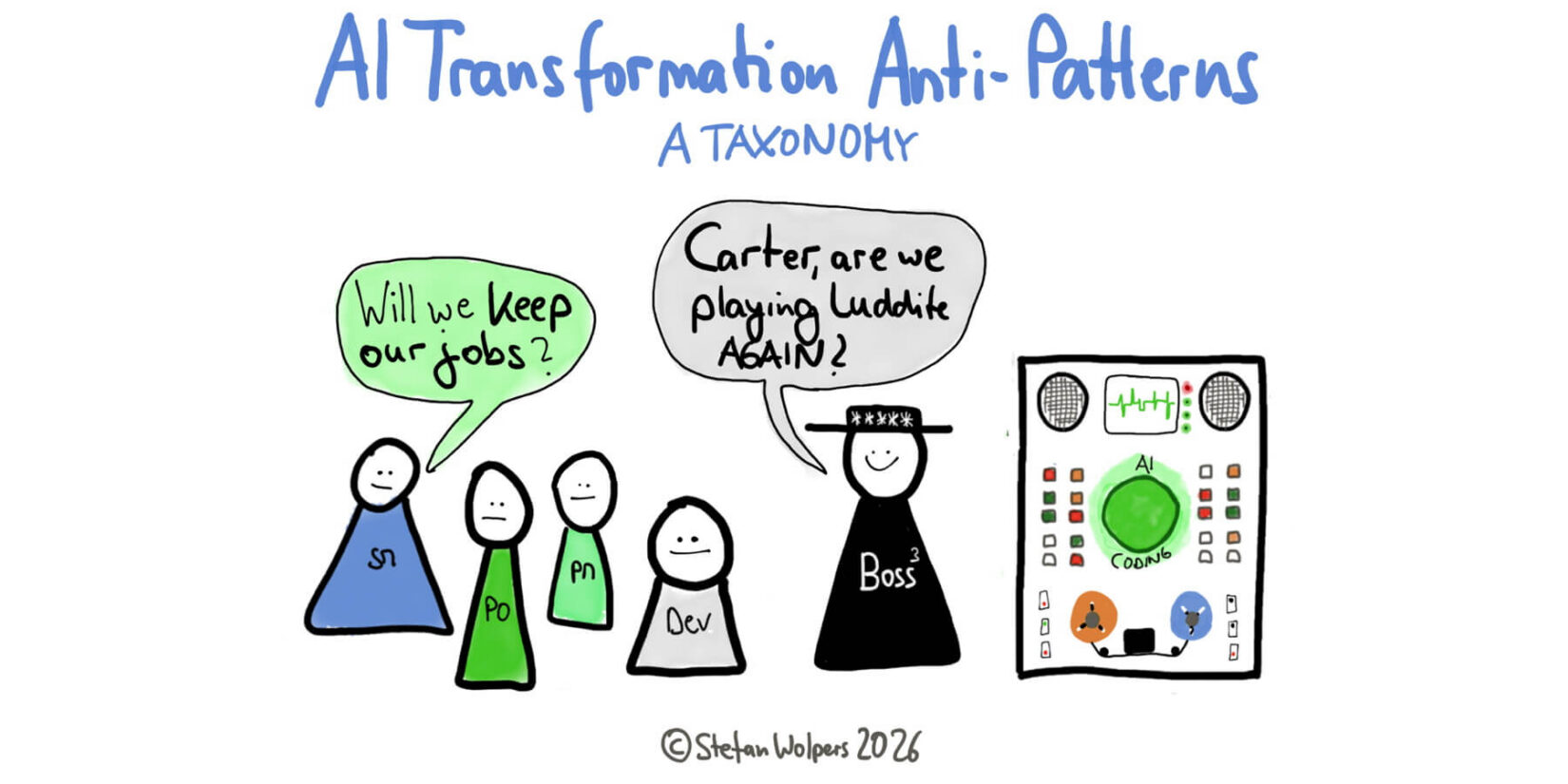
AI initiatives fail for the same reasons Agile transformations did: The majority of failures result from people, culture, and processes, not technology. This article gives you a diagnostic checklist of 10 AI transformation anti-patterns to spot where your organization’s initiatives are coming off track.

AI Transformation Anti-Patterns And How to Diagnose Them Before They Derail Your AI Initiative — Age-of-Product.com
Continue reading AI Transformation Anti-Patterns (And How to Diagnose Them)