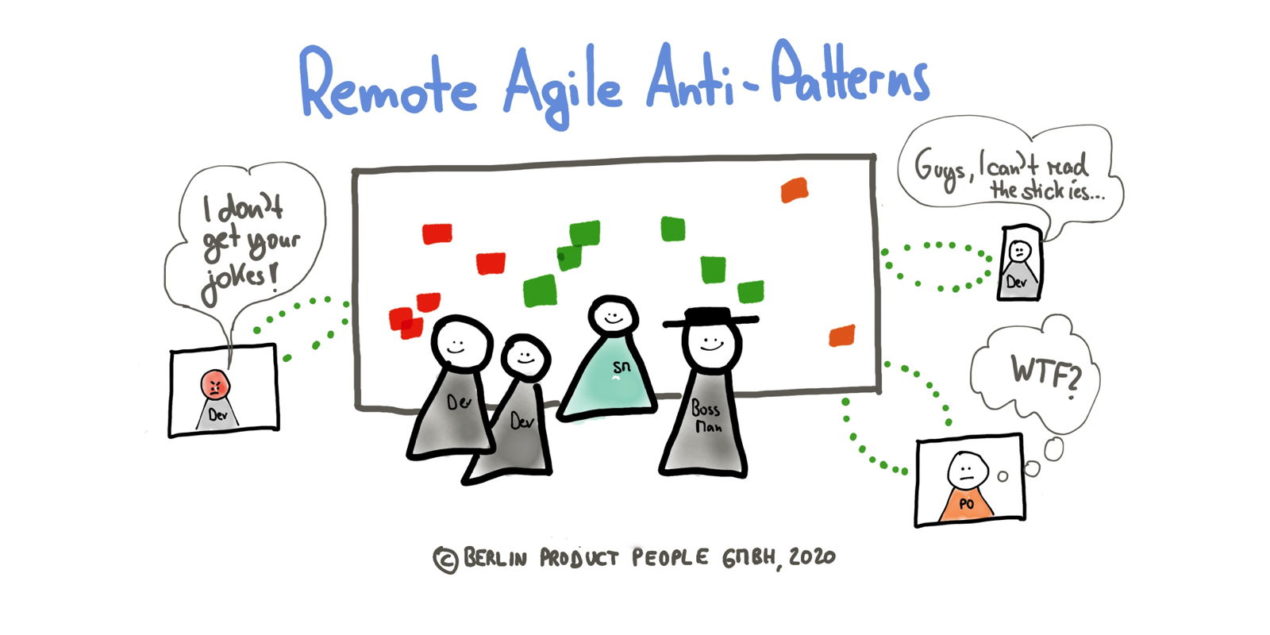
We started this series on remote agile with looking into practices and tools, followed by delving into virtual Liberating Structures, and how to master Zoom. This fourth article now addresses basic remote agile anti-patterns — the pitfalls any distributed team wants to avoid to become successful.
Watch the Replay of the Remote Agile Practices & Tools Live Virtual Class
At the end of March, we ran a Remote Agile Practices & Tools class with about 30 participants from all over Europe, the Eastern Seaboard, and Canada. The participants agreed on recording it and make it available to the agile community. We edited the recording slightly; for example, we removed the waiting time during the exercise timeboxes. Otherwise, the video accurately reflects how one way of collaborating with a distributed team using Zoom breakout rooms may work.
In this third post of the Remote Agile series, we address the tool at the heart of working with a distributed team as a Scrum Master, Agile Coach, or Product Owner: Zoom. While Zoom is an excellent video conference application—particularly for larger groups of twelve or more attendees—by all standards, its killer feature is breakout rooms. Turning a more or less passive audience into engaged collaborators where everyone is included and has a voice makes the difference between a successful facilitator and someone who fails to adapt to a new situation. Let’s have a look at what mastering Zoom is all about.
Last week, we addressed basic practices and tools of remote agile with distributed teams. Based on that article, I also ran a live virtual class, the recording of which will be made available soon on the Age-of-Product’s Youtube channel. This follow-up post now delves into virtual Liberating Structures, answering the question of how we can make use of the powerful toolbox of inclusive and collaborative practices in a remote setting.
TL; DR: Remote Agile, Part 1: Practices & Tools for Scrum Masters, Agile Coaches, and Product Owners
Agile has always been about colocation, about direct communication, physical boards, and all the other haptic and analog moments to create value in the digital realm. As a Professional Scrum Trainer, I strive to provide training classes without using PowerPoint or digital devices. Moreover, admittedly, I love index cards. However, times are changing. So, let’s dive into the particularities of practicing remote Agile with distributed teams.
We start with basic techniques and tools and follow up with how to apply Liberating Structures in the remote realm. If you like to get a hands-on introduction, consider joining my webinar/live virtual class next Thursday.
![Remote Agile: Practices and Tools [Video] — Age-of-Product.com](https://age-of-product.com/wp-content/uploads/Remote-Agile-Practices-Video-scaled.jpg)