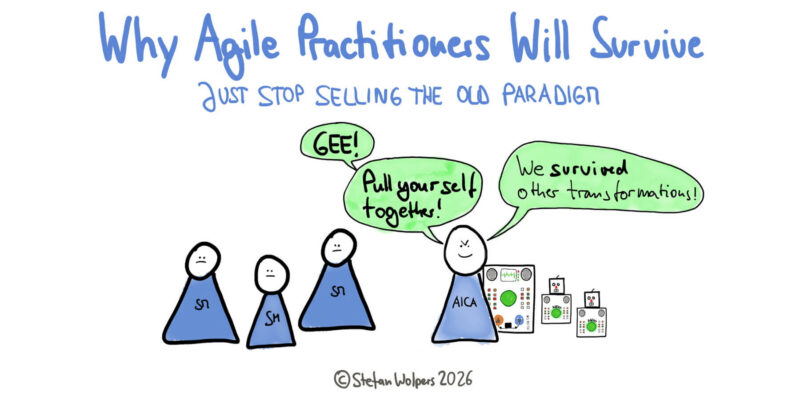
TL; DR: The Survival of Agile Practitioners
It is February 2026, and your LinkedIn feed oscillates between two narratives:
- Narrative #1: AI will replace agile practitioners such as Scrum Masters, Agile Coaches, and everyone whose job description includes “facilitate” or “coach.”
- Narrative #2: Stay calm, get another certification, and wait it out.
Both are wrong, and for the same reason: They treat AI adoption as a technology event when it is an organizational transformation. And you have already survived one of those.
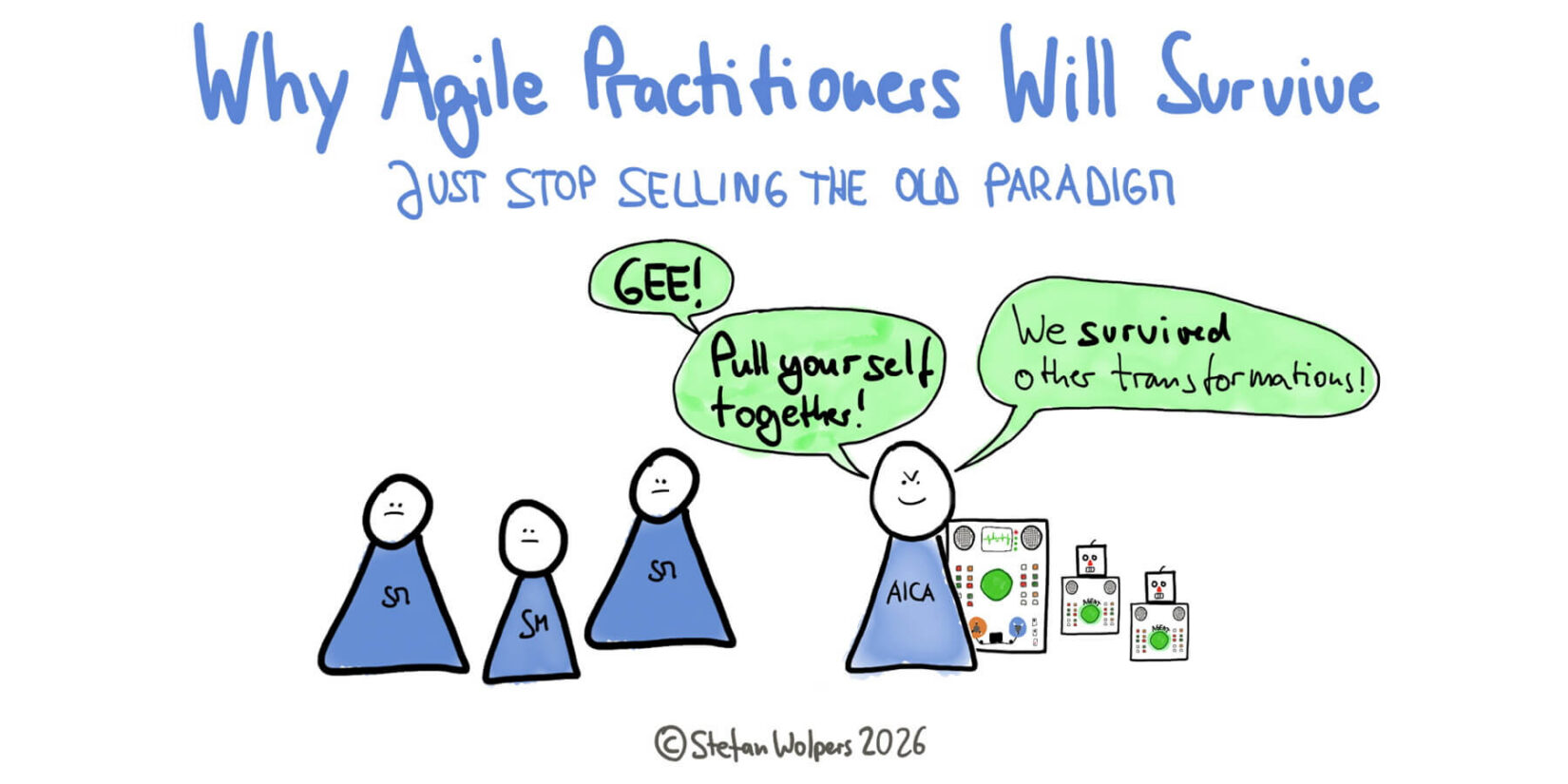
🎓 🇬🇧 🤖 The AI 4 Agile Online Course v2 at $149 — March 2, 2026
I developed the self-paced AI 4 Agile Online Course for agile practitioners, including Product Owners, Product Managers, Scrum Masters, Agile Coaches, and delivery professionals who want to integrate artificial intelligence into their workflows with clarity, ethics, and purpose.
You don’t need to become an AI expert. However, you do need to understand how LLMs like ChatGPT, Claude, or Gemini can support real agile work and where their limitations lie. As Jim Highsmith said, AI isn’t just a tool, but a new context for agility. This course shows you how to do that precisely .
The latest Version 2 will be released on March 2 and comes with an introductory price of $149 instead of $249—don’t miss this opportunity to save $100!
👉 Don’t like to wait until March 2? Go shopping Version 1 now at $199. (The upgrade to version 2 is included.)
Join 400-plus Peers — What Is Included:
- 10+ hours of self-paced video modules: Hacks, Skills, Agents
- A cohort-hardened, proven course design
- Learn to 10x your effectiveness with AI; your stakeholders will be grateful
- Delve into classic agile use cases of AI
- Help your team create more customer value
- All texts, slides, prompts, graphics; you name it
- Access custom GPTs, including the “Scrum Anti-Patterns Guide GTP”
- Enjoy community access for peer learning
- Guaranteed: Lifetime access to all course updates and materials; there is a lot more to come
- The AI4Agile Foundation Certificate.

👉 Please note: The course will only be available for sign-up at $149 until March 9, 2026! 👈
🎓 Join the Waitlist of the AI 4 Agile Online Course v2 Now: Master AI Integration for Agile Practitioners—No AI Expertise Required!
🗞 Shall I notify you about articles like this one? Awesome! You can sign up here for the ‘Food for Agile Thought’ newsletter and join 35,000-plus subscribers.
The Pattern Agile Practitioners Have Already Mapped
I have written extensively about how AI transformations fail for the same reasons Agile transformations did: Organizations perform change instead of actually changing. They buy tools before identifying problems. They celebrate pilots that cannot scale. They measure adoption dashboards while business outcomes remain flat. (See "AI Transformation Déjà Vu" and the "AI Transformation Anti-Patterns" diagnostic.)
But there is a second pattern hiding inside this observation, and it is the one that should make you optimistic: the organizations that succeed at AI adoption are the ones that already have agile delivery capability.
McKinsey's State of AI 2025 report, which surveyed nearly 2,000 organizations across 105 countries, found that 88% of organizations now use AI in at least one business function. That number looks threatening until you read what follows: Only about one-third have begun scaling AI across the enterprise. Nearly two-thirds remain stuck in experimentation. And the factor most strongly correlated with actually capturing value from AI? "Having an agile product delivery organization, or an enterprise-wide agile organization with well-defined delivery processes." [1]
The single strongest predictor was agile delivery capability, ahead of GPU count, data science headcount, and AI budget.
This Is Not a Tool Problem, But a Paradigm Problem.
Most organizations treat AI the way they treated Agile 15 years ago: as a new set of tools to bolt onto existing processes. License ChatGPT. Add an "AI" column to the project portfolio. Run a pilot. Declare victory.
I cataloged 166 distinct AI transformation anti-patterns, grouped into 16 categories. When you sort them by root cause, the distribution is familiar: roughly 65% are organizational failures (governance, roles, process, culture), 22% are technical, and 14% are contextual. The technology works; the organization does not.
This pattern should sound familiar because it is exactly what happened with Agile. Organizations bought Jira and called it a transformation. They renamed project managers to Scrum Masters and kept the same command-and-control structure. They measured velocity while customers saw no change in value delivery. The word "Agile" became corporate wallpaper while the underlying operating model stayed intact.
AI adoption is repeating this pattern on an accelerated timeline. But there is a critical difference: AI is not a process improvement. It is a paradigm shift.
When I say "paradigm shift," I do not mean the buzzword version. Every transformation is about people; that has always been true and is not a shift. The shift is in what the work itself becomes. Agile changed how teams organize work: Who decides what to build, in what sequence, with what feedback loops. AI changes which tasks require a human brain at all. When an LLM can draft acceptance criteria, generate Retrospective analyses, and produce stakeholder reports, the cognitive labor between humans and machines gets redistributed. That did not happen with Scrum. An organization that "adds AI" to its existing processes is like an organization that "added Scrum events" to its waterfall structure. It captures none of the benefits and adds overhead. You have watched that movie.
Becoming AI-native does not mean licensing ChatGPT for 10,000 employees. It means answering a question that Agile never had to ask: Which work stays human, which work moves to machines, and how do you redesign roles, decisions, and quality standards around that new division? McKinsey's high performers, the roughly 6% of organizations seeing real EBIT impact from AI, are more than three times more likely than others to pursue transformative change rather than incremental automation. [1] They fundamentally redesign workflows rather than layering AI onto existing processes. They rethink task ownership and rebuild processes around what AI can and cannot do.
A data science team cannot do that kind of redesign alone. It requires people who understand how organizations actually work, not how the org chart says they work.
Cannot see the form? Please click here.
Why Agile Practitioners Are Better Positioned Than You Think
Let me name some unpopular things, starting with the Agile community itself.
Too many Agile practitioners defined their value by the framework they practiced rather than the problems they solved. If your professional identity is "I run Daily Scrums and maintain the Sprint Backlog," then yes, AI is a threat. Those tasks will be automated, some already are.
But if your actual skill set, the one you built through years of messy, frustrating, sometimes failed transformations, includes the following, then the market for your work is expanding, not shrinking:
Navigating organizational resistance to change: Every AI initiative hits the same wall that every Agile transformation hit: People fear displacement, middle management protects existing power structures, and leadership says it wants change while rewarding the status quo. In my AI Transformation Anti-Patterns taxonomy, the "Ignored Fear" pattern, in which employees fear job displacement and leadership fails to name it, is rated as fatal. It kills the initiative. Agile practitioners have been working this exact dynamic for a decade. Not always successfully. But you have the scar tissue, and scar tissue is expertise.
Bridging the translation gap: One of the most common AI failure patterns is what I call "Missing Translator": rarely does someone connect data scientists to business stakeholders. Technical teams build what they think is useful. Business teams find it difficult to articulate their needs. Both sides point at each other. If you have ever sat between a developer and a business person who spoke different languages about the same product, you have done this translation work before. The domain is different. The skill is identical.
Running experiments under uncertainty: The Scrum principle of empiricism, transparency, inspection, and adaptation, is exactly what organizations need to move from AI pilot to AI at scale. The difference between a pilot graveyard (another fatal anti-pattern) and a scaling success is whether the organization knows how to inspect results, adapt its approach, and make decisions based on evidence rather than executive enthusiasm. You have been practicing this for years, even when the organization made it difficult.
Sensing what the org chart does not show: Simon Powers' concept of organizational "fields," the emotional tone, power dynamics, shared assumptions, and unwritten rules that shape behavior, is something experienced Agile practitioners sense intuitively. After all, culture is what happens when you are not looking. I rated "Field Blindness" as a fatal AI transformation anti-pattern. Leaders who cannot read the invisible system end up designing interventions that collapse the moment they meet the actual organization. You already know how to read a room and sense when a team's stated agreement hides real resistance. AI adoption needs that skill more than it needs another dashboard.
The Opportunity for Agile Practitioners Is Structural, Not Motivational
I am not offering optimism as a feeling. I am offering it as a market analysis.
Deloitte's 2026 AI report found that worker access to AI rose by 50% in 2025, and the AI skills gap is now seen as the biggest barrier to integration. [2] The gap is not primarily technical: Organizations have the technology; however, they cannot change how people work with it.
McKinsey's data tells the same story from a different angle: The intentional redesign of workflows "has one of the strongest contributions to achieving meaningful business impact" of all factors tested. [1] High performers are nearly three times as likely as other organizations to have fundamentally redesigned their workflows. [1] The companies seeing limited value are the ones that bolted AI onto existing processes and measured cost savings while leaving the actual work untouched.
The organizations that are failing at AI are failing because they lack the organizational change capability. That is a market signal, not a motivational poster.
Conclusion: To Survive as Agile Practitioners, Stop Selling the Old Paradigm
However, the opportunity sketched above is only available to agile practitioners who stop defining themselves by the frameworks they practice and start defining themselves by the organizational problems they solve.
If you walk into an AI transformation conversation and lead with "I am a Certified Scrum Master," you will be politely shown the door. If you walk in and say, "I have spent 10 years helping organizations redesign how they work when the old way stops producing results. Here is what I have learned about why change initiatives fail and what the successful ones have in common," you will have their attention.
The Agile community spent 20 years building expertise in organizational change, empirical process control, cross-functional collaboration, and iterative delivery. The demand for that expertise is higher now than at any point in the last decade, precisely because the organizations adopting AI need it and do not know where to find it.
They are looking for "AI transformation leads" and "change management consultants." They should be looking for experienced agile practitioners who understand that transformation is not about the technology. It never was.
In next week's article, I will get specific: what this means for your career this quarter, what experiments you should run now, and what I have learned from rebuilding my own practice around this shift.
References:
[1] McKinsey & Company: "The state of AI in 2025: Agents, innovation, and transformation," November 2025.
[2] Deloitte Consulting: "The State of AI in the Enterprise," January 2026.
📖 The Survival of Agile Practitioners — Related Posts
The AI4Agile Practitioners Report 2026
Ralph Wiggum Ships Code While You Sleep. Agile Asks: Should It?
Assist, Automate, Avoid: How Agile Practitioners Stay Irreplaceable with the A3 Framework
Agile Is Dead, Long Live Agility
The Reformation That Became the Church
The Immunity Response: How Organizations Neutralize Change

👆 Stefan Wolpers: The Scrum Anti-Patterns Guide (Amazon advertisement.)
📅 Scrum Training Classes, Workshops, and Events
Learn more about the Survival of Agile Practitioners with our AI and Scrum training classes, workshops, and events. You can secure your seat directly by following the corresponding link in the table below:
| Date | Class and Language | City | Price |
|---|---|---|---|
| 🖥 💯 🇬🇧 March 10-11, 2026 | GUARANTEED: Professional Scrum Master—Advanced Training (PSM II; English; Live Virtual Class) | Live Virtual Class | €1299 incl. 19% VAT |
| 🖥 💯 🇬🇧 March 19-April 16,2026 | GUARANTEED: AI4Agile BootCamp #6 — March 19-April 16,2026 (English; Live Virtual Cohort) | Live Virtual Cohort | €499 incl. 19% VAT |
| 🖥 🇩🇪 March 24-25, 2026 | Professional Scrum Product Owner Training (PSPO I; German; Live Virtual Class) | Live Virtual Class | €1.299 incl. 19% VAT |
| 🖥 🇩🇪 April 22-23, 2026 | Professional Scrum Product Owner – AI Essentials Training (PSPO AIE; German; Live Virtual Class) | Live Virtual Class | €799 incl. 19% VAT |
| 🖥 🇩🇪 May 19-20, 2026 | Professional Scrum Product Owner Training (PSPO I; German; Live Virtual Class) | Live Virtual Class | €1.299 incl. 19% VAT |
See all upcoming classes here.

You can book your seat for the training directly by following the corresponding links to the ticket shop. If your organization's procurement process requires a different purchasing approach, please contact Berlin Product People GmbH directly.
✋ Do Not Miss Out and Learn More about the Survival of Agile Practitioners — Join the 20,000-plus Strong ‘Hands-on Agile’ Slack Community
I invite you to join the “Hands-on Agile” Slack Community and enjoy the benefits of a fast-growing, vibrant community of agile practitioners from around the world.

If you would like to join all you have to do now is provide your credentials via this Google form, and I will sign you up. By the way, it’s free.