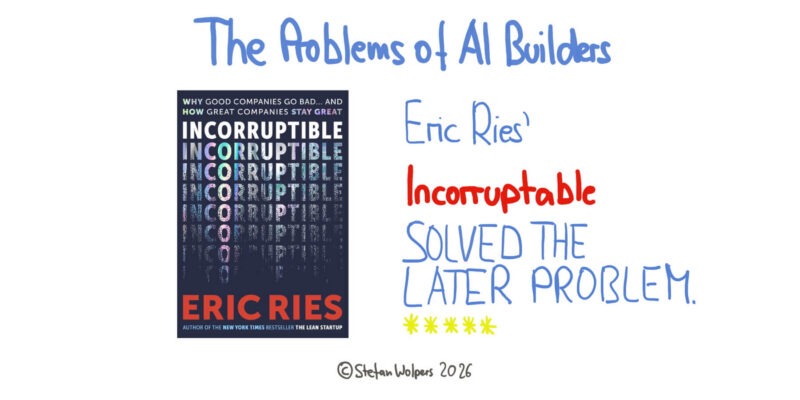
TL; DR: The Problem of AI Builders
Eric Ries’ new book ‘Incorruptible’ solves a problem most readers will not face for years: protecting a valuable organization from capture once it succeeds. The builders that AI is creating hit an earlier issue: Building software used to force the question of whether it was worth building. That gate has largely collapsed. Eric Ries asks how mission survives success; we, the normals, how judgment survives abundance.
Thesis: Ries’s Incorruptible solves a later problem, protecting a valuable organization from capture; cheap building created an earlier one, where judgment about what is worth building is the only gate left. That is the problem this article addresses.
🎓 🇬🇧 The Claude Cowork Online Course — Available June 8-15 for $129
You have been prompting AI for months. The results are inconsistent, every conversation starts from zero, and the model forgets who you are. That is the ceiling of prompting.
The Claude Cowork Online Course teaches you to break through it: build Skills that encode your expertise, connect them to your tools, and assemble Agents who handle recurring work the way you would handle it yourself. No coding required.
What You Will Get:
✅ 8+ hours of self-paced video modules: Skills, Agents, delegation frameworks — ✅ Tested with a live BootCamp cohort (April 2026) — ✅ The A3 Framework: decide what to delegate and what to keep — ✅ Starter kit with folder structure, CLAUDE.md, and Skill templates — ✅ All texts, slides, prompts, graphics; you name it — ✅ Designed for the $20/month Pro plan — ✅ Lifetime access to the version you purchase — ✅ Claude Cowork Foundational Certificate.

👉 Please note: The course will be available for $129 from June 8 to 15, 2026! (After that, $199.) 👈
🎓 Join the Waitlist of the Course Now: Claude Cowork: Stop Prompting. Start Delegating. No Coding Required!
🇩🇪 Zur deutschsprachigen Version des Artikels: Eric Ries hat das spätere Problem gelöst. KI-Gründer haben ein früheres..
🗞 Shall I notify you about articles like this one? Awesome! You can sign up here for the ‘Food for Agile Thought’ newsletter and join 35,000-plus subscribers.
🎓 Join Stefan in one of his upcoming training classes!
The AI-Enabled Paradigm Shift We Are Observing
Let me share a story: A friend of mine recently spent three weeks building a SaaS product with Claude Code. He cannot write software. The product works, and he has paying customers. He still cannot tell me whether it is worth building on, and he has stopped asking, because nothing in his process forces the question anymore.
That question used to come with a built-in moment. It lived in the part where you had to convince an engineer to write the code, or pay someone to do it, or learn enough yourself to know what you were committing to. The cost of building was a gate. The gate was annoying, and it was doing quiet work at the same time: before you started, it made you decide whether the thing was worth the money and the months.
For my friend, that gate is gone. He is not worse off for it, as he has joined the AI builders segment of society. He now has a real business. The problem is the one he cannot see. He never had to develop the judgment the gate used to stand in for, and now nothing stands in for it at all.
Ries Invites Everyone. His Prescriptions Assume an Owner
I read Eric Ries’ new book, Incorruptible (Amazon Affiliate link at no cost to you. Thank you for your support!). The book is very good, but it is about a different problem than my friend’s.
Incorruptible (Authors Equity in the US, Penguin in the UK, 2026) is, to me, Ries’ most serious book since The Lean Startup. His argument: successful, mission-driven companies get captured. Ries calls the force “financial gravity,” the pull of shareholder primacy, short-term investors, governance fashions, and an economy that rewards extraction over endurance.
His prescription comes in two parts:
- First, in his words, “create something worth protecting.”
- Second, build the structures that protect it: supervoting shares without sunset clauses, boards with explicit dual loyalty, perpetual purpose trusts, and at the far end a “spiritual holding company” (yes, that is the actual term) that holds mission authority over the operating business.
His case studies are companies that did this: Patagonia, Novo Nordisk, Bosch, Carlsberg, IKEA, Anthropic, and Costco. He cites research that foundation-structured companies are six times more likely to reach age fifty than conventional ones, 60 percent against 10 percent.
The invitation is more generous than the summary suggests. Ries says you can begin building something incorruptible before you hold any formal power, and he writes for people choosing where to work and where to spend their money, not only for founders. He is not addressing a narrow elite.
The prescriptions are narrower than the invitation. Every tool Ries hands you assumes you own, or will one day own, a piece of an organization with other people in it: Charters, boards, trusts, voting structures, and holding companies. They answer one question: how do I keep a valuable organization from being taken from me?
Now, let us put the two problems side by side. Ries is writing about how mission survives success. AI is now creating builders who have to answer a different question first: how does judgment survive abundance?
Cannot see the form? Please click here.
A Cottage Industry Needs None of His Protections Yet
My friend is not the kind of owner Ries pictures, and many of the people drawn to this book will not be either.
AI is creating a new population of builders who may never own that kind of organization. A person who could not write a line of code can now run a real software product. A two-person shop can serve a few thousand customers. A family can build a profitable software business that supports several livelihoods without becoming a venture-backed company. None of this is a consolation prize. A cottage industry of small, profitable, durable firms is a good outcome, and probably the best broadly available outcome of affordable building. The reflex is to treat these businesses as lesser, which is not the case.
They also own nothing Ries’ structures are built to protect. No hedge fund is coming to gut a family software shop doing $4 million a year. There is no IPO, no activist investor, no ownership transition where the mission goes on the table. The capture Ries spends more than four hundred pages defending against usually does not arrive at that scale, because the thing never becomes large or liquid enough to be worth capturing. You do not need a perpetual purpose trust as your first move when no one is trying to take the business from you.
The Threats Are Smaller, Closer, and Often Self-Inflicted
None of this means the business of AI builders is safe. The danger comes from a different direction.
A small software business can be destroyed without a single share changing hands. A platform changes its terms, and your distribution disappears. An app store takes its cut and rejects your update. A model provider you built on raises prices or changes its usage policy, and your margins go with it. A payment processor freezes your account. One large customer grows into most of your revenue and quietly becomes the person deciding what you build. None of these is the governance capture Ries writes about. They are dependencies: someone else controls something the business cannot live without.
The most dangerous threat does not come from outside at all. It is the offer. The venture money that is accepted to accelerate. The acquisition that promises to keep everything the same and then does not. The pivot toward the customers who pay the most and want the least of what you set out to make. These are the moments where the cottage-industry builder walks straight into Ries’ world, by choice, and his book becomes exactly relevant. The most dangerous capture is the one you invite in, because it arrives looking like success.
The Two Problems, Side by Side
Ries’s problem is a later one: Incorruptible defends a successful, valuable organization against capture by financial gravity, the pull of shareholder primacy, short-term investors, and an economy that rewards extraction over endurance. Its tools, from supervoting shares to perpetual purpose trusts, assume you already own something worth protecting.
The AI builders’ problem is an earlier one: The cost of building used to be a gate that forced the question of whether a thing was worth the money and the months. The cheap building removed the gate. Judgment about what to build now stands alone, with nothing left to force the question.
The threats look nothing alike: A cottage software business is not captured by a hedge fund. Dependencies kill it, a platform changes its terms, a model provider raises prices, or by offers that look like success: venture capital, an acquisition, a pivot toward the highest-paying customers.
His Case Studies Are the Ones That Survived
Hold the book a little more loosely still, because even that world, the one you might one day choose to enter, Ries shows you through its survivors. Patagonia, Novo Nordisk, IKEA, Costco: companies that built something worth protecting, protected it, and lasted. The trouble with a gallery of survivors is that you cannot see who is missing. For every enduring foundation-owned firm, there are principled, well-structured companies that died anyway: wrong timing, no market, a competitor with deeper pockets, a founder who guessed wrong about what customers wanted. Good governance did not save them, because governance was never their binding constraint.
Ries is not naive about this. He cites relevant research, and the 60-against-10 figure is a base-rate comparison, not a selection of winners. But the vivid chapters are persuasive and full of companies that won. A reader can close the book believing structure causes endurance, when the honest claim is narrower: structure protects endurance once you have earned it by other means; endurance comes first, structure follows. For most people who pick up this book, earning it, knowing what to build and for whom, is the whole task.
The Cottage-Industry AI Builders Need a Judgment Gate
Knowing what to build used to have an enforcer: the cost of building it. That cost did double duty. It limited what got built, and it forced a moment where someone had to decide whether a thing was worth doing. The old gate was crude and often unfair. It killed good ideas along with bad ones, protected incumbents who could afford to build, and forced people to write business plans full of fiction. (I did so for a living 20-plus years ago; my Excel-based 5-year simulations were appreciated by VCs, despite being a fantasy product.) It also created a pause, which worked in many cases, preventing a worst-case scenario from taking over. Cheap building removed the cost and took the pause with it. Most people are treating that as pure upside. They are missing the cost of the “loss.” The marginal cost of generating another plausible product has collapsed. The cost of understanding whether anyone wants it has not moved.
The failure mode is already visible. A solo builder ships a feature because the model produced it overnight, then another, then ten more, and six months later, the product is a pile of capabilities no single customer asked for, and the builder can no longer simplify. Each build cost almost nothing, so each decision felt free. The accumulated cost arrived all at once, as a product nobody understands. (Remember “cognitive debt” and “cognitive surrender” in the context of AI perils?)
I made this case for software teams in a recent piece on “Write As Little Code As Possible” Was Always the Point. AI Just Made It Urgent. It holds with more force for the solo builder, who has no Product Owner, no discovery process, and no colleague to ask who the thing is even for. If you can build anything in a weekend, the binding constraint is no longer your ability to build. It is your judgment about what is worth building, and your product sense about whether the result will change how a real person behaves. Cheap building removed everything that used to compensate for the absence of both.
So the challenge for AI builders is to rebuild the gate by hand. Before you build, decide what you will not build, who you will not sell to, and what you will refuse to optimize for, even when it costs nothing. That list is the closest AI builders get to what Ries calls structural integrity. It needs no lawyer, and it has to live in your head, because there is no board to enforce it for you.
Conclusion: The Honest Version of Where This Leaves Us
This is bigger than product work. The gate that disappeared is not only a problem for software developers. It is one piece of a wider loss of the arrangements that once told capable people what to do next.
For many knowledge workers, the old bargain offered at least the appearance of compounding: get better, earn more trust and more responsibility, and let the institution absorb some of the risk when you stumbled. That bargain is weakening, and for a growing share of people it is already gone. I cannot tell you the exact shape of what replaces it, and anyone who says they can is selling something.
My read, and I will mark it as a read rather than a fact, is that we are in a Schumpeterian round of creative destruction with an ugly asymmetry: we are dismantling the old order faster than we are building the new one. The opportunities are tangible. The cottage industry of AI builders is real; what a single capable person can now do alone is unprecedented, and it is thrilling. The destruction is also real, and it affects first the people who did everything the old order told them to do. Both are true at once, and the gap between them is where many people will live for a while.
I am writing this in the last stretch of my own career, repositioning myself again at an age when I did not plan to. I am doing it because the work is more fascinating than ever, and the alternative is worse. The cost of building has collapsed, so your judgment is the whole job now. Decide what is worth building before the absence of friction decides for you. Then join the AI builders; I will meet you there.
Key Questions This Article on Incorruptible and AI Builders Answers
What is Eric Ries’s Incorruptible about?
Incorruptible (2026) argues that successful, mission-driven companies get captured by financial pressure, what Ries calls “financial gravity,” and it prescribes structures to resist it. The two-part blueprint is to create something worth protecting, then build the protections: supervoting shares, perpetual purpose trusts, dual-loyalty boards, and at the far end a “spiritual holding company.” Case studies include Patagonia, Novo Nordisk, IKEA, and Costco.
Who is Incorruptible for, and who is it not for yet?
It is for people who own, or will one day own, a valuable organization worth protecting from capture. It is not yet for the new population of AI builders running small software businesses, because no hedge fund, IPO, or activist investor threatens a family-run product earning a few million a year. Its protections answer a problem that population may never have.
What problem do AI builders face that Incorruptible does not address?
An earlier one: judgment about what is worth building. The cost of building software used to be a gate that forced the question of whether a thing was worth the money and the months. Cheap AI building removed that gate. AI builders must now rebuild it deliberately, deciding what they will not build and who they will not sell to, before they build.
How does a small, AI-built software business actually get killed?
Rarely by the capture Ries describes. More often by dependencies: a platform changes its terms, an app store rejects an update, a model provider raises prices, or a payment processor freezes the account. Or by self-inflicted choices that look like success: venture money taken to accelerate, an acquisition that does not keep its promise, a pivot toward the customers who pay the most and want the least of what you set out to build.
What is “financial gravity” in Eric Ries’s Incorruptible?
Financial gravity is Ries’s term for the constant pull dragging a mission-driven company toward capture: shareholder primacy, short-term investors, governance fashions, and an economy that rewards extraction over endurance. Ries argues that founders resist it by first creating something worth protecting, then building legal structures, such as supervoting shares, trusts, and dual-loyalty boards, that hold the mission above day-to-day operations.
AI Builders — Related Articles
“Write As Little Code As Possible” Was Always the Point. AI Just Made It Urgent.
Ralph Wiggum Ships Code While You Sleep. Agile Asks: Should It?
The AI Spending Trap: Why Adoption Outpaces Outcomes
Assist, Automate, Avoid: How Agile Practitioners Stay Irreplaceable with the A3 Framework
Three AI Skills to Sharpen Judgment
No More Cheap Claude: Four First Principles of Token Economics in 2026
👆 Stefan Wolpers: The Scrum Anti-Patterns Guide (Amazon advertisement.)
📅 Training Classes, Workshops, and Events
Learn more about AI Builders with our AI and Scrum training classes, workshops, and events. You can secure your seat directly by following the corresponding link in the table below:
| Date | Class and Language | City | Price |
|---|---|---|---|
| 🖥 💯 🇬🇧 July 20,2026 | GUARANTEED: AI 4 Agile Course v3 — Master AI for Agile Practitioners (English; Self-paced Online Course) | Self-paced Online Course | $149 incl. 19% VAT (If applicable.) (Before and after: $249) |
| 🖥 💯 🇬🇧 July 23,2026 | GUARANTEED: HoA 76: Where Are Your Decisions to Avoid AI Debt? (English) | Meetup | FREE |
| 🖥 🇩🇪 August 25-26, 2026 | Professional Scrum Product Owner Training (PSPO I; German; Live Virtual Class) | Live Virtual Class | €999 incl. 19% VAT (If applicable.) |
| 🖥 💯 🇬🇧 August 27 to September 17,2026 | GUARANTEED: AI4Agile BootCamp #8 (English; Live Virtual Cohort) | Live Virtual Cohort | €499 incl. 19% VAT (If applicable.) |
| 🖥 💯 🇬🇧 Sep 28-29,2026 | GUARANTEED: A3 Delegation System Founding Workshop (English; Live Virtual Class) | Live Virtual Class | $199 incl. 19% VAT (If applicable.) |
| 🖥 🇩🇪 Sep 30 to Oct 1, 2026 | Professional Scrum Product Owner Training (PSPO I; German; Live Virtual Class) | Live Virtual Class | €999 incl. 19% VAT (If applicable.) |
See all upcoming classes here.

You can book your seat for the training directly by following the corresponding links to the ticket shop. If your organization’s procurement process requires a different purchasing approach, please contact Berlin Product People GmbH directly.
✋ Do Not Miss Out and Learn More about AI Builders — Join the 20,000-plus Strong ‘Hands-on Agile’ Slack Community
I invite you to join the “Hands-on Agile” Slack Community and enjoy the benefits of a fast-growing, vibrant community of agile practitioners from around the world.

If you would like to join all you have to do now is provide your credentials via this Google form, and I will sign you up. By the way, it’s free.