How to Sabotage A Product Owner — 53 Anti-Patterns from the Trenches

TL; DR: How to Sabotage A Product Owner — 53 Anti-Patterns from the Trenches to Avoid

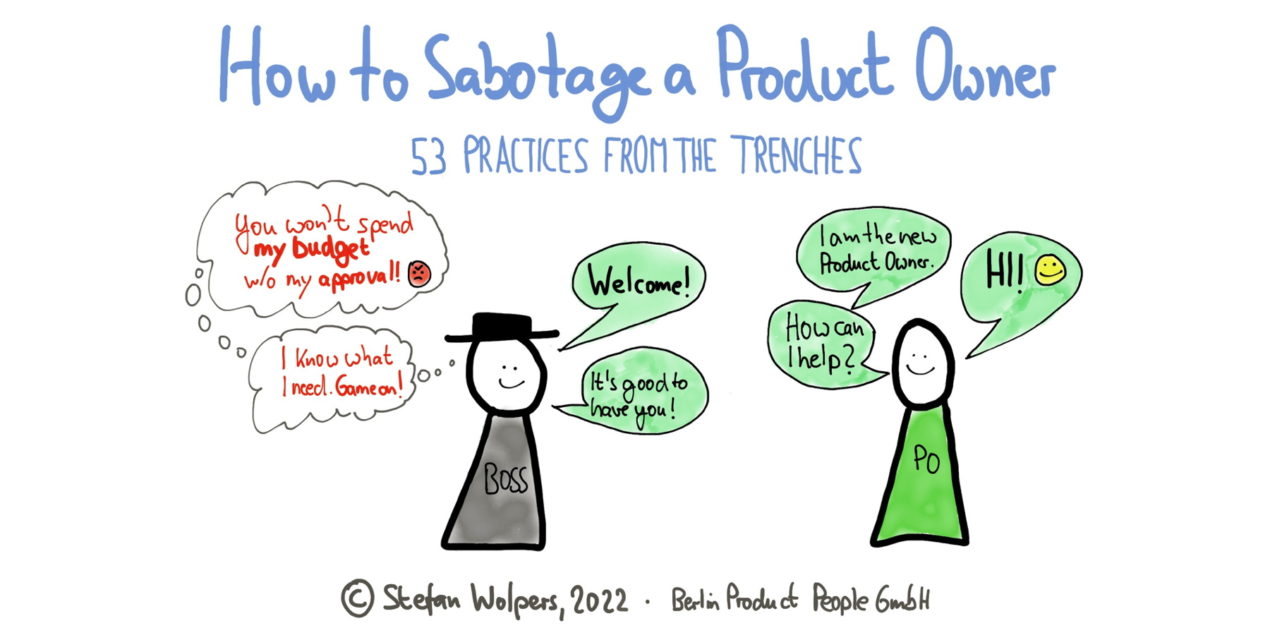
One of my favorite exercises from my Professional Scrum Product Owner classes is how to best sabotage a Product Owner as a member of the middle management. The exercise rules are simple: You’re not allowed to use any form of illegal activity. So, outsourcing the task to a bunch of outlaws is out of the question. Instead, you are only allowed to use practices that are culturally acceptable within your organization.

Read on and learn more on how to best sabotage a Product Owner from the exercise results of more than twenty PSPO classes. (I edited the suggestions for better readability.)

How to Sabotage A Product Owner — 53 Anti-Patterns from the Trenches — Age-of-Product.com
Continue reading How to Sabotage A Product Owner — 53 Anti-Patterns from the Trenches

Food for Agile Thought #330: Making Room for New Things, web3 Product Management, Talking to Engineers, Survival Roadmapping

TL; DR: Making Room, web3 Product Management — Food for Agile Thought #330

Welcome to the 330th edition of the Food for Agile Thought newsletter, shared with 34,562 peers. This week, we point out the importance of saying no to make room for tackling high-value adhoc/new activities. Also, we delve into how to change the way you respond to challenges by embracing a whole ‘body yes.’ We then explore the origins of low-quality code and what you can do to avoid accruing technical debt as a consequence, and we shed light on the problem of unwarranted confidence because a heuristic has served you well forever. (Until it doesn’t.)

We then share an epic guide on what web3 is, its pros and cons, and how web3 may become an opportunity for your product career. Also, we have eleven tips on improving communication with your engineers, from including them early to respecting their BS detector, and we learn how to switch into survival mode as a product mensch when your company is about to go belly-up.

Lastly, we revisit “real OKRs,” try to regain control over your calendar, freeing up time for critical issues, and ask: Is a Scrum certificate a sound investment for your career?

Food for Agile Thought #330: Making Room for New Things, web3 Product Management, Talking to Engineers, Survival Roadmapping— Age-of-Product.com
Continue reading Food for Agile Thought #330: Making Room for New Things, web3 Product Management, Talking to Engineers, Survival Roadmapping

Scrum Certification: Is It a Sound Investment for Your Career?

TL; DR: Is a Scrum Certification a Sound Investment Advice?

Do you need a Scrum certification to become good at what you do? Not really. It took me nine years after I started working in this industry to get my first certificate.

What are the benefits then of having a Scrum certification? Well, becoming certified by a recognized Scrum certification organization such as Scrum.org is sound investment advice, as documented by the Scrum Master Salary Report 2022: There is a statistical correlation between your remuneration and the certificates you hold.

Also, prospective clients and employers use, for example, PSM and CSM as search terms on LinkedIn. Scrum certificates are hence an affordable way of signaling competence and dedication. However, be smart about where to become certified and avoid investing in Scrum certificates that have no brand recognition.

Scrum Certification: Is It a Sound Investment for Your Career? Age-of-Product.com
Continue reading Scrum Certification: Is It a Sound Investment for Your Career?

Food for Agile Thought #329: #NoCoaching, Opportunity Assessment, Supporting Team Decisions, What Is Good Monthly Churn?

TL; DR: #NoCoaching — Food for Agile Thought #329

Welcome to the 329th edition of the Food for Agile Thought newsletter, shared with 34,503 peers. This week, we address #NoCoaching, pointing at situations and probable consequences when your work as a coach is rejected. We also elaborate on the benefits of having a capable Scrum Master at your side and what you can do as a product mensch if there is none, and we point out critical knowledge to become agile: maximizing the amount of work not done is essential.

We then provide a pragmatic, hands-on approach to deciding which ideas are worth further attention, and we delve into the effects of rushing to work before clarifying your team’s vision and mission. Moreover, we share Tendayi Viki’s take on how to move from being a corporate pirate—restrained by red tape—to a valued explorer, appreciated by the organization.

Lastly, we point at numbers for healthy (vs. deathly) churn for B2C and B2B companies serving various markets. Also, we explain why the habit of under-promising and over-delivering regarding OKRs is an anti-pattern, not a qualification, and we share an epic guide on how to ace remote work and why improving your writing skills is essential.

Food for Agile Thought #329: #NoCoaching, Opportunity Assessment, Supporting Team Decisions, What Is Good Monthly Churn? Age-of-Product.com
Continue reading Food for Agile Thought #329: #NoCoaching, Opportunity Assessment, Supporting Team Decisions, What Is Good Monthly Churn?

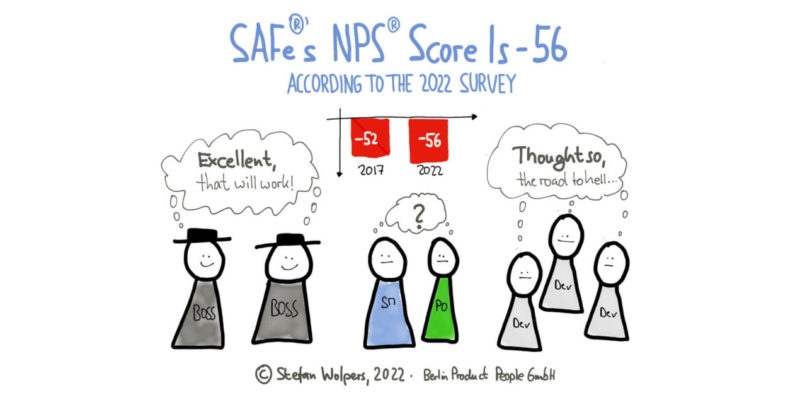
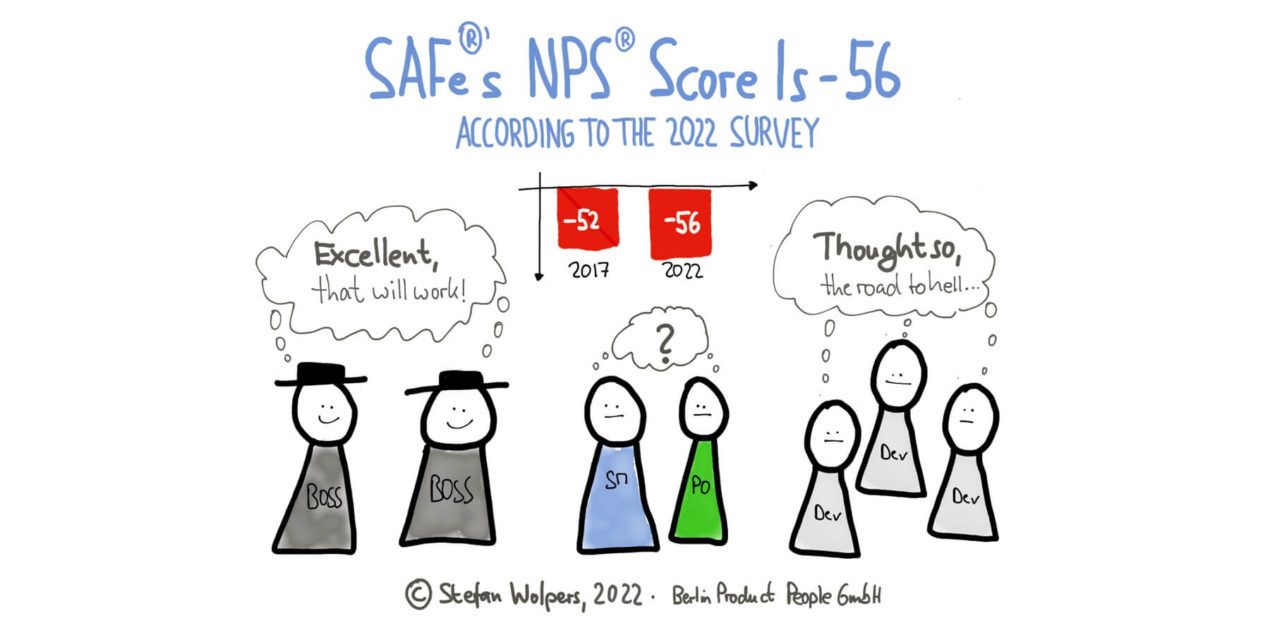
SAFe ®’s NPS ® Score as a Scaling Framework Is -56 According to 505 Survey Participants

TL; DR: The SAFe ® NPS ® Score as a Scaling Framework Is -56

SAFe® has always been a controversial topic within the agile community. Therefore, back in 2017, I ran a first survey on the Net Promoter Score® of the Scaled Agile Framework SAFe®. The result back then was -52. Four and a half years later, I reran the poll: SAFe® has been through several iterations, and many more agile practitioners have experienced working with it. However, the question still is: Would you recommend SAFe ®?

Executive Summary: SAFe®’s NPS® score based on the 2022 sample equals -56. (For details, see the data below.)

SAFe ®’s NPS ® Score as a Scaling Framework Is -56 According to 505 Survey Participants — Age-of-Product.com
Continue reading SAFe ®’s NPS ® Score as a Scaling Framework Is -56 According to 505 Survey Participants

Food for Agile Thought #328: KPI Trees, The Product-Led Process, Scaling Agility in Real-Life, Experimenting w/ Netflix

TL; DR: KPI Trees, Scaling Agility in Real-Life — Food for Agile Thought #328

Welcome to the 328th edition of the Food for Agile Thought newsletter, shared with 34,452 peers. This week, we advocate a simple tool to ‘help you foster alignment, transparency, and focus in your product organization:’ The KPI tree. Also, we share six real-life examples of extraordinary organizations and their path to business agility, from Vanguard to Bosch to Paypal, and we point at a simple lesson: You may likely accrue more technical debt first before efforts to reduce it bear fruit.

We then consider an idea about the ‘right’ way to build products by steepening the learning curve while helping customers reap benefits earlier. Next, Board of Innovation summarizes how it invalidated 100-plus business ideas last year, pointing at the importance of identifying weak spots early. Moreover, we enjoy a detailed history of Netflix, pointing at all the experiments it took to lift them to today’s level, and we reflect on probable anti-patterns when organizations start aligning humanity and the development process utilizing a seemingly intuitive practice.

Lastly, we learn from Dave West how his job as CEO unintentionally seems to affect his role as a stakeholder. Also, Shane Hastie interviews Patricia Kong of Scrum.org on how collecting empirical evidence supports decision-making in complex environments and how EBM supports that approach.

Food for Agile Thought #328: KPI Trees, The Product-Led Process, Scaling Agility in Real-Life, Experimenting w/ Netflix — Age-of-Product.com
Continue reading Food for Agile Thought #328: KPI Trees, The Product-Led Process, Scaling Agility in Real-Life, Experimenting w/ Netflix