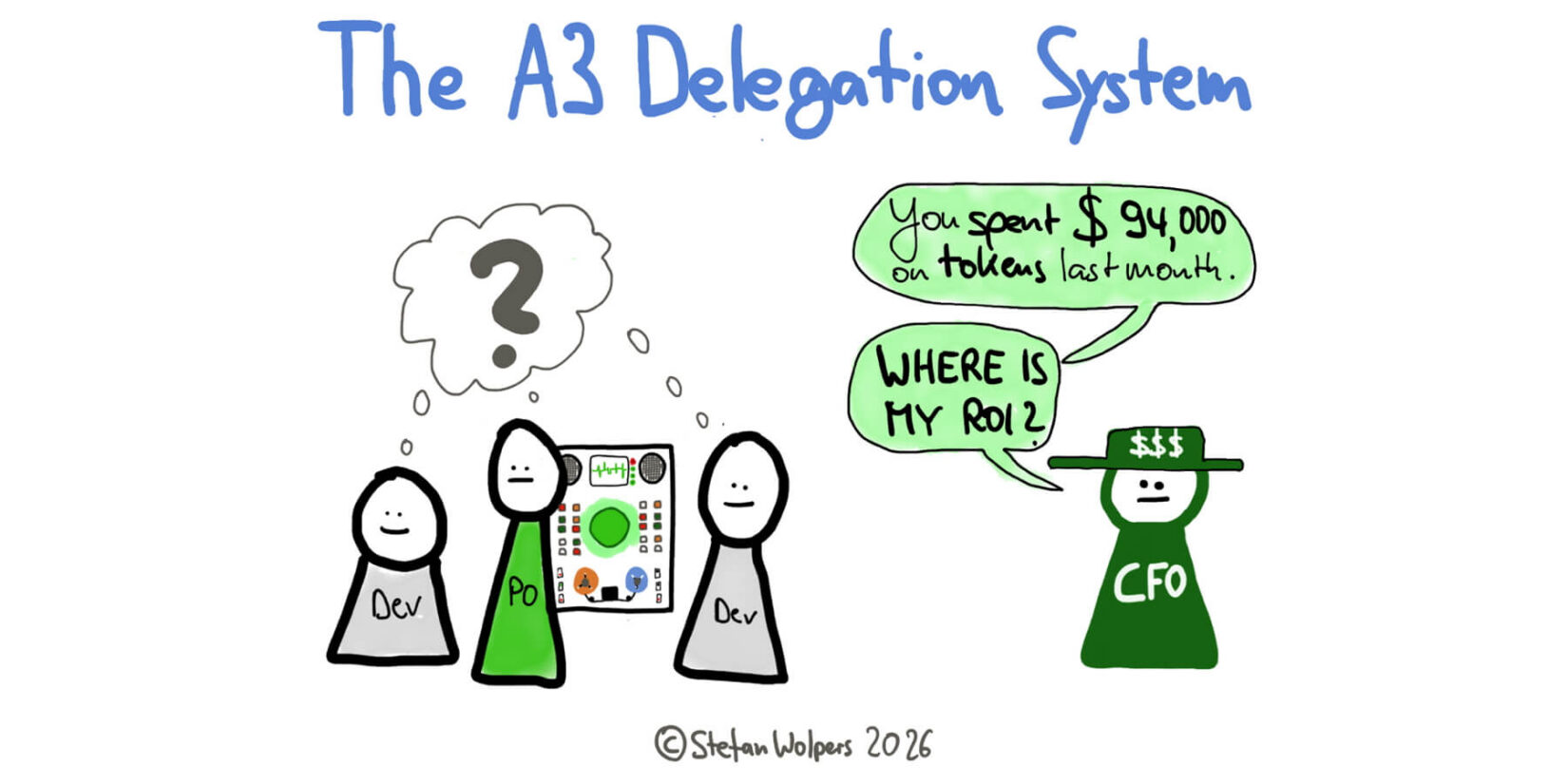
How the A3 Delegation System Helps to Avoid AI Debt Borrowing from Agile Artifacts

TL; DR: Reusing Agile Artifacts to Avoid Accumulating AI Debt

In this video from the 76th Hands-on Agile Meetup, I walk you through the A3 Delegation System and show how it helps avoid AI debt by borrowing artifacts and practices from Agile, such as the Definition of Done and Retrospectives. If you’d like to download the corresponding canvases (the artifacts of the A3 Delegation System), you can do so below.

You will get a full set of PDFs, along with the guide to the A3 Delegation System, so that you can run the system with your own teams. Enjoy the video and let me know whether you consider the A3 Delegation System useful.

How the A3 Delegation System Helps to Avoid AI Debt Borrowing from Agile Artifact - Age-of-Product.com

📺 Watch the video now: How the A3 Delegation System Helps to Avoid AI Debt — Hands-on Agile Meetup 76.

Continue reading How the A3 Delegation System Helps to Avoid AI Debt Borrowing from Agile Artifacts

Food for Agile Thought 554: Toyota Production System, Pressure-Testing Product Ideas, Nokia’s Demise, Drowning in Work?

TL; DR: Toyota Production System — Food for Agile Thought #554

Welcome to the 554th edition of the Food for Agile Thought newsletter, shared with 35,428 peers. This week, Nigel Thurlow presents the Toyota Production System (TPS) as a disciplined whole, a lesson Pavel Samsonov and Ash Maurya extend to product work: faster AI delivery only magnifies incoherence without workflow thinking, customer evidence, and validation. Zvi Mowshowitz shows the darker side of unchecked AI optimization, while Steve Newman questions its societal impact to date. Barry O’Reilly ties these concerns to leadership, urging redesign of workflows, judgment, decision rights, and accountability before scale amplifies weak systems. (Again, history rhymes; remember “Agile?”)

Next, Leah Tharin reframes activation as the full path from first touch to lasting habit, a view that challenges vanity metrics. Also, Michele Zanini and Gary Hamel question inflated AI claims, and Zanna Iscenko and Scott Strand add evidence of broad but shallow adoption. Chris Chinchilla’s Nokia history warns of what happens when execution lags behind change, and Johanna Rothman brings the remedy to focus: visualize work, expose delays, finish one thing, and reject the rest.

Lastly, Ant Murphy separates strategic leverage from strategy labels, while Steven Sinofsky argues that restricting AI model distillation would entrench incumbents, when more competition should be the goal. David Burkus turns to management, showing how leaders can shield teams from chaos without hiding uncertainty. Addy Osmani warns that AI-automated code creates comprehension debt, and John Cutler connects the themes: AI succeeds only when teams understand the work, retain human judgment, and trust leaders not to weaponize productivity gains.
Continue reading Food for Agile Thought 554: Toyota Production System, Pressure-Testing Product Ideas, Nokia’s Demise, Drowning in Work?

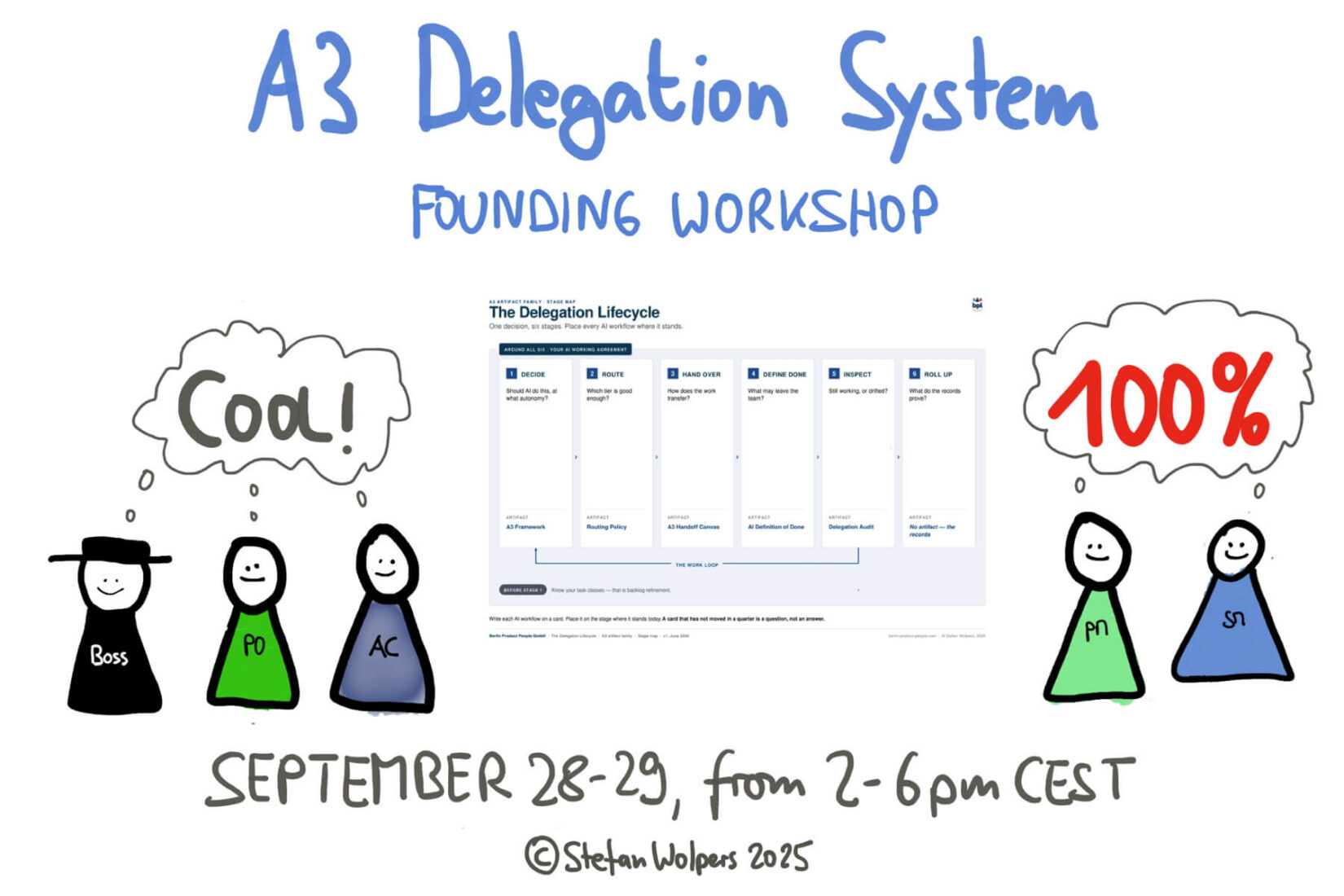
A3 Delegation System Founding Workshop — September 28-29, 2026

Turn An AI Workflow Into an Explicit Delegation

Your team already delegates work to AI: reports, research, customer feedback analysis, stakeholder communication, or parts of operational workflows.

But can you answer these questions without improvising?

  • What may AI decide, and what must remain a human decision?
  • What does “good enough” mean for this particular work?
  • Who verifies the result before somebody acts on it?
  • Who checks whether the delegation still works after the model or workflow changes?

If those answers live in one person’s head, or nowhere, your problem is no longer prompting. You have a delegation problem.

The A3 Delegation System gives you a practical way to decide what AI may do, hand over the work clearly, define acceptable results, and inspect the delegation over time.

During two hands-on sessions, you will apply the system to a workflow. You will leave with a clear understanding of how to apply the A3 Delegation System to your workflows so that team members or stakeholders can understand, challenge, and continue your AI delegation work. Everything you learn is directly applicable to your situation the next day. The class is in English.

A3 Delegation System Founding Workshop — September 28-29, 2026 — by Stefan Wolpers Berlin-Product-People.com
Continue reading A3 Delegation System Founding Workshop — September 28-29, 2026

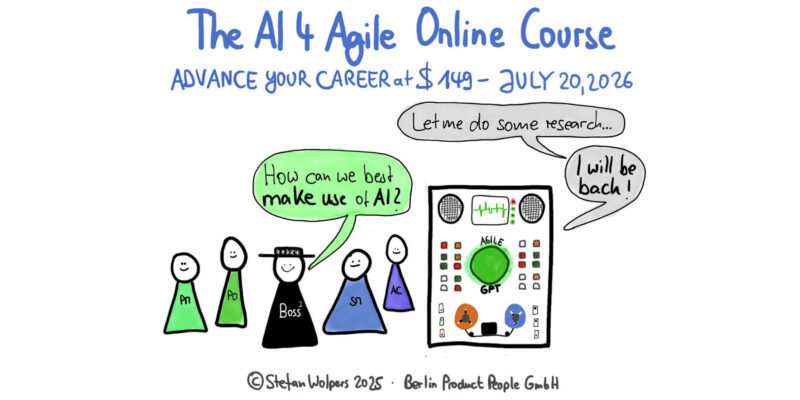
From Prompting to Operating Capability: The AI4Agile Online Course Release v3

TL; DR: AI4Agile v3 Is Live

You learned to prompt, and your organization learned to spend. Unfortunately, few organizations have learned to connect the two. That is where the AI4Agile online course comes in.

An AI operating capability exists when delegated work can be reproduced without its original creator, meets an explicit quality standard, follows a defensible execution path, has a named owner, and is inspected often enough to detect drift. The AI4Agile Online Course V3 teaches practitioners how to build one, independent of a particular AI model, and still, there is no coding required. The course is in English. 🇬🇧

📺 Watch me walk you through the AI4Agile online course, pointing to the new modules.

AI4Agile Course v3: Master AI for Agile Practitioners — Berlin-Product-People.com

👉 AI4Agile V3 launches today, July 20, 2026, at the introductory price of $149, including a 14-Day Money Back Guarantee. (On July 28, it will be $249.)

Continue reading From Prompting to Operating Capability: The AI4Agile Online Course Release v3

Food for Agile Thought 553: Dangerous Agile Myths, Produce Evidence Quality, Running Experiments, Playing Politics?

TL; DR: Dangerous Agile Myths — Food for Agile Thought #553

Welcome to the 553rd edition of the Food for Agile Thought newsletter, shared with 35,462 peers. This week, Henrik Mårtensson dismantles seven dangerous Agile myths, showing that fat-tailed cycle-time data invalidates the use of story points. Teresa Torres and Petra Wille question whether support tickets can replace story-based interviews, while Roman Pichler pushes visions beyond feature lists toward purpose. Turning to AI, Laura Summers finds LLM-assisted coding replaces building satisfaction with supervision fatigue, Benedict Evans sees foundation models becoming commodities, and Satya Nadella urges firms to own their learning loops before providers capture proprietary knowledge.

Next, John Cutler reframes software assets through a portfolio lens, asking whether AI makes you faster or moves you faster in the wrong direction. George Sivulka and Arvind Narayanan both place the bottleneck in management, not model capability. On the human side, Sean Goedecke redefines engineering politics as knowing who holds power and making contributions visible, while Steven Sinofsky compares Chicago Law School’s AI ban to Harvard’s 1982 computer ban, arguing such restrictions never last.

Lastly, Pavel Samsonov argues that product empathy rings hollow without respect, a gap LLMs deepen by pushing error correction onto users. Thomas Squeo and Matt Kamelman trace enterprise AI failure to missing governance, not weak models. Susan MacKenty Brady, Stuart Kliman, and Leslie Smith name four leadership traps quietly eroding trust. Finally, Dave Rooney rethinks story slicing when AI handles large tasks, and Tristan Kromer notes AI accelerates experiments but cannot pick the right question.

Food for Agile Thought 553: Dangerous Agile Myths, Produce Evidence Quality, Running Experiments, Playing Politics? Age-of-Product.com
Continue reading Food for Agile Thought 553: Dangerous Agile Myths, Produce Evidence Quality, Running Experiments, Playing Politics?

You Already Have an AI Working Agreement. Write It Down.

TL;DR: The AI Working Agreement

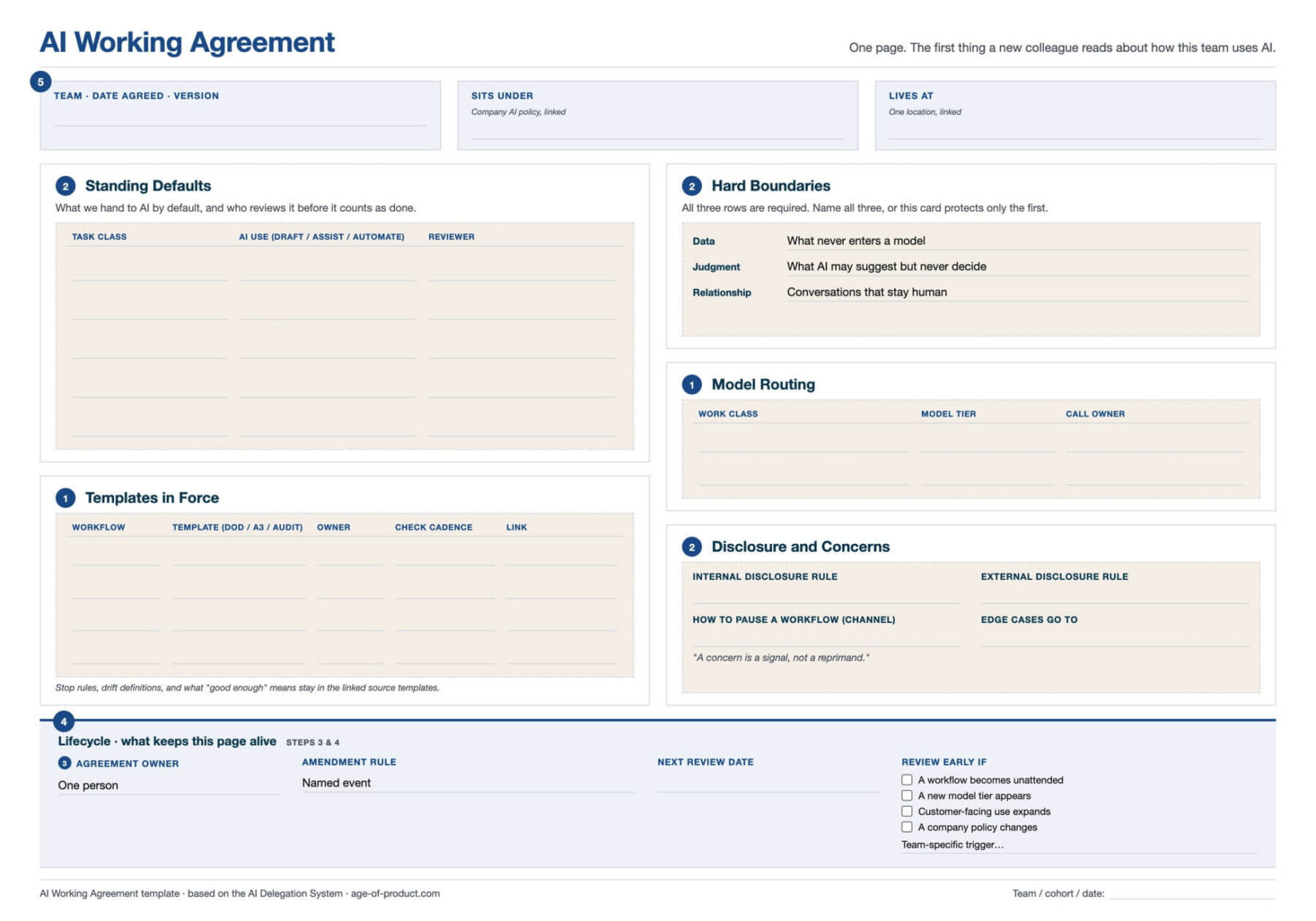
Your team already has rules for using AI. Some live in templates, some in habits, exceptions, and one person’s memory. The AI Working Agreement puts the decisions that matter in one place: what the team delegates to AI, what stays human, what must be reviewed, what never enters a model, who owns which workflow, and how the agreement changes. Write it, and a new colleague can read your team’s AI decisions on their first day, while the decisions stay when someone leaves.

You Already Have an AI Working Agreement. Write It Down to Turn Scattered AI Decisions into an Inspectable Artifact - Age-of-Product.com

Thesis: Team-level AI governance fails more from uncodified judgment than from missing policies. The AI Working Agreement turns scattered AI decisions into one inspectable artifact, so a team can onboard people, survive departures, and challenge its own habits before those habits harden into risk.

Continue reading You Already Have an AI Working Agreement. Write It Down.