Food for Agile Thought’s issue #134—shared with 15,621 peers—focuses on agile failure patterns in organizations, at the leadership and the operational level.
We also learn new tricks how to deal with unexpected work during a sprint, which might come handy when agile coaching by virtual reality techniques finally overcomes the Manifesto’s face-to-face mantra. Supposedly, that will happen in a few years time.
Lastly, we revisit the fate of Yahoo where having the best and brightest at the right place at the right time did not prevent Yahoo’s decline and—ultimately—demise.
Food for Agile Thought’s issue #133—shared with 15,436 peers—explains why agile Taylorism — or introducing ‘agile’ by a command and control — is a futile approach. We also learn that competing and collaborating do not have to be mutually exclusive while becoming a learning organization.
We get a better understanding how continuous product discovery works in practice, how to avoid triggering your customers’ resistance to (product) changes, and why Geoffrey Moore might have been wrong.
Lastly, we enjoy the opportunity to learn more about becoming agile in distributed teams—with a free ebook courtesy of InfoQ.
Food for Agile Thought’s issue #132—shared with 15,184 peers—covers the latest version of the Agile Fluency ™ Model. Moreover, we learn why we are particularly bad at planning projects of all kind, and how visualizing with LEGO® may add to your organization’s bottom line.
We also find out how to deal with brilliant jerks and other difficult people as well as picking your battles in general.
Lastly, we appreciate a lesson on how to deal with legacy organizations that embrace innovation mostly verbally.
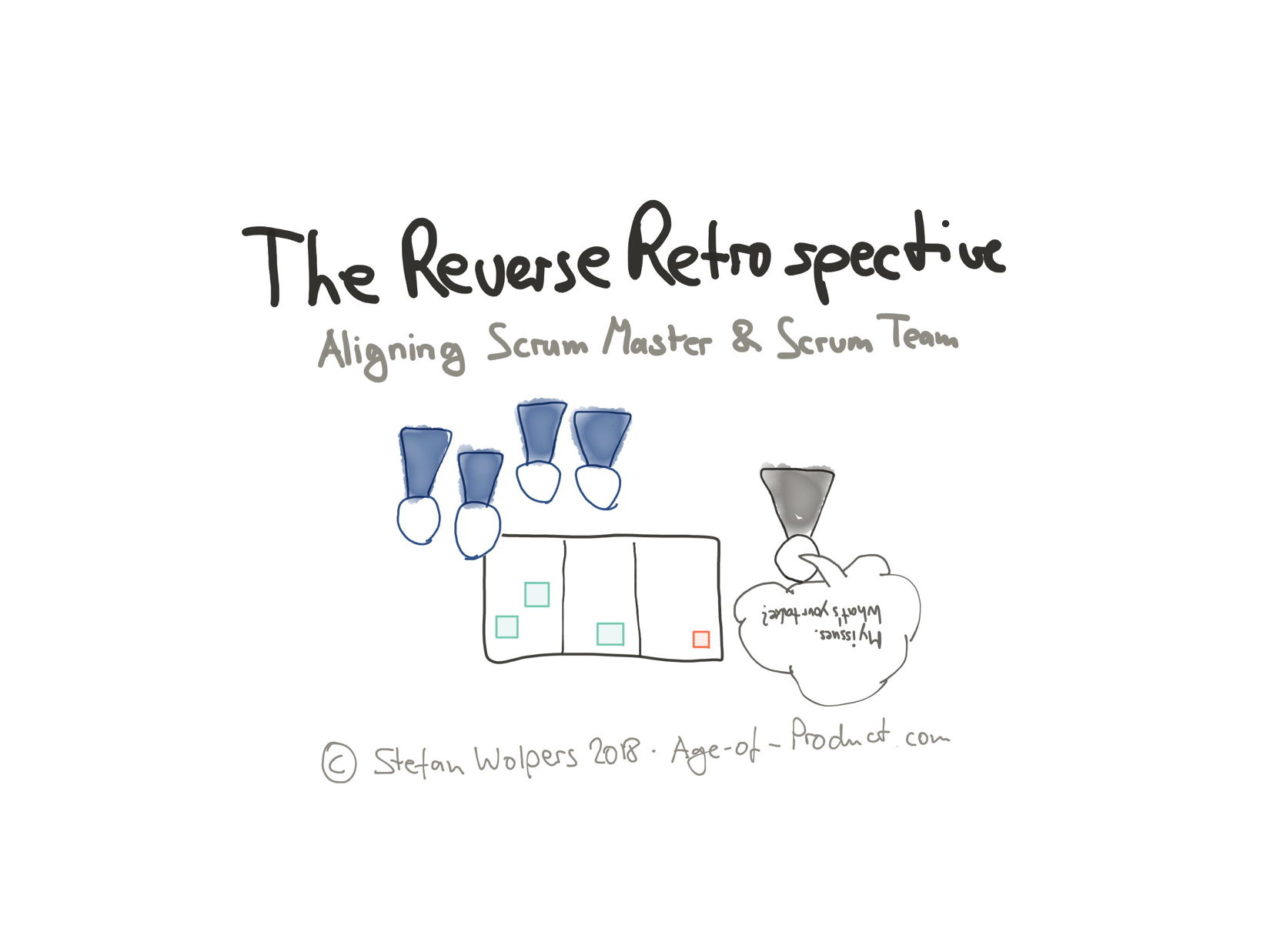
Are you—as a scrum master or agile coach—experiencing more communication kerfuffles with “your” team? Is its speed of improvement stalling? Are you under the impression that the team is slipping back into old habits and patterns? Maybe, it is time to run a reverse retrospective where you share your observations with the team.
Learn how to run a reverse retrospective to realign with your scrum team.
Food for Agile Thought’s issue #131—shared with 15,032 peers—focuses on how to make agile happen in large organizations: who will most likely kick-off a successful adoption, how to embed ‘experimentation’ in the culture, and why distributed teams do not exclude an organization from becoming agile.
We then get back to the challenge of ‘what to build.’ John Cutler shares a list of questions for product roadmap and prioritization issues, and we learn how to reduce the risk of creating an MVP with JTBD. Also, Alpha shared the results of its recent product management trends survey.
Lastly, we are invited to get a better understanding of Sociocracy 3.0 — one of the agile concepts left of the chasm.
Supposedly, becoming agile is a journey, not a destination. This is a convenient narrative if the viability of your consultancy depends on selling men and materiel. The fuzzier the objective of an agile transition the less likely there will be an agile audit addressing the return on investment question the customer might have.
Moreover, a fuzzy objective such as ‘we want to become an agile organization’ is probably the reason for applying the same methodologies indiscriminately to every organization—a one size fits all approach for agile transitions.
However, what if not every organization embarking on a transition to agile practices is meant to become a teal organization or a holacracy? What if being late to the agile transition party is instead a deliberate choice than a manifestation of hubris, ignorance or leadership failure?
Read more on why feedback loops in the form of an agile audit are beneficial for organizations and teams alike.