The A3 Framework: Assist, Automate, Avoid — A Decision System for AI Delegation

TL; DR: The A3 Framework

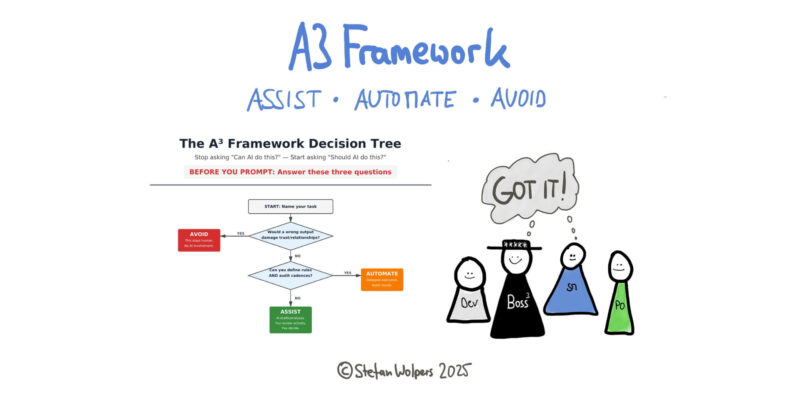
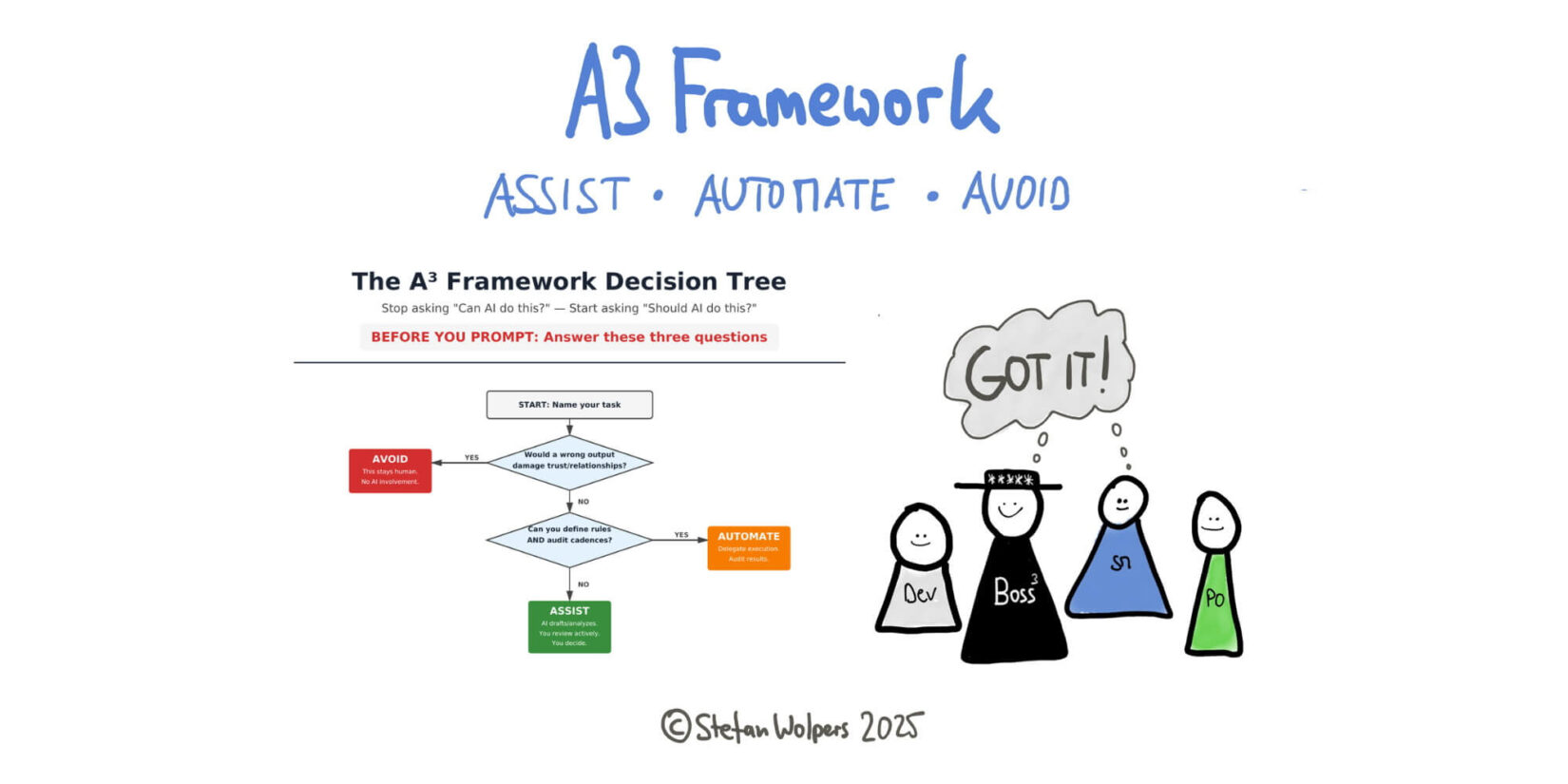
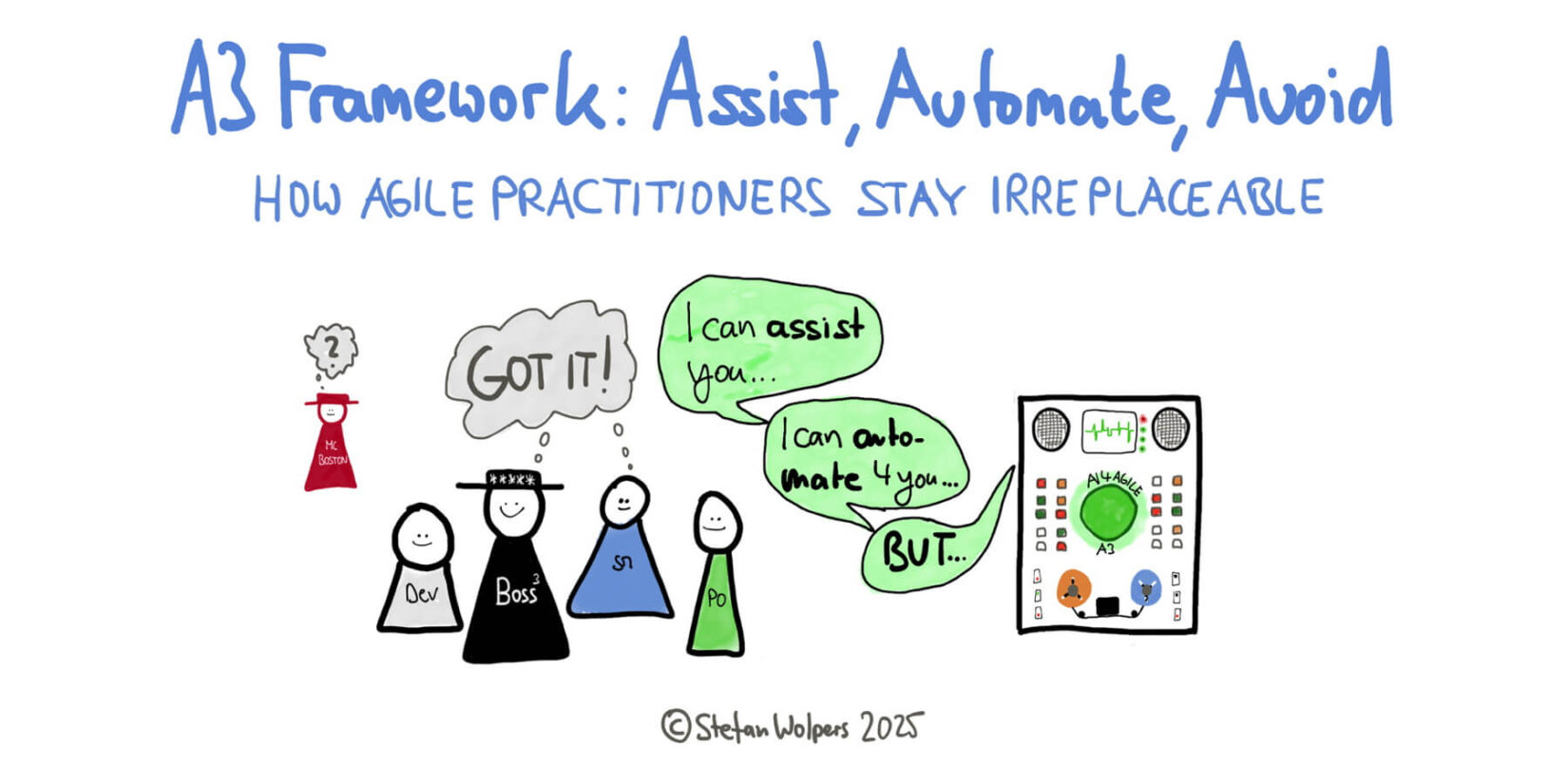
The A3 Framework categorizes AI delegation before you prompt: Assist (AI drafts, you actively review and decide), Automate (AI executes under explicit rules and audit cadences), or Avoid (stays entirely human when failure would damage trust or relationships). Most AI training teaches better prompting. The A3 Framework teaches the prior question: Should you be prompting at all? Categorize first, then prompt.

The A3 Framework: Assist, Automate, Avoid — A Decision System for AI Delegation to Preserve Professionalism — Age-of-Product.com
Continue reading The A3 Framework: Assist, Automate, Avoid — A Decision System for AI Delegation

Food for Agile Thought #526: Claude Code Moment, Product Model Failure, Wrong Decisions, How to Navigate the Unknown

TL; DR: The Claude Code Moment — Food for Agile Thought #526

Welcome to the 526th edition of the Food for Agile Thought newsletter, shared with 35,788 peers. This week, Ethan Mollick and Teresa Torres unpack how Claude Code’s agentic architecture and workflow primitives hint at a new era of autonomous work: powerful, yet risky in practice. John Cutler and Randy Silver challenge teams to stop copying frameworks and start fixing the organizational rules that shape product behavior, while Stephanie Leue highlights why speed stalls when finance, structure, and decision rights stay frozen. Also, Barry O’Reilly and Annie Duke close with lessons on judgment, attention, and decision hygiene.

Next, Teresa Torres lists 2026 product conferences and asks readers to add missing events. Peter Yang shares 25 product beliefs that favor user contact, ruthless focus, and shipping over process theater, and Jaclyn Konzelmann outlines AI-era principles that build agency, intuition, and clear thinking. Mike Fisher warns that culture debt compounds when leaders trade trust for speed, plus Daniel North reframes performance issues as system signals and pushes calm, incentive-aware technical leadership.

Then, Nathan Furr and Andrew Shipilov argue that AI pilots fail when teams pursue scattered experiments rather than customer value, and they call for disciplined tests that scale through empowered cross-functional teams. Andi Roberts reframes silent meetings as social risk or overload and shows how leaders can make speaking up safer, and Christina Wodtke explains how OKR key results force clarity and can legitimize joyful work. Also, Anh-Tho Chuong breaks down AI-driven SaaS pricing. Finally, Aakash Gupta and Pawel Huryn show PMs how to use n8n for automations and agents.

Food for Agile Thought #526: Claude Code Moment, Product Model Failure, Wrong Decisions, How to Navigate the Unknown — Age-of-Product.com
Continue reading Food for Agile Thought #526: Claude Code Moment, Product Model Failure, Wrong Decisions, How to Navigate the Unknown

Assist, Automate, Avoid: How Agile Practitioners Stay Irreplaceable with the A3 Framework

TL;DR: The A3 Framework by AI4Agile

Without a decision system, every task you delegate to AI is a gamble on your credibility and your place in your organization’s product model. AI4Agile’s A3 Framework addresses this with three categories: what to delegate, what to supervise, and what to keep human.

Learn more about what is coming in Q1 of 2026.

The A3 framework for Product People, Coaches, and Scrum Masters who refuse to become obsolete — Age-of-Product.com
Continue reading Assist, Automate, Avoid: How Agile Practitioners Stay Irreplaceable with the A3 Framework

Food for Agile Thought #525: Product Model Failures, Language of Money, AI Productivity Myths, Habits to Transform Systems

TL; DR: Product Model Failures — Food for Agile Thought #525

🎉 Happy 2026 and welcome to the 525th edition of the Food for Agile Thought newsletter, shared with 35,782 peers. This week, John Cutler warns product operating model failures when artifacts replace enabling conditions, while Stephanie Leue shows how reactive overload blocks real product work. Itamar Gilad critiques Google’s drift toward output over learning. Andrej Karpathy tracks 2025 LLM shifts reshaping who builds software, and Janelle Teng Wade examines AI’s power-law economics and fragile bets. Also, Mike Fisher uses Nokia to show how relentless change overwhelms the capacity for absorption and judgment.

Next, Marty Cagan and Elias Lieberich describe Google’s product model built on empowered teams, discovery, and outcomes at scale. Ant Murphy surveys 2026 product shifts and urges PMs to strengthen strategy and business judgment amid noisy AI adoption. Stephane Derosiaux questions AI productivity claims outside greenfield work, while Teresa Torres shares how she deliberately uses Claude Code, even for non-coding tasks. Andi Roberts distills Adam Kahane’s view of change through habits, experiments, and relationships.

Then, Johanna Rothman argues that culture shifts through stories, experiments, and flow metrics that improve decisions, not activity counts. Kevin Kelly reframes data as a commons that gains value through connection and shared governance, Sean Goedecke shows how complexity erodes system understanding over time, and Rich Mironov urges product leaders to speak in revenue terms. Finally, Jenn explains why sustainable meetups depend on organizer energy, clear norms, and intentional culture design.

Food for Agile Thought #525: Product Model Failures, Language of Money, AI Productivity Myths, Transform Systems — Age-of-Product.com
Continue reading Food for Agile Thought #525: Product Model Failures, Language of Money, AI Productivity Myths, Habits to Transform Systems

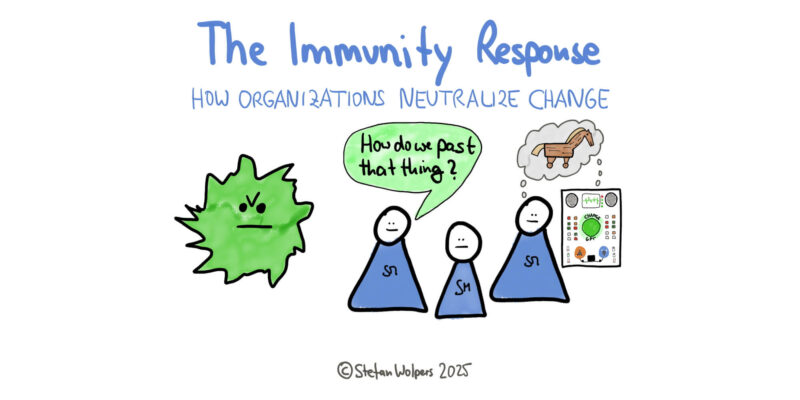
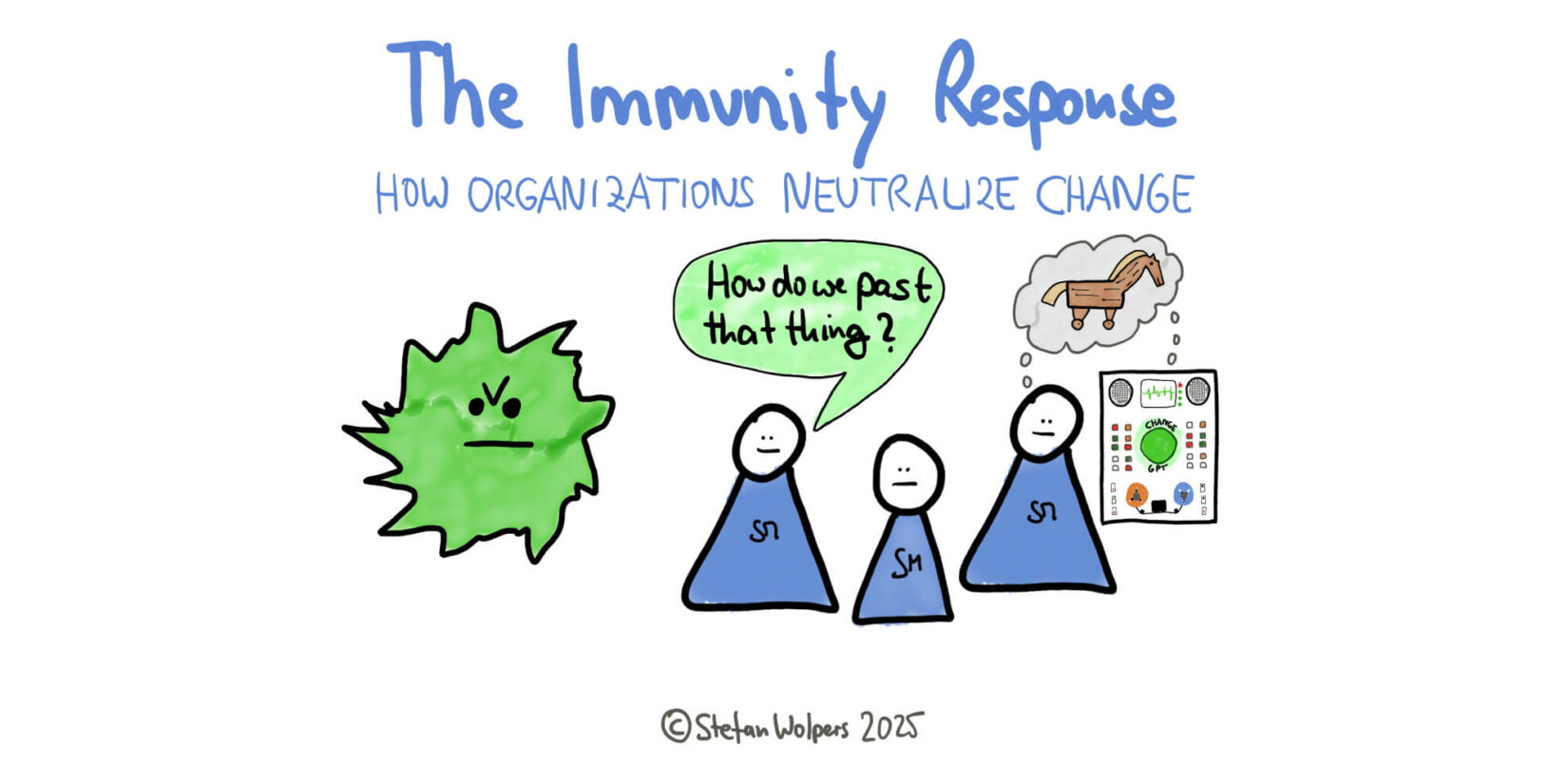
The Immunity Response: How Organizations Neutralize Change

TL; DR: The Immunity Response and How the Principles Spread Anyway

Organizations resist change through immune responses: encapsulation, assimilation, exhaustion, redefinition, and expulsion. But immune systems attack what they recognize. Hence, if you are in the business of change and expect push-back, stop announcing transformations. Instead, to overcome the immunity response, start solving problems: The principles spread through practice, through demonstrations of value, not by proclamation.

This article is Part 3 of a three-part series. In Part 1, Agile Is Dead, Long Live Agility, we saw how the Agile brand became toxic while the principles spread faster than ever under different names. In Part 2, The Reformation That Became the Church, we traced how every disruptive movement hardens into the orthodoxy it opposed.

This final part answers the question we left open: Can you practice the principles without the apparatus? Yes. But only if you understand why organizations reject change and how to stop triggering that rejection.

The Immunity Response: How Organizations Neutralize Change And How the Principles Spread Anyway — Age-of-Product.com
Continue reading The Immunity Response: How Organizations Neutralize Change

Food for Agile Thought #524: Irreplaceable Skills, Prototypes over PRD, Context Before Code, Deflation by AI

TL; DR: Irreplaceable Skills — Food for Agile Thought #524

🎄 Peaceful holidays and welcome to the 524th edition of the Food for Agile Thought newsletter, shared with 35,792 peers.

This week, Max Berry warns that AI is squeezing entry-level file work and forcing people to compete on accountable judgment, listing irreplaceable skills in the age of AI, while Stephen Dowling shows how Steve Sasson invented digital photography at Kodak long before the market could use it. John Cutler builds on that gap between idea and reality by separating operating model patterns from the operating system teams must actually design. Esther Derby adds that hierarchy blocks candor until risks grow teeth, and Simon Powers argues that change fails when tone and power stay untouched. Natalia Quintero ties it back to AI: teams stall without clear workflows and local champions.

Next, Theo Bleier shows how he lived inside Notion sales workflows, removed copy-paste friction, then used product signals to improve account prioritization with humans in the loop. Tomasz Tunguz spots AI deflation as Gemini 3 Flash cuts costs while staying close to benchmarks, and Michael Wall treats ChatGPT Pro as a first hire to ship software and run his music business. Also, Chris Matts warns that DORA metrics backfire when executives weaponize them, and Shreyas Doshi rejects slogans and pushes situational judgment.

Then, Peter Hunter and Elena Stojmilova show how Open GI escaped a monolith by decentralizing architecture with Team Topologies, a DDD context map, ADRs, and an open advisory forum. Ianemmanuel Crueldad pushes back on agentic AI when deterministic automation works better and fails less, while Emma Webster favors high-fidelity prototypes over PRDs to align and validate fast. Lizzie Matusov links daily stand-ups to psychological safety and performance. Finally, Austin Tedesco uses AI to compress planning through shared context and iterative drafts.

📅 Programming Note: Food for Agile Thought #525 will be available on January 4, 2026.
Food for Agile Thought #524: Irreplaceable Skills, Prototypes over PRD, Context Before Code, Deflation by AI — Age-of-Product.com
Continue reading Food for Agile Thought #524: Irreplaceable Skills, Prototypes over PRD, Context Before Code, Deflation by AI