Back in 2017, we started the Scrum Master Salary Report 2017—the first industry report that covered in-depth the educational background, working experience, industries, and organizational details of the companies Scrum Masters or agile coaches work for. In 2019, we partnered with Scrum.org—to create the 2019 edition. Moreover, we plan to continue the collaboration in 2021 with the next edition.
If you have to make a career decision early next year, you will find the industry data the Scrum Master Trends Report 2019 contains still very helpful.
TL; DR: Awesome Remote Teams, Agile Iron Triangle — Food for Agile Thought #272
Welcome to the 272nd edition of the Food for Agile Thought newsletter, shared with 28,937 peers. This week, we embrace a set of lessons learned, tools, and practices for awesome remote teams. We also address the necessary buy-in to an agile transformation’s underlying philosophy, and we revisit the once-popular project management tool that still might be beneficial in the age of agility.
We then analyze the difference between product management and Product Ownership; we identify product-driven companies’ cultural principles, and we reflect on why so many product teams end up in the feature factory.
Lastly, we delve into the ‘one-[framework]-fits-all’ myth of agile transformation approaches.
The following 58 Product Owner theses describe the PO role from a holistic product creation perspective.
They cover the concept of the Product Owner role, product discovery, how to deal with external and internal stakeholders, product portfolio and product roadmap planning, and the Product Backlog refinement. The Product Owner theses also address the Product Owner’s part in Scrum events from Sprint Planning to Sprint Review to Sprint Retrospective, and the Daily Scrum.
TL; DR: Pre-Mortems, Leaving the Feature Factory — Food for Agile Thought #271
Welcome to the 271st edition of the Food for Agile Thought newsletter, shared with 28,708 peers. This week, we understand the advantages of pre-mortems to kick-off agile transformations; we discover learning obstacles rooted in entrenched ways of operating, and we appreciate the learnings from a long yet successful lean transformation.
We then learn about how quarterly process changes can unshackle a product team to realize its full potential; we check a system to apply objectives and key results (OKR) to product management, and we acknowledge common traps of validating product ideas, such as false positives.
Lastly, we dissect the consequences of remote work, ranging from the remote hype cycle, the risk of return, new physical and digital solutions, and the implications of remote and hybrid work.
TL; DR: Agile’s Intangibles, Productive Uncertainty — Food for Agile Thought #270
Welcome to the 270th edition of the Food for Agile Thought newsletter, shared with 28,431 peers. This week, we cover Agile’s intangibles; we delve into innovation, risk mitigation, and creating value, and we analyze prerequisites of successful agile transformations at an organizational level.
We then learn about a developer’s perspective on what it takes to build a successful product development team. Also, we explore a handy tool for ordering Product Backlogs beyond the usual suspects like Cost of Delay, Kano model, or RICE, and we ask: “What else about product [management] is as ‘simple as it sounds’ but needs to be learned? Why do we fall into these traps?”
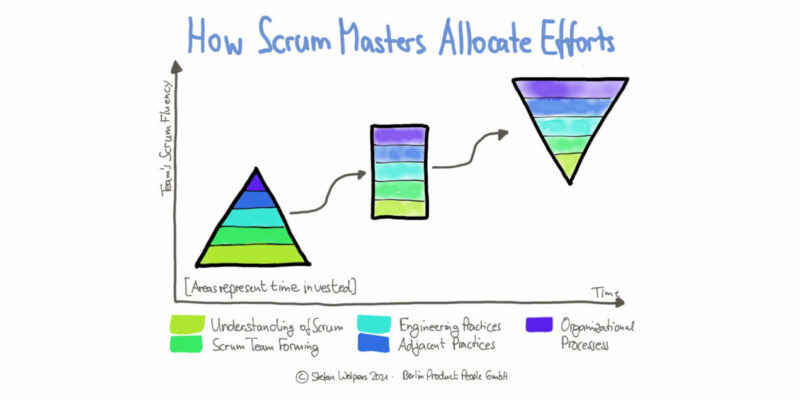
The following 70 Scrum Master theses describe the role of a holistic product creation perspective.
The theses cover the accountabilities of the Scrum Master from product discovery to product delivery in a hands-on practical manner. On the one side, they address typical Scrum events such as Sprint Planning, Sprint Review, and the Sprint Retrospective. On the other hand, the Scrum Master theses also cover, for example, the relationship with the Product Owner, they deal with agile metrics, and how to kick-off an agile transition, thus moving beyond the original framework of the Scrum Guide.