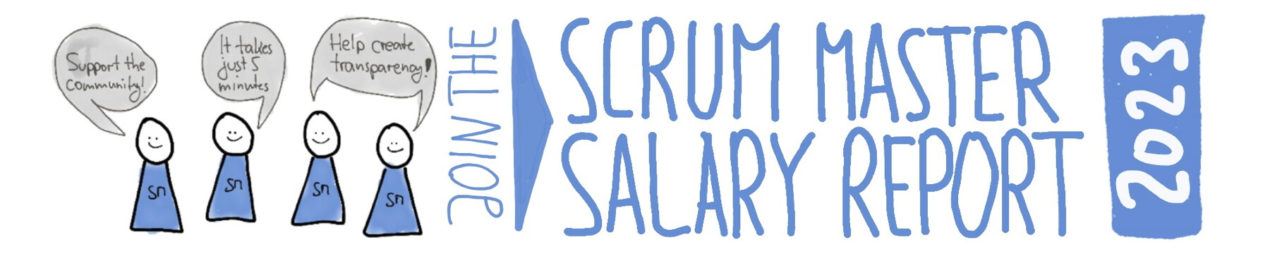
TL;DR: Scrum Master Salary Report 2023 — An Anonymous Poll by the Community for the Community
The purpose of this anonymous Scrum Master salary report 2023 is to create a clear, data-backed benchmark that allows everyone in the agile community to understand whether their compensation is adequate. (And yes, the report will cover Scrum Masters as well as Agile Coaches, both employed and freelancing.)
The goal is to have a sufficient number of replies – that would be at least 1,000 – by the end of November 2022 to create the report in time for January 2023. Of course, the report will be available for free.
TL; DR: Useful Agile Metrics — Food for Agile Thought #361
Welcome to the 361st edition of the Food for Agile Thought newsletter, shared with 35,942 peers. This week, we enjoy an Agile 2022 workshop, where Doc Norton deep-dives into the tricky issue of useful agile metrics, from the problematic ones, like velocity, to gaming metrics to selecting metrics that support your team. Also, we dissect contributing factors to successful agile transformations while pointing at what to avoid, from cargo-cultism to HyperScrum-dementalism to agile scapegoatism, and delve into the rationale of higher purpose goals, from motivating people to driving autonomy. Finally, did you know that the fourth element of Scrum’s empiricism—beyond transparency, inspection, and adaptation—is hiding in plain sight in a sentence on Scrum Values?
Then, we learn from Lenny Rachitsky how to best proceed in becoming the stakeholder whisperer, while Jon Moore and Marty Cagan sketch necessary changes in how you build products when transforming to become a strong, product-led company. Moreover, John Cutler reflects on the “tension between your go-to-market (GTM) and product teams as you scale,” resulting in more complexity, for example, product debt. By the way, there is also an interview with John by Jason Knight.
Finally, we listen to John Drogosz pitching the advantages of value stream mapping for cross-functional teams to improve their way of working and suggest ten steps to gain any basic industry understanding, from diagrams to glossaries to thought leaders and conferences. Moreover, Rita McGrath elaborates on Kodak’s demise and what the halo effect has to do with it. Think printers from the company that invented digital photography.
TL; DR: How Minds Change, Think Big & Work Small — Food for Agile Thought #360
Welcome to the 360th edition of the Food for Agile Thought newsletter, shared with 35,907 peers. This week, we have a fantastic interview with David McRaney on how minds change, rationalization, and belief. (If you are coaching other people, you should listen.) Also, we learn how teams can “experiment and learn, develop new markets, [and] outmaneuver the competition,” and we reflect on who may likely get ahead when encountering an impediment. Switching perspectives, we delve into the “best way to kill a grassroots movement at your company” and how to help it flourish instead.
Then, we point to the necessary “changes to how the product teams need to interact with customers” when an organization abandons a sales-driven approach, and Roman Pichler details his product model, from product vision to Product Backlog, including four artifacts and two templates. Moreover, we reflect on the perils of Think Small and Work Big, Think Big, Work Big, and Think Small, Work Small, and link mental models to building products, from Parkinson’s Law of Triviality to Conway’s Law to the Pareto Principle.
Finally, Mike Cohn shares a free assessment tool for your team’s mastery of 20 essential elements of a successful transformation. Also, we advocate using anti-personas to “help anticipate how products can be misused in ways that can harm users and the business.” Lastly, Phil Mistry tells the incredible story of an invention ahead of its time in a classic case of an innovator’s dilemma: How Steve Sasson invented Kodak’s digital camera!
TL; DR: UX & Engineering, AI in Product — Food for Agile Thought #359
Welcome to the 359th edition of the Food for Agile Thought newsletter, shared with 35,852 peers. This week, we delve into UX & engineering, detailing how product discovery benefits from including engineers early in the process, from timely feasibility discussions to designing minimum viable experiments (MVE). Also, we reflect on the many aspects of velocity, “if you are planning for a stable team with high morale that can consistently deliver,” and explore a vital character trait of any trainer, coach, entrepreneur, or artist — tenacity — with Jerry Colonna and Jules Pieri.
Then, Allan Holub explores the importance of product management for agile teams, from C-level buy-in to empowering people w/o leaving them to JIRA’s perils, while dissing Scrum. Moreover, Ryan J. Salva shares the success story of Copilot, GitHub’s OpenAI’s ML engine, while Martin Spinnangr asks: Continue, pivot, kill, or charge ahead?
Finally, Sachin Rekhi points to four Lean Startup issues, from agnostic experimentation to over-focusing on MVPs to incrementalism, and we dig into the benefits of journaling for decision-making. Also, we explore the effects of limiting beliefs on change, from anchoring to selection bias. PS: Can I interest you in Dr. Laurence J. Peter explaining some of the observations leading to his theory?
TL; DR: Agility: Scaling Innovation, #NoBacklogs — Food for Agile Thought #358
Welcome to the 358th edition of the Food for Agile Thought newsletter, shared with 35,833 peers. This week, Steven Sinofsky analyzes the challenges of scaling innovation, delving into concepts, tools, culture, and change. Also, Allan “Nuke the backlog” Kelly delves into the current discussion regarding the Product Backlog’s usefulness. Furthermore, we analyze research papers on cross-functionality from Google Scholar and point to the moment when deteriorating software quality insects with a higher demand for new features.
Then, Wes Kao and Lenny Rachitsky cover how to engage your audience and improve your communication for product success. Moreover, we dissect aspects of product leadership, from strategic thinkers to the get-it-done thinkers, and we explain the negative consequences of employing SAFe® for product management, for example, its obsession with process.
Finally, we share Brad Dunn’s new approach to product management: replace the product manager role with a value manager and a discovery engineer. Additionally, we provide a concept of gathering health indicators to support better product decisions, plus a canvas to help you “avoid creating the right solution to the wrong problem.”
TL; DR: Agility: Timeless, Team Dynamics — Food for Agile Thought #357
Welcome to the 357th edition of the Food for Agile Thought newsletter, shared with 35,789 peers. This week, we celebrate the Agile 2022 keynote of Joshua Kerievsky, where he reflects on why “Agility isn’t a formula, a framework, nor a set of roles and rituals to follow” but a timeless way of thinking. Also, Linda Rising, Diana Larsen, and James Shore delve into the dynamics that make and break Agile teams, from the importance of trust to the Tuckman model. Moreover, we suggest six ways of encouraging feedback from team members, from creating psychological safety to leading by example, and we close with a rant about mission statements.
Then, we listen to Mary Cagan, sharing his learnings after more than 20 years at the forefront of product management, from Steve Jobs to building product teams to which trends to ignore. Additionally, we analyze the four most significant threats to building great products and how to deal with them, from difficult developers to executive bullies, and we tackle product roadmaps from a pragmatic angle.
Finally, we share a new game to “find a golden path to delivering maximum business value by benefiting from collaboration vs. getting stuck in dependencies” and a “primer on what you need to know to leverage VSM to chart your lean journey.” Lastly, inspired by Kurt Vonnegut’s lecture on “the simple shapes of stories,” Ash Maurya shows that JTBD’s customer stories also have archetypical shapes.