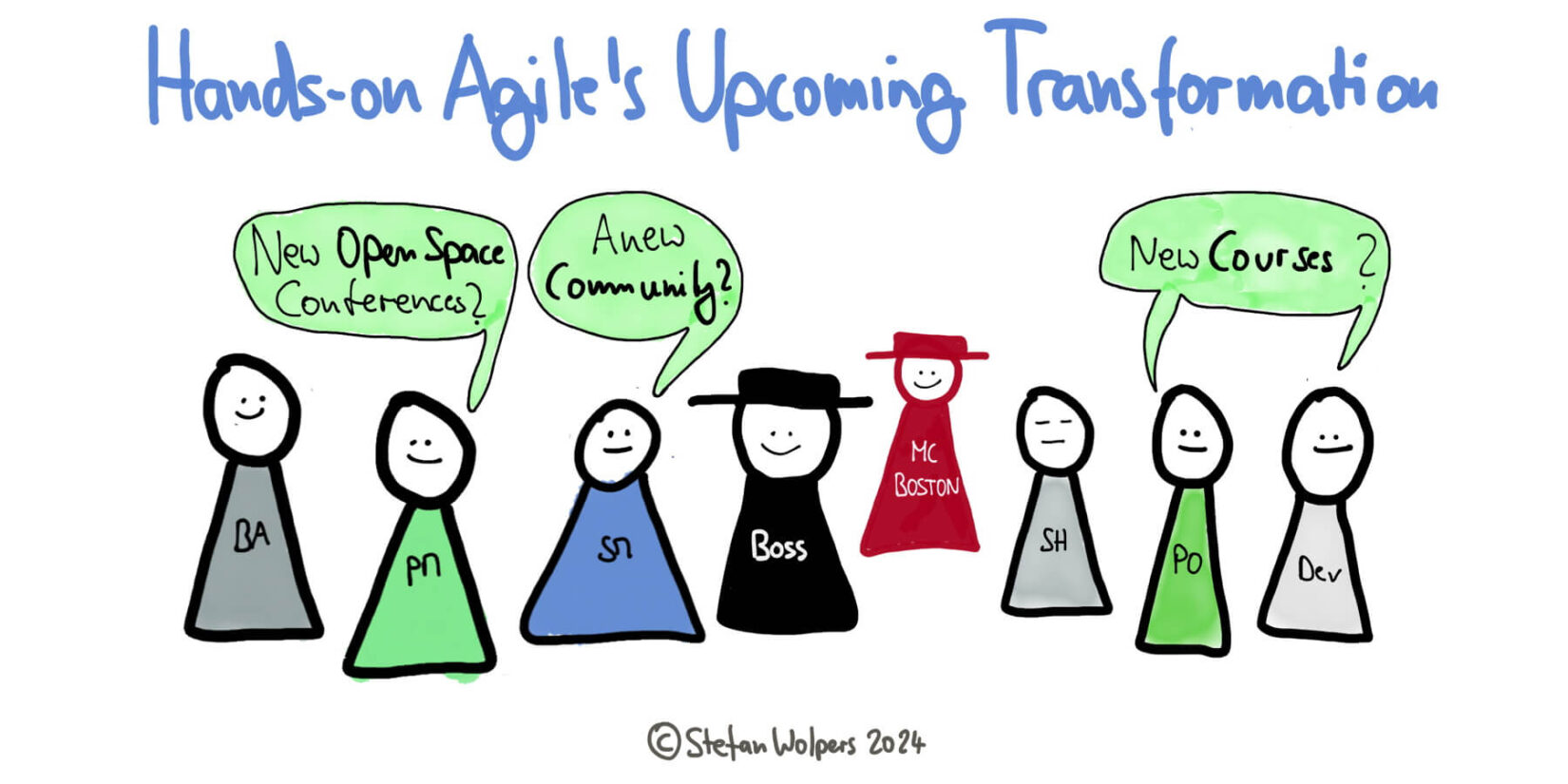
Hands-on Agile’s Upcoming Transformation

TL; DR: Reinventing Hands-on Agile

For years, I have supported the Agile community with a wealth of free resources and opportunities for growth. From the Food for Agile Thought newsletter to the Scrum Master Salary Report to tools like the Scrum Master Job GPT, and from ebooks like the Scrum Master Interview Questions Guide to the Hands-on Agile Slack and Meetup groups, I’ve consistently provided value without asking for anything in return than your support and participation. As for all communities, there is a simple rule: the more, the merrier; the benefit of being a member increases with the size of the community and those who contribute themselves. Giving back to the community is a win-win proposition.

However, the landscape is changing. The recent economic downturn and a noticeable backlash against Scrum have presented new challenges. As a result, the business model that has sustained these efforts—financing by subsidies through my Professional Scrum classes—has become increasingly unsustainable. Consequently, my approach to continuing to support this incredible community will need to evolve, too.

The Upcoming Transformation of Hands-on Agile: Embracing change by creating a new community and relaunching BarCamps — Age-of-Product.com
Continue reading Hands-on Agile’s Upcoming Transformation

Food for Agile Thought #455: Creative Destruction Canvas, Identifying Digital Products, Descaling for Fun and Profit, Perfectionism

TL; DR: Identifying Digital Product — Food for Agile Thought #455

Welcome to the 455th edition of the Food for Agile Thought newsletter, shared with 42,701 peers. This week, Jeff Patton explores how identifying digital products is crucial for adopting a product operating model, while Esther Derby, Diana Larsen, and David Horowitz discuss updates in their second edition of Agile Retrospectives. Barry Overeem addresses Agile Coach burnout and the importance of creating supportive environments, and Henry E. Pozzetta examines the impact of cognitive biases on Agile, offering strategies to mitigate them. Also, Shane Gibson and Murray Robinson interview Arnold Stroobach about the Buurtzorg model, showcasing the success of small, self-managed teams in delivering high-quality, cost-effective care.

Next, Janna Bastow and Leah Tharin discuss the evolving role of product managers in the age of AI, stressing that AI should enhance rather than replace human judgment. Todd Lankford offers a three-step guide to building effective product teams by fostering ownership and adaptability, and Alexandre Serrurier shares his experiences at ManoMano, highlighting the critical role of ProductOps in optimizing product environments with strong leadership and structured initiatives. Moreover, Marty Cagan clarifies that adopting a product model doesn’t require reorganization; organizational design should align with business strategy and product vision.

Lastly, Philipp Pelka and Johannes Schartau introduce the Creative Destruction Canvas, a tool to help teams trim bloated products by removing unnecessary features. Aakash Gupta delivers a comprehensive analysis of the product analytics market, emphasizing its importance in product management, and Gregor Ojstersek and Jordan Cutler discuss the detrimental effects of perfectionism on engineering productivity, advocating for progress over perfection. Then, dynomight7 explores why advice often fails, offering strategies to enhance its effectiveness through simplicity and practicality, and, finally, Pavel Samsonov examines Nike’s costly reliance on easily gathered data, stressing the importance of qualitative insights in product strategy.

Food for Agile Thought #455: Creative Destruction Canvas, Identifying Digital Products, Descaling for Fun and Profit, Perfectionism — Age-of-Product.com
Continue reading Food for Agile Thought #455: Creative Destruction Canvas, Identifying Digital Products, Descaling for Fun and Profit, Perfectionism

Food for Agile Thought #454: Product Type Canvas, AI Tools for Product Managers, High-Stakes Collaboration, Disrupting Large Organizations

TL; DR: Product Type Canvas — Food for Agile Thought #454

Welcome to the 454th edition of the Food for Agile Thought newsletter, shared with 42,673 peers. This week, Jeff Patton introduces his Product Type Canvas, aiding teams in understanding users and measuring product value. Cady Coleman shares lessons from her NASA career on risk assessment and cross-cultural communication, and Alex Ewerlöf discusses how organizational structure affects service reliability and the importance of consumer journeys. Moreover, Woody Zuill delves into mob programming with Murray Robinson and Shane Gibson, highlighting its impact on team effectiveness and skill development, and we ask: Are there regulated industries that are agile?

Then, Marty Cagan discusses his book Transformed, focusing on a product operating model that prioritizes outcomes, empowered teams, and continuous deployment, emphasizing engineers’ role in innovation. Steve Blank explores why large organizations struggle with disruption, highlighting legacy systems and leadership inaction. In an interview with Lenny Rachitsky, Roger Martin outlines five essential questions for effective strategy development, emphasizing clear aspirations, market focus, competitive advantage, necessary capabilities, and supportive management systems. Also, Andrew Chen examines the failure of high-growth, high-churn products, emphasizing the importance of retention and the challenges of sustaining growth in a dopamine-driven market.

Lastly, Marc Abraham highlights AI tools transforming product management and aiding PMs in understanding customer problems. We also examine competitive analysis, its importance, and practical templates for SaaS companies, while Matt O’Connell discusses handling overwhelming Opportunity Solution Trees (OSTs) with five archetypes and strategies to prioritize opportunities. Christoph Steinlehner introduces Reverse Impact Mapping to shift from feature requests to outcomes, focusing on business impact. Finally, Bandan Jot Singh explains software estimate inaccuracies and offers five modern roadmap methods prioritizing value-driven metrics over strict timelines.

Food for Agile Thought #454: Product Type Canvas, AI Tools for Product Managers, High-Stakes Collaboration, Disrupting Large Organizations – Age-of-Product.com
Continue reading Food for Agile Thought #454: Product Type Canvas, AI Tools for Product Managers, High-Stakes Collaboration, Disrupting Large Organizations

Food for Agile Thought #453: Product Management Organizations, Improving ProductOps, New Feature Revenue Estimations, Quo Vadis Agile?

TL; DR: Product Management Organizations — Food for Agile Thought #453

Welcome to the 453rd edition of the Food for Agile Thought newsletter, shared with 42,652 peers. This week, we feature insights from Melissa Perri, who provides a framework for robust product management organizations focusing on alignment, efficiency, and continuous improvement. Stefan Lindegaard warns about Organizational Debt Syndrome and the need for proactive leadership to maintain agility, and Jennifer Riggins reveals a study highlighting developers’ lost productivity due to management inefficiencies, stressing better communication. Also, Evan Leybourn discusses the future of Agile, shifting from anecdotes to data-driven insights. At the same time, Terry Danylak shares strategies to move from firefighting to proactive management, enhancing productivity and workplace health.

Then, Itamar Gilad critiques the “user-needs-first” approach, advocating for a flexible strategy that aligns ideas with company goals for high-impact products. John Cutler suggests that percentage allocations obscure priorities and advocates prioritizing based on value and urgency, and Jon Odo provides five tips for trimming Product Backlogs, emphasizing removing outdated and unclear items to boost team efficiency. Moreover, Zach Dunn highlights the pitfalls of overestimating revenue from sales feedback and offers strategies to avoid these mistakes when prioritizing features.

Lastly, Johanna Rothman advocates for continual planning over quarterly planning to help agile teams adapt and deliver maximum value. Jenny Wanger introduces a product operations tool using process maps to diagnose inefficiencies and improve workflows, and Chris Matts explains Karl Weick’s Sensemaking framework for better organizational dynamics and collaboration. Jurgen Appelo presents 32 key concepts from systems thinking and complexity theory, highlighting their importance in Lean and Agile approaches. Finally, Rory Sutherland discusses marketing and behavioral science with Lenny Rachitsky, focusing on the role of psychology, product success paradoxes, and the pitfalls of metrics-driven workplaces.

Food for Agile Thought #453: Product Management Organizations, Improving ProductOps, New Feature Revenue Estimations, Quo Vadis Agile? Age-of-Product.com
Continue reading Food for Agile Thought #453: Product Management Organizations, Improving ProductOps, New Feature Revenue Estimations, Quo Vadis Agile?

Food for Agile Thought #452: Agile Implementation Differences, Output to Outcome, LeSS Scrum Guide, Alignment Tools

TL; DR: Agile Implementation — Food for Agile Thought #452

Welcome to the 452nd edition of the Food for Agile Thought newsletter, shared with 42,633 peers. This week, Alistair Cockburn and Jon Kern discuss differences in global Agile implementation. Hrishikesh Karekar explores evolving Scrum Master roles, and Maarten Dalmijn critiques overreliance on the Agile Manifesto. Yossi Kreinin advocates for incompetent management benefits, while Derk-Jan de Grood balances stable and restructured teams. We also enhance team effectiveness with alignment tools.

Next, Teresa Torres emphasizes the shift from outputs to outcomes for product success, and Vladimir Kalmykov champions the ‘MVP Razor’ for efficient feature development. Ian Vanagas outlines strategies for deciding what to build next. Moreover, Lenny Rachitsky interviewed Jeff Weinstein about customer obsession and impactful metrics at Stripe.

Lastly, Craig Larman and Bas Vodde introduce the LeSS version of the Scrum Guide, enhancing multi-team alignment. Prateek Singh explores the value of small-batch deliveries and continuous learning, and Ben Kuhn stresses the role of trust in team efficiency. Finally, Jim O’Shaughnessy advocates for handwritten journaling to maintain accurate self-reflection.

Food for Agile Thought #452: Agile Implementation Differences, Output to Outcome, LeSS Scrum Guide, Alignment Tools — Age-of-Product.com
Continue reading Food for Agile Thought #452: Agile Implementation Differences, Output to Outcome, LeSS Scrum Guide, Alignment Tools

Food for Agile Thought #451: Product Manager Replacement, Agile Backlash: Try XP, Sales-Driven to Product-Led, Defending Vanity Metrics

TL; DR: Product Manager Replacement — Food for Agile Thought #451

Welcome to the 451st edition of the Food for Agile Thought newsletter, shared with 42,601 peers. This week, Mike Taylor shows how close AI is as a product manager replacement, often outperforming humans in complex PM tasks, while Dave Rooney addresses Agile backlash and advocates for Extreme Programming (XP). Woody Zuill highlights the benefits of Mob Programming, and Maarten Dalmijn introduces a Sprint Goal template to avoid anti-patterns. Also, Todd Lankford emphasizes reducing dependency on experts to reclaim team flow, and we ask: Why don’t we regard teams as investors?

Next, Jason Knight explores the challenges of transforming sales-driven companies into product-led ones. Moreover, Johanna Rothman shares five critical ideas for effective product development, including understanding customers and solving one problem at a time. Richard Mironov highlights building executive coalitions by understanding C-level priorities, and Roman Pichler emphasizes involving key stakeholders in co-creating product strategies and roadmaps for successful execution.

Lastly, Jeff Gothelf argues that vanity metrics, while not ultimate success measures, provide early insights into activities and idea resonance. Wes Kao emphasizes the importance of effectively defending your work to build leadership credibility. At the same time, Pim de Morree critiques downsizing, advocating for employee engagement and innovation instead. Aatir Abdul Rauf shares how the SPACER framework aligns Product Managers and Marketers on feature value. Finally, Gergely Orosz discusses recent changes in the tech industry and their impact on software engineering in a post-pandemic world.

Food for Agile Thought #451: Product Manager Replacement, Agile Backlash: Try XP, Sales-Driven to Product-Led, Defending Vanity Metrics — Age-of-Product.com
Continue reading Food for Agile Thought #451: Product Manager Replacement, Agile Backlash: Try XP, Sales-Driven to Product-Led, Defending Vanity Metrics